
Bare-necked Umbrellabird
Cephalopterus glabricollis
Order: Passeriformes / Family: Cotingidae

Wikimedia Commons
About the Bare-necked Umbrellabird
The Bare-necked Umbrellabird (Cephalopterus glabricollis) is a remarkable species within the family Cotingidae, native to the tropical rainforests of Central America. This bird is particularly notable for its distinctive appearance, featuring a conspicuously bare, bright red throat patch and an impressive umbrella-like crest that can be raised or lowered at will. Its presence in the cloud forests of Costa Rica and Panama underscores the rich biodiversity of these regions and highlights the ecological significance of preserving native habitats. This species plays a vital role in seed dispersal, contributing to the regeneration of tropical forests. During the breeding season, which typically occurs from March to June, the Bare-necked Umbrellabird engages in elaborate courtship displays, using its crest and vocalizations to attract mates. These behaviors, coupled with its striking appearance, make it an iconic representative of the tropical avifauna. Conservation efforts are crucial for this species, as habitat loss and fragmentation pose ongoing threats to its survival. The Bare-necked Umbrellabird's presence in protected areas like Costa Rica's Monteverde Cloud Forest Reserve offers hope for its continued existence, serving as a reminder of the importance of conservation initiatives in maintaining biodiversity. This bird's ecological role extends beyond its immediate environment, as its migratory patterns influence the dynamics of forest ecosystems across a broader landscape. Overall, the Bare-necked Umbrellabird is a testament to the intricate relationships within tropical ecosystems, emphasizing the need for ongoing research and conservation to protect these vital connections.
The Bare-necked Umbrellabird belongs to the family Cotingidae, within the order Passeriformes. These birds typically live 8-10 years, with a max recorded of 15 years.
How to Identify a Bare-necked Umbrellabird
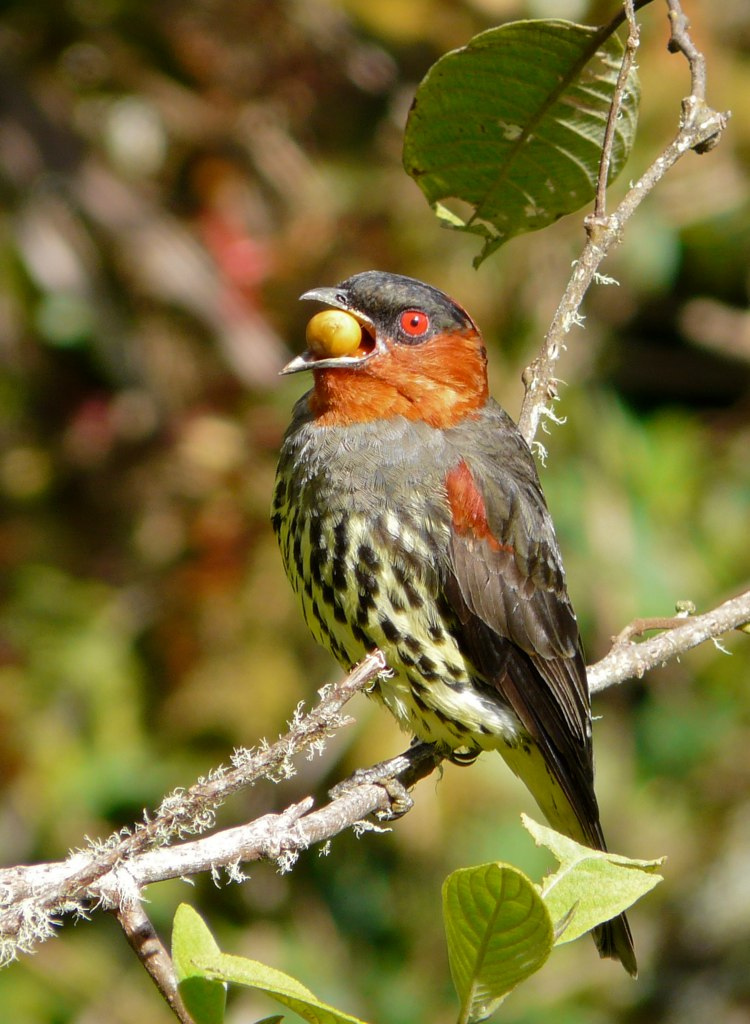
The Bare-necked Umbrellabird is a large bird, measuring approximately 40-45 cm in length, with males being slightly larger than females. Its most striking feature is the glossy black plumage, which contrasts sharply with the bare, bright red skin on its throat. This bare patch is especially prominent in males, who also possess the characteristic umbrella-like crest that can be erected during displays. Females and juveniles exhibit similar plumage, though their coloration may be slightly duller. In terms of field marks, the bird's large size and distinctive crest make it relatively easy to identify compared to other species. However, it can be confused with other members of the Cotingidae family, such as the Long-wattled Umbrellabird, which shares similar habitat but has a longer throat wattle. The Bare-necked Umbrellabird's flight silhouette is characterized by broad wings and a short tail, and its perching posture often displays the bright red throat patch prominently, especially during courtship or when alarmed.
Having trouble telling birds apart? Upload a photo to our bird identification tool for an instant species match.
Bare-necked Umbrellabird Habitat and Range
Preferred Habitat
This species thrives in the humid, montane cloud forests of Central America, with a strong preference for elevations between 700 and 2,000 meters. These forests, often shrouded in mist, provide the dense canopy cover and abundant fruit sources necessary for the bird's survival. The Bare-necked Umbrellabird can also be found in primary and secondary forests, though it shows a marked preference for undisturbed habitats. During the non-breeding season, it may descend to lower elevations in search of food. Urban presence is rare, as the bird favors remote, forested areas far from human activity. Seasonal habitat shifts are influenced by food availability, prompting occasional movement to different forest strata or neighboring forest patches.
Geographic Range
The Bare-necked Umbrellabird's range is confined to the cloud forests of Costa Rica and Panama. In Costa Rica, it is primarily found in the highland areas such as the Tilarán and Talamanca mountain ranges. Its presence extends into western Panama, where suitable habitat conditions persist. The species does not undertake long-distance migrations but rather exhibits altitudinal movements in response to seasonal fruiting patterns. These movements are typically confined within its range, as the bird seeks suitable feeding grounds. Population density is higher in protected areas, where conservation efforts have helped maintain suitable habitat conditions.
Want to know which birds visit your area? Browse our backyard birds by location guides for region-specific species lists.
What Does the Bare-necked Umbrellabird Eat?
The Bare-necked Umbrellabird primarily feeds on fruits, making it an important seed disperser in its ecosystem. Its diet includes a variety of fruits from trees like Lauraceae and Araliaceae, which are abundant in its forest habitat. The bird's feeding technique involves perching quietly and plucking fruits with its strong bill. During the breeding season, it may also consume insects and small vertebrates to supplement its diet and increase protein intake. Seasonal changes in fruit availability drive the bird's foraging behavior, prompting shifts in diet composition. The Bare-necked Umbrellabird's feeding schedule is crepuscular, with increased activity during early morning and late afternoon.
Bare-necked Umbrellabird Behavior and Social Structure
The Bare-necked Umbrellabird exhibits complex social and territorial behaviors. Males are known for their elaborate courtship displays, which involve raising their umbrella-like crest and emitting deep, resonant calls to attract females. These displays occur in lek-like gatherings, where multiple males display in close proximity. Territoriality is pronounced, with males defending display areas from rivals. Outside the breeding season, the bird is more solitary, although small groups may form during foraging. Its response to predators involves remaining motionless or flying to higher perches. Daily activity patterns are influenced by feeding needs, with peak activity during dawn and dusk.
Bare-necked Umbrellabird Nesting and Reproduction
Nest construction for the Bare-necked Umbrellabird involves building a loose platform of twigs and leaves in the fork of a tree, often high in the canopy. The female is primarily responsible for nest building and incubation, while the male focuses on courtship displays. The typical clutch size is one or two eggs, with an incubation period of approximately 23-25 days. Following hatching, both parents participate in feeding the chicks, which fledge after about 28-30 days. The species generally raises one brood per year, although successful rearing of two broods may occur in favorable conditions.
Bare-necked Umbrellabird Sounds and Vocalizations
The Bare-necked Umbrellabird's primary song is a deep, resonant booming that carries across the forest. This sound, produced by males during courtship, is rhythmic and can be likened to the distant sound of a bass drum. Call notes are less dramatic, consisting of short, soft whistles used for communication between individuals. Alarm calls are sharp and loud, serving to alert others to potential danger. During the dawn chorus, the bird's vocalizations contribute to the symphony of sounds that characterize the rainforest at this time.
Interesting Facts About the Bare-necked Umbrellabird
- 1The Bare-necked Umbrellabird's throat patch can inflate slightly when making calls, enhancing its vocal display.
- 2This umbrellabird's striking appearance is often compared to a Victorian gentleman with a top hat.
- 3Despite its size, the Bare-necked Umbrellabird can be elusive, often hiding high in the canopy.
- 4The bird's diet helps regenerate forests, as it disperses seeds of over 30 plant species.
- 5During courtship, males perform a unique 'moonwalk' display, sliding along branches to attract females.
Bare-necked Umbrellabird Conservation Status
The Bare-necked Umbrellabird is currently classified as Vulnerable by the IUCN. The primary threats to its population include habitat loss due to deforestation and land conversion for agriculture. Conservation efforts focus on protecting remaining forest habitats and establishing corridors to connect fragmented areas. Historical population trends indicate a decline, though the establishment of reserves has helped stabilize numbers in certain areas. Ongoing research and habitat restoration are critical for ensuring the survival of this unique species in the wild.
Other Cotingidae Species



Birds Similar to the Bare-necked Umbrellabird
These species are often confused with the Bare-necked Umbrellabird due to similar appearance or overlapping range.

