
Bare-throated Bellbird
Procnias nudicollis
Order: Passeriformes / Family: Cotingidae

Wikimedia Commons
About the Bare-throated Bellbird
The Bare-throated Bellbird (Procnias nudicollis) stands out in the avian world due to its powerful call and striking appearance. This bird inhabits the Atlantic Forest region of Brazil, Paraguay, and northeastern Argentina, favoring subtropical and tropical moist lowland and montane forests. Its ecological significance is considerable, as it plays a critical role in seed dispersal, particularly of large fruit trees. During the breeding season, the male's resonant bell-like call can carry over long distances, serving as an auditory beacon that marks its territory. The Bare-throated Bellbird's stark white plumage, contrasting with its bare blue throat, makes it a memorable sight in its lush green environment. This species is mainly arboreal, residing in the canopy layer where it finds ample food and relative safety from ground predators. Habitat loss due to deforestation poses a significant threat to the Bellbird, making conservation efforts crucial. Its presence in protected areas like the Iguazú National Park highlights its importance within the ecosystem, as well as the ongoing efforts to preserve its natural habitat. Seasonal behaviors include altitudinal migrations, where individuals may move to lower elevations during the non-breeding season, following fruiting patterns of trees. Through its role as a seed disperser, the Bare-throated Bellbird contributes to the maintenance and regeneration of the forest ecosystem, supporting biodiversity and ecological balance. Understanding the impact of these birds can aid conservationists in creating strategies that protect not only the Bare-throated Bellbird but also the intricate web of life it supports.
The Bare-throated Bellbird belongs to the family Cotingidae, within the order Passeriformes. These birds typically live average 9 years with a maximum recorded of 14 years..
How to Identify a Bare-throated Bellbird
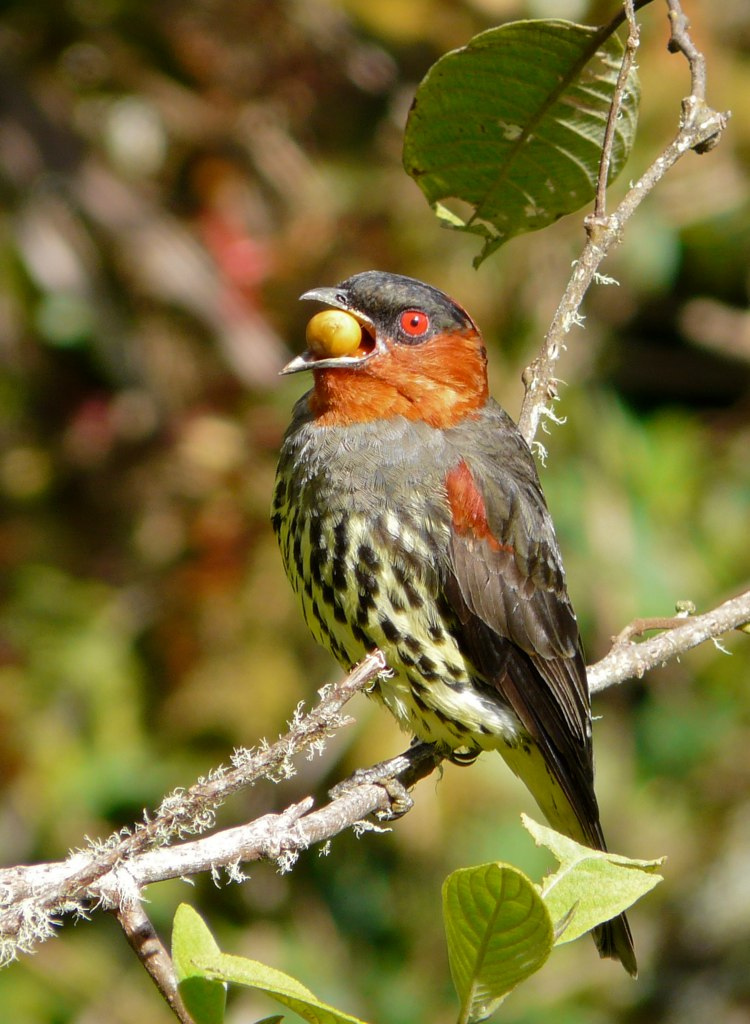
Adult Bare-throated Bellbirds are strikingly white with a distinctive bare blue skin on their throats, a feature from which they derive their name. This vibrant blue patch is more prominent in males, serving as a visual cue during courtship displays. Females and juveniles differ notably, with females sporting a more subdued greenish-brown plumage that provides excellent camouflage in the dense foliage. Juveniles resemble females but can be distinguished by their less vibrant coloration and the presence of some residual white feathers as they transition to adulthood. The Bare-throated Bellbird's robust beak and stout body differentiate it from similar species like the White Bellbird, which lacks the bare-throat feature. In flight, the bird's silhouette appears compact, with broad wings that aid in maneuvering through the forest canopy. When perched, it often sits upright on exposed branches, a behavior that facilitates its loud, far-reaching call. Observers may confuse them with other white-plumaged birds, but the vivid contrast of the blue throat and their unique vocalizations help in correct identification.
Having trouble telling birds apart? Upload a photo to our bird identification tool for an instant species match.
Bare-throated Bellbird Habitat and Range
Preferred Habitat
The Bare-throated Bellbird resides primarily in subtropical and tropical moist forests, preferring the canopy levels where fruit is abundant. It thrives in the Atlantic Forest biome, a region characterized by high humidity and dense vegetation. This bird occupies elevations ranging from sea level up to 1,600 meters, often found in both primary and secondary forests. During the non-breeding season, it may shift to lower elevations or fragmented habitats in search of food. While it can be found in rural areas, its presence in urban environments is rare, mostly limited to parks and forest reserves that mimic its natural habitat. Seasonal changes in fruit availability drive its movement patterns within these habitats.
Geographic Range
The Bare-throated Bellbird's range encompasses the eastern edge of South America, specifically within Brazil, Paraguay, and northeastern Argentina. It breeds primarily in the Atlantic Forest, a crucial biodiversity hotspot within these regions. During the winter months, some populations may migrate short distances to find food, although it is largely considered a resident species. In Brazil, the bird is often sighted in states like Paraná, São Paulo, and Minas Gerais. Argentina's Misiones Province and parts of eastern Paraguay also host significant populations. Despite being localized to certain areas, the Bare-throated Bellbird is not evenly distributed, with higher densities in undisturbed forest patches.
Want to know which birds visit your area? Browse our backyard birds by location guides for region-specific species lists.
What Does the Bare-throated Bellbird Eat?
The diet of the Bare-throated Bellbird consists predominantly of fruits, particularly those of large-seeded upper canopy trees. It favors species like Lauraceae and Myrtaceae, which provide the high-energy fruits necessary for sustenance. During certain seasons, when fruit is less available, the Bellbird may supplement its diet with insects, although this is less common. Its foraging technique involves scanning from high perches before making quick, direct flights to pluck fruits, often swallowing them whole. This behavior aids in seed dispersal, as seeds are often excreted far from the parent tree. Feeding typically occurs during the cooler hours of the morning and late afternoon, allowing the bird to avoid midday heat.
Bare-throated Bellbird Behavior and Social Structure
The Bare-throated Bellbird exhibits solitary and territorial behaviors, especially during the breeding season. Males claim and defend territories through their distinctive calls, which serve both to attract females and deter rival males. The bird's courtship display includes vocalizations combined with visual cues, where the male showcases his vibrant throat and white plumage. Outside the breeding season, the Bellbird may be seen in loose flocks, particularly when food sources are plentiful. Its response to predators includes remaining motionless to blend with its surroundings, relying on its plumage for camouflage. Daily activity patterns are diurnal, with peak activity in the morning and late afternoon.
Bare-throated Bellbird Nesting and Reproduction
The nesting behavior of the Bare-throated Bellbird involves constructing a simple, cup-shaped nest made of twigs and leaves, typically placed high in the forest canopy to avoid predators. Preferred nesting sites are often found in the forks of branches of tall trees. The female is primarily responsible for incubation, laying 1-2 eggs per clutch. The incubation period lasts about 23 days, followed by a fledging period of up to three weeks during which both parents feed the young. The species usually raises one brood per year, although in food-rich years, they may attempt a second.
Bare-throated Bellbird Sounds and Vocalizations
The Bare-throated Bellbird's call is one of the loudest bird sounds, described as a metallic, bell-like 'bock' that can be heard over long distances. This primary song consists of a series of sharp notes, delivered with such volume that it resonates through the forest. The bird also produces softer call notes used in close communication. Alarm calls differ, being harsher and more rapid, usually triggered by the presence of predators. During the dawn chorus, the Bellbird's call is a dominant soundscape feature, echoing through the canopy as a signature of its territory.
Interesting Facts About the Bare-throated Bellbird
- 1The Bare-throated Bellbird's call can reach up to 100 decibels, comparable to the noise level of a chainsaw.
- 2Despite its loud voice, the Bare-throated Bellbird prefers solitude, often seen alone except during breeding.
- 3The bird can swallow fruits whole, aiding in the dispersal of large seeds across the forest floor.
- 4Males can sing up to 50 calls per minute during peak breeding season, showcasing their stamina and vocal prowess.
- 5The Bare-throated Bellbird's white plumage contrasts sharply with the deep green forests it inhabits.
- 6This species is a vital part of its ecosystem, influencing the composition and structure of the forest through seed dispersal.
- 7Females choose mates based on call volume and frequency, indicators of the male's health and vitality.
Bare-throated Bellbird Conservation Status
According to the IUCN, the Bare-throated Bellbird is classified as Near Threatened, with populations declining primarily due to habitat loss and fragmentation from deforestation. Illegal trapping for the pet trade poses an additional threat. Conservation efforts focus on habitat protection and restoration, particularly within the Atlantic Forest region. Historical data suggests a more widespread distribution before extensive deforestation. Protected areas and national parks like Iguazú in Argentina play a crucial role in safeguarding remaining populations by offering secure habitats and corridors for movement.
Other Cotingidae Species



Birds Similar to the Bare-throated Bellbird
These species are often confused with the Bare-throated Bellbird due to similar appearance or overlapping range.

