
Bearded Bellbird
Procnias averano
Order: Passeriformes / Family: Cotingidae

Wikimedia Commons
About the Bearded Bellbird
The Bearded Bellbird, Procnias averano, is an extraordinary member of the Cotingidae family, notable for its distinctive vocalizations and vibrant presence in the neotropical forests. Characterized by the male's unique black, fleshy wattles that dangle from his throat, this species is a fascinating subject for bird watchers and ornithologists alike. The Bearded Bellbird inhabits primarily the humid forested regions of South America, with a range spanning from Trinidad and Tobago to the northern parts of Brazil and Venezuela. This species plays a crucial ecological role as both a predator and a seed disperser, contributing significantly to the health and regeneration of its forest habitats. The bellbird's strong preference for high canopy layers allows it to exploit food resources unavailable to many other avian species, thereby reducing direct competition. Seasonal behaviors of the Bearded Bellbird include intricate courtship displays, which typically occur during the breeding season in the wet months. During this time, the males become particularly vocal, using their resonant calls to establish territories and attract females. The bellbirds are primarily resident birds, showing limited migratory movements, though some populations may move short distances in response to food availability. Their presence is a strong indicator of healthy forest ecosystems, as they thrive in environments with abundant fruiting trees, which they depend on for sustenance. The significance of the Bearded Bellbird extends beyond its ecological contributions. It also holds cultural importance in regions like Trinidad and Tobago, where its calls are part of the natural soundscape, symbolizing the untamed beauty of the tropical forests. As a species, the Bearded Bellbird underscores the interconnectedness of forest ecosystems, supporting biodiversity through its foraging and feeding habits. Conservation efforts focused on preserving the bellbird's habitat are critical, as deforestation and habitat fragmentation pose significant threats to its continued survival.
The Bearded Bellbird belongs to the family Cotingidae, within the order Passeriformes. These birds typically live average 10 years with a maximum recorded of 15 years..
How to Identify a Bearded Bellbird
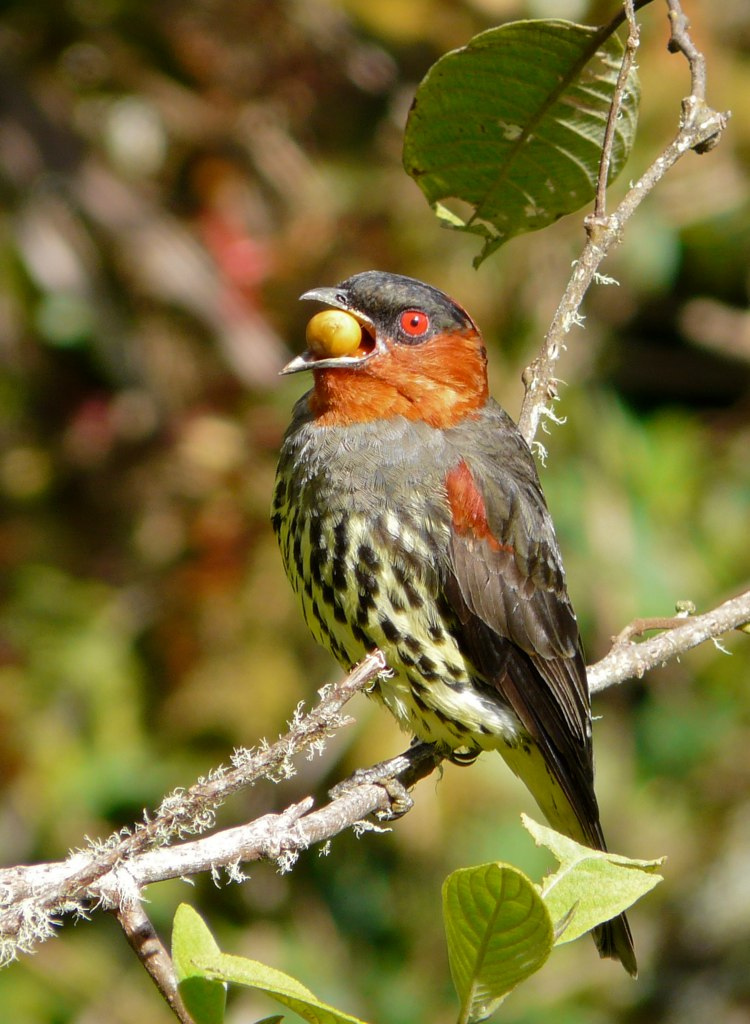
The Bearded Bellbird is a medium-sized bird, averaging 28-30 cm in length, with a noticeable sexual dimorphism between males and females. Adult males are particularly striking with their glossy white plumage contrasted against a black face and throat adorned with long, pendulous wattles, giving them a bearded appearance. Females, on the other hand, are more subdued in coloration, exhibiting olive-brown upperparts and streaked underparts, which offer better camouflage in the forest canopy. Juvenile bellbirds resemble females but are often duller and have fewer streaks. The male Bearded Bellbird's call is its most distinguishing feature, a loud, metallic "bong" that can carry over a kilometer in dense forest. This call differs markedly from those of similar species, such as the Three-wattled Bellbird, which has a more varied and complex vocalization pattern. In flight, the Bearded Bellbird displays short, rounded wings and a stocky body, typical of many canopy-dwelling birds. Its perching posture is often upright, allowing the bird to project its voice effectively across its territory.
Having trouble telling birds apart? Upload a photo to our bird identification tool for an instant species match.
Bearded Bellbird Habitat and Range
Preferred Habitat
The Bearded Bellbird thrives in lowland and montane tropical forests, favoring areas with dense canopy cover. It is predominantly found at elevations ranging from 500 to 1,200 meters, though some populations can occur at higher altitudes. These birds are most commonly associated with primary and secondary growth forests, indicating their adaptability to varying degrees of forest maturity. In Trinidad and Tobago, the Bearded Bellbird often inhabits the forests of the Northern Range, while in Venezuela, it prefers the humid forests of the Guiana Shield. During the breeding season, these bellbirds may shift their habitat preference slightly to optimize access to fruiting trees, upon which they heavily rely for nutrition. Despite their adaptability, the Bearded Bellbirds are notably absent from urban environments, as they require the complex forest structure and extensive canopy layers that urban settings cannot provide.
Geographic Range
The Bearded Bellbird's range includes several countries in northern South America, with notable populations in Trinidad and Tobago, northeastern Colombia, Venezuela, and the Guianas. Their distribution extends southward into the northern regions of Brazil. While generally considered a resident species, some populations exhibit minor migratory behavior, influenced by seasonal fruit availability. These movements are typically altitudinal, with birds descending to lower elevations during periods of food scarcity in higher regions. Throughout its range, the Bearded Bellbird is more common in areas where substantial tracts of undisturbed forest remain, though smaller populations can persist in fragmented habitats provided there is sufficient canopy cover. In the past, the bellbird's range might have been more extensive, but deforestation and habitat degradation have likely curtailed its distribution.
Want to know which birds visit your area? Browse our backyard birds by location guides for region-specific species lists.
What Does the Bearded Bellbird Eat?
The Bearded Bellbird is primarily frugivorous, with a diet consisting mainly of fruits from a variety of tropical trees. They exhibit a particular preference for the fruits of Lauraceae and Meliaceae family trees, which they consume whole. During the wet season, when fruit is abundant, the bellbirds can afford to be selective, focusing on the most nutrient-rich offerings. In the dry season, they may expand their diet to include a wider range of fruits and occasionally insects, providing additional protein. The Bearded Bellbird's foraging technique involves perching quietly in the upper canopy, scanning for ripe fruits before making quick, direct flights to pluck them. Their strong beaks enable them to handle a variety of fruit sizes, facilitating efficient seed dispersal. Feeding typically occurs during the early morning and late afternoon, aligning with cooler temperatures and peak fruit availability.
Bearded Bellbird Behavior and Social Structure
The Bearded Bellbird exhibits a solitary and territorial nature, particularly evident during the breeding season. Males establish territories within the forest canopy, using their powerful calls to ward off rivals and attract females. This vocal prowess is not only a mating tool but also a mechanism for maintaining spacing between individuals in the dense forest. Courtship displays by males involve impressive vocal performances and visual displays that highlight their wattles. The bellbird's daily activity patterns revolve around feeding and territorial maintenance. They are most active during the cooler parts of the day, including dawn and dusk. Although primarily solitary, Bearded Bellbirds may loosely associate with mixed-species flocks outside the breeding season, providing increased foraging efficiency and predator vigilance. In the presence of predators, they rely on their cryptic plumage and remain motionless, blending into the canopy foliage.
Bearded Bellbird Nesting and Reproduction
Bearded Bellbirds construct open cup nests, typically located high in the forest canopy, often in the fork of a tree branch. The nest is made from a variety of plant materials, including twigs, leaves, and vines, providing a sturdy yet camouflaged structure. Females solely take on the responsibilities of nest building, incubation, and chick rearing. A typical clutch consists of one to two eggs, which the female incubates for approximately 17 to 21 days. Upon hatching, the chicks remain in the nest for about 20 to 25 days before fledging. During this period, the female diligently feeds and cares for the young, while the male continues to defend the territory vocally. The Bearded Bellbird generally raises one brood per year, though favorable conditions may occasionally allow for a second.
Bearded Bellbird Sounds and Vocalizations
The primary vocalization of the Bearded Bellbird is a distinctive, metallic "bong" sound, resembling the tolling of a bell. This call is both loud and far-reaching, often serving as the first indication of the bird's presence in the dense forest. Aside from the primary call, the bellbird produces a series of shorter, harsher notes that function as alarm calls when predators approach. During the dawn chorus, males are particularly vocal, with their calls often overlapping as they compete for territory and mates. The bellbird's sound repertoire is unique among its relatives, with a tonal quality that can be likened to the ringing of a hammer on an anvil, providing a reliable auditory cue for identification.
Interesting Facts About the Bearded Bellbird
- 1The Bearded Bellbird's call is one of the loudest bird calls in the world, audible over 1 km away.
- 2Male Bearded Bellbirds spend up to 70% of their day calling during the breeding season.
- 3Despite the male's striking appearance, the female Bearded Bellbird handles all nesting duties.
- 4The fleshy wattles of the male Bearded Bellbird are unique among the bellbird species.
- 5Bearded Bellbirds can consume fruits with diameters up to 2 cm, aiding in seed dispersal.
- 6Their call frequency can reach up to 1,000 Hz, making it a vital tool for territory defense.
- 7Bearded Bellbirds are considered an indicator species, reflecting the health of tropical forests.
Bearded Bellbird Conservation Status
Currently listed as Least Concern by the IUCN, the Bearded Bellbird faces threats from habitat loss due to deforestation and land conversion for agriculture. While its population trend appears stable, ongoing habitat destruction could pose significant risks to its long-term survival. Conservation efforts focus on preserving large tracts of forest and promoting sustainable land-use practices. Historically, the bellbird's population has fluctuated in response to habitat availability, with declines noted in areas experiencing extensive logging or agricultural expansion. Protection of key habitats in countries like Venezuela and Trinidad and Tobago is crucial for maintaining population stability.
Other Cotingidae Species



Birds Similar to the Bearded Bellbird
These species are often confused with the Bearded Bellbird due to similar appearance or overlapping range.

