
Black-breasted Parrotbill
Paradoxornis flavirostris
Order: Passeriformes / Family: Sylviidae

Wikimedia Commons
About the Black-breasted Parrotbill
The Black-breasted Parrotbill (Paradoxornis flavirostris) is a distinctive bird endemic to the dense grasslands and reed beds of Northeast India, primarily within the states of Assam and Arunachal Pradesh. This bird is significant not only because of its unique appearance but also due to its specialized habitat preferences. The Black-breasted Parrotbill plays an important ecological role in its habitat, contributing to seed dispersal and insect control. Its presence is often an indicator of habitat health, particularly in the floodplain grasslands near the Brahmaputra River. In these habitats, the parrotbill thrives in areas with tall grasses, such as Saccharum and Phragmites, which provide both food and cover. Seasonally, the Black-breasted Parrotbill may exhibit slight shifts in habitat use, moving to higher ground during monsoon flooding. However, it largely remains within the same general geographic region throughout the year, reflecting its status as a non-migratory species. The parrotbill's ecological role extends beyond its own survival. It also forms part of a complex food web, serving as prey for raptors and mammals in its native grasslands. Additionally, the bird's feeding habits help control the populations of insects, contributing to the ecological balance of its environment. Conservationists view the Black-breasted Parrotbill as a flagship species for the protection of the threatened grassland ecosystems of Northeast India. The preservation of its habitat is crucial for maintaining biodiversity in these areas, as the parrotbill often shares its environment with other rare and specialized fauna. Understanding the Black-breasted Parrotbill's habitat requirements and behaviors aids in efforts to conserve its dwindling populations and the grasslands they inhabit.
The Black-breasted Parrotbill belongs to the family Sylviidae, within the order Passeriformes. These birds typically live average 4 years, max recorded 7 years.
How to Identify a Black-breasted Parrotbill
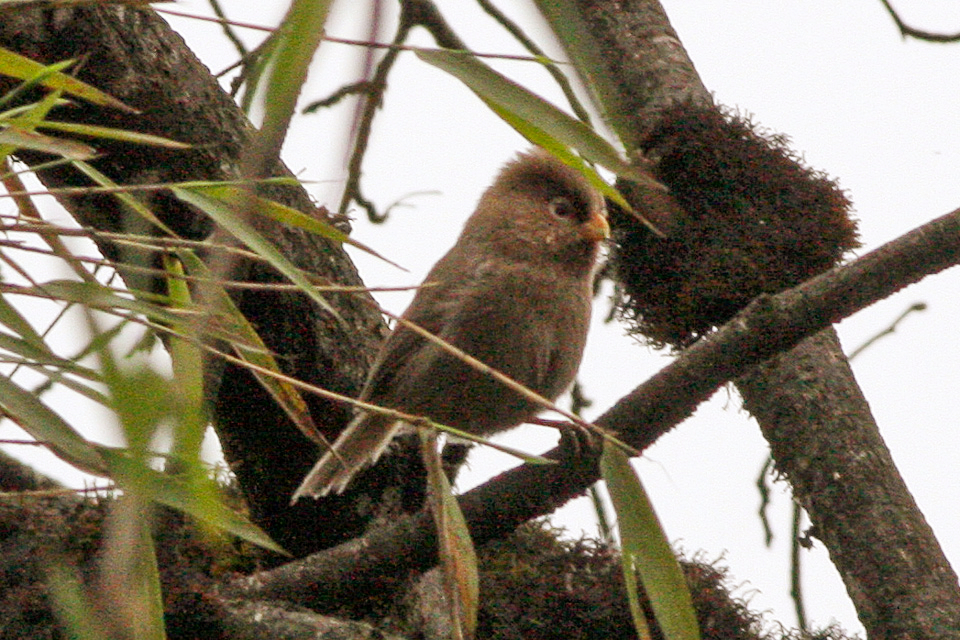
Identification of the Black-breasted Parrotbill involves noting several key features. This medium-sized bird measures about 18-20 cm in length, with a robust, parrot-like bill that is bright yellow, contrasting with its predominantly brown plumage. The most striking feature of this bird is its black throat and upper chest, which gives the species its common name. Adult birds have a warm brown back and wings, which may appear slightly rufous under direct sunlight. The underparts are buff, fading to a lighter tone towards the belly. Juvenile Black-breasted Parrotbills typically lack the complete black throat patch, displaying a more mottled appearance in the chest area. Males and females are similar in plumage, making sex differentiation in the field challenging without close observation. The bird's silhouette is characterized by its relatively short wings and long tail, which aid in maneuvering through dense vegetation. When perched, the Black-breasted Parrotbill often adopts an upright posture, using its strong legs to grasp reeds and grasses firmly. Confusion with similar species is minimized by the bird's unique throat coloration and stout bill. However, observers should still be mindful of potential misidentification with other parrotbills that share overlapping ranges.
Having trouble telling birds apart? Upload a photo to our bird identification tool for an instant species match.
Black-breasted Parrotbill Habitat and Range
Preferred Habitat
The habitat of the Black-breasted Parrotbill is primarily restricted to the tall grasslands and reed beds of Northeast India. These environments are typically dominated by species such as Saccharum, Phragmites, and Arundo donax, providing both food and shelter. The bird prefers areas that are seasonally flooded, which often coincide with the floodplains of major rivers like the Brahmaputra. The elevation range of its habitat generally spans from the lowland plains up to about 300 meters. Unlike many bird species, the Black-breasted Parrotbill does not occupy urban environments, maintaining its presence in rural and wild grassland settings. Seasonal habitat shifts are minor, primarily involving movements to avoid floodwaters during the monsoon season. Despite these shifts, the species remains within its preferred habitat type throughout the year.
Geographic Range
The range of the Black-breasted Parrotbill is confined to the northeastern region of India, with its core habitat located in Assam and parts of Arunachal Pradesh. It is typically found in the grasslands adjacent to the Brahmaputra River, areas that are subject to seasonal flooding. The bird does not migrate long distances, remaining within its breeding range year-round. This limited range makes the species vulnerable to habitat destruction and environmental changes. Population density is highest in protected areas like the Dibru-Saikhowa National Park in Assam, where conservation efforts aim to preserve the unique floodplain ecosystem. The Black-breasted Parrotbill is considered rare outside of these specific locales, and its presence is often used as a measure of grassland habitat health.
Want to know which birds visit your area? Browse our backyard birds by location guides for region-specific species lists.
What Does the Black-breasted Parrotbill Eat?
The diet of the Black-breasted Parrotbill primarily consists of insects and seeds, reflecting its adaptation to the grassland environment. Insects such as grasshoppers, beetles, and caterpillars form a significant portion of its diet, particularly during the breeding season when protein-rich food is essential for chick development. The bird forages by clambering through dense vegetation, using its strong bill to probe for insects and to crack open seeds. The feeding schedule is largely diurnal, with peak activity occurring during the cooler hours of the morning and late afternoon. During the dry season, when insect availability decreases, the Black-breasted Parrotbill relies more heavily on seeds. It may also consume small berries when available. The bird's foraging technique is methodical, often involving a combination of gleaning and probing, which allows it to exploit a range of food sources within its habitat.
Black-breasted Parrotbill Behavior and Social Structure
The Black-breasted Parrotbill exhibits a complex social structure, often forming small family groups outside of the breeding season. These groups are typically composed of an adult pair and their offspring, and they may join other families to form loose flocks. Territorial behavior is pronounced during the breeding season, with pairs fiercely defending their chosen nesting site from intruders. Courtship displays involve mutual preening and feeding exchanges between mates, reinforcing pair bonds. The parrotbill's response to predators includes a range of behaviors from silent freezing to sudden flights into dense cover. Daily activity patterns are diurnal, with most foraging and social interactions occurring during daylight hours. During the hottest part of the day, the birds may retreat to shaded areas to conserve energy. Flocking patterns become more apparent outside the breeding season, as the birds form small, cohesive groups to forage and roost.
Black-breasted Parrotbill Nesting and Reproduction
The Black-breasted Parrotbill constructs cup-shaped nests, often concealed within dense grass or reeds. Nest materials primarily include grasses, leaves, and sometimes spider silk for binding. Preferred nesting sites are low to the ground, typically no more than a meter above the base of the grass stand. The female lays a clutch of 2-4 eggs, which she incubates for about 12-14 days. Both parents participate in feeding the nestlings, which fledge approximately two weeks after hatching. The fledging timeline is critical, as the young must quickly learn to navigate the dense grassland environment. Parental roles are well defined, with males often taking on the duty of territory defense while females focus on nurturing the young. The Black-breasted Parrotbill usually raises one brood per year, although in years of abundant resources, a second brood may be attempted.
Black-breasted Parrotbill Sounds and Vocalizations
The vocalizations of the Black-breasted Parrotbill include a primary song that is a series of rapid, sharp notes often described as 'tsit-tsit-tsit' with a rhythmic and repetitive quality. Call notes are shorter and sharper, functioning primarily as contact calls between mates or family members. Alarm calls are more strident and can alert other birds in the vicinity to potential danger. During the dawn chorus, the parrotbill contributes with its distinctive song, which stands out due to its clarity and repetition. The sounds are reminiscent of other grassland species but are distinguishable by their pitch and the specific sequence of notes.
Interesting Facts About the Black-breasted Parrotbill
- 1The Black-breasted Parrotbill has a uniquely adapted bill that resembles that of a parrot, aiding in its specialized feeding habits.
- 2This species is one of the few birds that primarily inhabit the floodplain grasslands of Northeast India, highlighting its ecological specialization.
- 3Despite its striking appearance, the Black-breasted Parrotbill remains elusive, often hidden within dense reed beds and tall grasses.
- 4The parrotbill plays a vital role in the ecosystem by controlling insect populations and aiding in seed dispersal.
- 5Black-breasted Parrotbills are often used as indicator species for the health of grassland habitats due to their dependency on specific environmental conditions.
- 6This bird's rarity and specialized habitat have made it a focal species in conservation efforts aimed at preserving Northeast India's biodiversity.
- 7During courtship, Black-breasted Parrotbills engage in mutual preening and food exchanges, behaviors that strengthen pair bonds.
Black-breasted Parrotbill Conservation Status
The Black-breasted Parrotbill is currently listed as Vulnerable on the IUCN Red List, with its population trend showing a decreasing pattern. The primary threats to the species include habitat loss due to agricultural expansion, human encroachment, and changes in river management that affect the natural floodplain dynamics. Conservation efforts focus on protecting and restoring grassland habitats, particularly in protected areas like Dibru-Saikhowa National Park. Historical population data suggest a significant decline in numbers over the past few decades, necessitating urgent conservation action. Efforts are underway to engage local communities in habitat conservation, raising awareness of the parrotbill's ecological importance and the need for sustainable land-use practices.
Other Sylviidae Species



Birds Similar to the Black-breasted Parrotbill
These species are often confused with the Black-breasted Parrotbill due to similar appearance or overlapping range.
