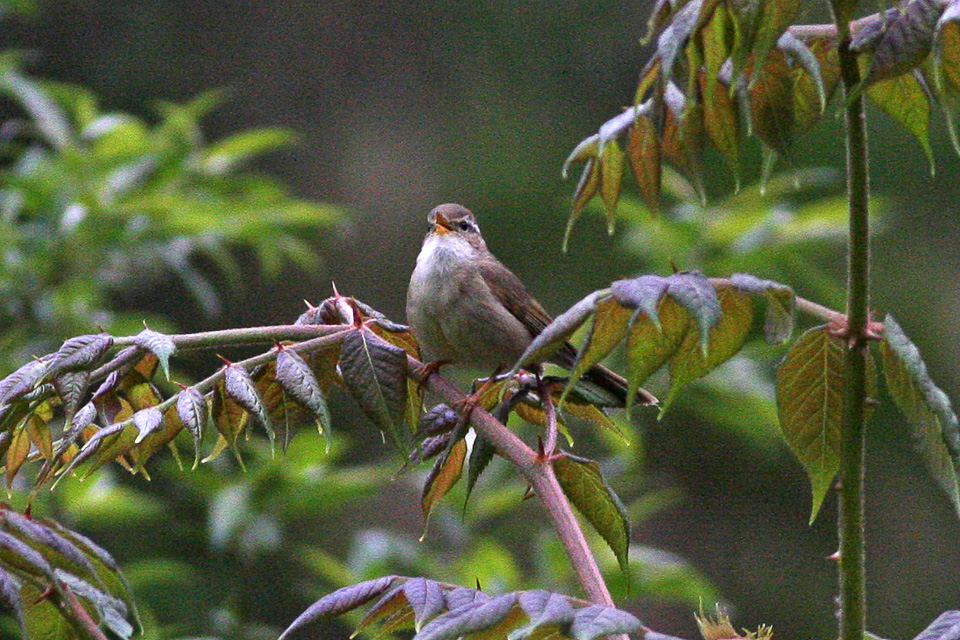
Black-capped Woodland-Warbler
Phylloscopus herberti
Order: Passeriformes / Family: Phylloscopidae

Wikimedia Commons
About the Black-capped Woodland-Warbler
The Black-capped Woodland-Warbler, known scientifically as Phylloscopus herberti, is a captivating member of the Phylloscopidae family. This small songbird is renowned for its striking black cap, which provides a stark contrast to its otherwise olive-green and yellow plumage. Found predominantly in the sub-Saharan regions of Africa, this warbler inhabits dense, moist woodlands and montane forests. Its presence in these ecosystems plays a significant role in insect population control, as it primarily feeds on a variety of small invertebrates. The Black-capped Woodland-Warbler exhibits a fascinating array of seasonal behaviors. During breeding season, its territorial calls become more frequent and vibrant, serving as both a mating call and a territorial warning. In contrast, non-breeding seasons see these warblers forming small flocks, which may include mixed-species groups. This social behavior aids in foraging efficiency as well as predator avoidance. The ecological significance of the Black-capped Woodland-Warbler cannot be overstated. By controlling insect populations, it helps maintain the health of forest ecosystems. This role is especially critical in areas where deforestation and habitat fragmentation threaten biodiversity. The bird's adaptability to varying altitudes and its ability to exploit different woodland niches make it a resilient species, albeit one that still faces challenges from habitat destruction. Throughout the year, the Black-capped Woodland-Warbler migrates locally within its range, often in response to seasonal changes in food availability. These movements, though not long-distance migrations, demonstrate the bird's adaptability to changing environmental conditions. As climate change continues to alter habitats, understanding the ecological role and behavioral adaptations of species like the Black-capped Woodland-Warbler becomes increasingly important.
The Black-capped Woodland-Warbler belongs to the family Phylloscopidae, within the order Passeriformes. These birds typically live average 5 years with a max recorded of 7 years..
How to Identify a Black-capped Woodland-Warbler
Identifying the Black-capped Woodland-Warbler involves noting several key field marks. Adults display a prominent black cap that sharply contrasts with their yellow-green body. The face is characterized by a pale supercilium, or eyebrow line, which enhances the contrast with the dark cap. Juveniles, while similar in size, often have a duller coloration, lacking the fully developed black cap seen in adults. Males and females are remarkably similar in appearance, making field identification of sex difficult without behavioral cues. In flight, the Black-capped Woodland-Warbler exhibits a rapid, fluttery movement, typical of the Phylloscopidae family. Its wings are relatively short and rounded, aiding in quick maneuvers through dense foliage. When perched, this warbler often assumes a horizontal stance, with its tail slightly flicked upwards. This posture, combined with its quick, darting movements, is a useful identification characteristic. Confusion may arise with other woodland warblers, such as the Yellow-throated Woodland-Warbler, which shares a similar habitat but lacks the distinctive black cap. Observing these field marks in combination with vocalizations can aid significantly in accurate identification.
Having trouble telling birds apart? Upload a photo to our bird identification tool for an instant species match.
Black-capped Woodland-Warbler Habitat and Range
Preferred Habitat
The Black-capped Woodland-Warbler predominantly inhabits moist, dense woodlands and montane forests. It thrives in elevations ranging from 500 to 3000 meters, particularly favoring areas with dense understory vegetation. Such habitats are common in regions like the Albertine Rift montane forests, which provide ample cover and food resources. During different seasons, this warbler may shift habitats slightly, moving to lower elevations or more open woodland areas if necessary. Though primarily associated with natural woodlands, the Black-capped Woodland-Warbler can occasionally be found in semi-urban environments where suitable patches of forest remain. This adaptability highlights its resilience, although the bird tends to thrive best in undisturbed, natural habitats.
Geographic Range
The Black-capped Woodland-Warbler's range is predominantly centered in the sub-Saharan regions of Africa. It can be found from the forests of Cameroon and Gabon in the west to the montane areas of Uganda and Rwanda in the east. This warbler is a resident species, with most populations not undertaking extensive migrations. However, some local movements do occur, often in response to seasonal food availability or environmental conditions. Population densities are typically highest in areas where moist, dense forests are abundant, such as the eastern slopes of the Albertine Rift. The range of this species does not extend into the arid regions or the coastal plains, as it prefers the humid conditions of montane and submontane forests.
Want to know which birds visit your area? Browse our backyard birds by location guides for region-specific species lists.
What Does the Black-capped Woodland-Warbler Eat?
The diet of the Black-capped Woodland-Warbler primarily consists of small invertebrates, including insects and spiders. During the breeding season, the warbler's diet is particularly rich in protein, aiding in the nourishment of their young. This period sees an increase in the consumption of caterpillars and other larvae, which are abundant in forested environments. In non-breeding seasons, the bird's diet may diversify slightly to include small fruits and seeds, particularly when insect availability declines. The Black-capped Woodland-Warbler employs a foraging technique known as 'gleaning,' where it picks insects off leaves and bark while moving through the forest canopy. This method allows the bird to exploit a wide variety of prey sizes, from tiny aphids to larger beetles. Feeding typically occurs during daylight hours, with peak activity in the early morning and late afternoon when insect activity is highest.
Black-capped Woodland-Warbler Behavior and Social Structure
The Black-capped Woodland-Warbler exhibits a variety of intriguing behaviors that are central to its survival and reproductive success. Socially, this warbler is known for its flexibility, being both solitary and social depending on the season. During the breeding season, males establish and defend territories vigorously, using song and displays to deter rivals and attract mates. These territories are crucial for nesting success, as they provide a safe area with abundant food resources. Outside the breeding season, Black-capped Woodland-Warblers often join mixed-species flocks. This behavior offers several benefits, including increased foraging efficiency and enhanced protection against predators. The warblers remain active throughout the day, with peaks in activity during the cooler morning and late afternoon hours. When threatened by predators, this warbler may employ a variety of evasive maneuvers, including rapid flight and seeking refuge in dense foliage. Its response to predation threats is both behavioral and vocal, as it may emit sharp alarm calls to alert other birds of danger. Courtship involves a series of displays and calls, with males showcasing their plumage and vocal prowess to potential mates. These displays are often complemented by short flights and wing flicks, designed to capture the attention of females.
Black-capped Woodland-Warbler Nesting and Reproduction
Nesting habits of the Black-capped Woodland-Warbler are characterized by careful selection and construction. Nests are typically located in dense undergrowth or low shrubs, providing both concealment and protection from predators. The nest itself is a small cup structure, constructed using fine grasses, leaves, and spider silk. This combination of materials ensures the nest is both lightweight and secure. Clutch size usually ranges from two to four eggs, with an incubation period of approximately 12 to 14 days. Both parents play active roles in feeding the chicks, though the female primarily undertakes incubation duties. The fledging period lasts about 14 to 16 days, after which the young birds leave the nest but remain dependent on their parents for food and protection for several more weeks. Typically, the Black-capped Woodland-Warbler raises one to two broods per year, depending on environmental conditions and food availability.
Black-capped Woodland-Warbler Sounds and Vocalizations
The vocalizations of the Black-capped Woodland-Warbler are both distinctive and varied. Its primary song consists of a series of high-pitched, melodious notes that can be described as a rapid trill. This song serves multiple purposes, from establishing territory to attracting mates during the breeding season. In addition to its song, the Black-capped Woodland-Warbler emits a variety of call notes. These include sharp 'chip' sounds that serve as alarm calls, alerting other birds to the presence of predators. During the dawn chorus, this warbler's song is particularly prominent, contributing to the rich tapestry of sounds that characterize these early morning hours. Its vocal repertoire is a critical aspect of its behavioral ecology, facilitating both social interaction and predator avoidance.
Interesting Facts About the Black-capped Woodland-Warbler
- 1The Black-capped Woodland-Warbler can consume up to 50% of its body weight in insects daily, showcasing its role in pest control.
- 2Despite its small size, the Black-capped Woodland-Warbler's song can travel over 100 meters, facilitating communication in dense forests.
- 3This warbler's nesting success is highly dependent on the density of understory vegetation, which provides critical cover from predators.
- 4The Black-capped Woodland-Warbler engages in a behavior known as 'anting,' where it uses ants to remove parasites from its feathers.
- 5During mixed-species flocking, the warbler often associates with other insectivorous birds, enhancing its foraging success.
- 6The warbler's lifespan ranges from 3 to 5 years, with survival heavily influenced by habitat quality and food availability.
- 7Recent studies have shown that climate change could impact the Black-capped Woodland-Warbler's breeding timing, potentially affecting population dynamics.
Black-capped Woodland-Warbler Conservation Status
The conservation status of the Black-capped Woodland-Warbler is currently of least concern according to the IUCN, with population trends considered stable. However, habitat loss due to deforestation poses a significant threat to this species. Efforts to conserve its habitat focus on protecting large tracts of forest and promoting sustainable land-use practices that minimize habitat fragmentation. Historically, the population has shown resilience in adapting to changing environments, but ongoing deforestation in parts of its range could alter this trend. Conservation programs are increasingly emphasizing the importance of preserving montane forests, which not only support the Black-capped Woodland-Warbler but also a multitude of other forest-dependent species.