
Black Guineafowl
Agelastes niger
Order: Galliformes / Family: Numididae

Wikimedia Commons
About the Black Guineafowl
The Black Guineafowl, scientifically known as Agelastes niger, is a remarkable member of the Numididae family. This bird is primarily found in the dense forests of West and Central Africa, including countries like Liberia, Sierra Leone, and the Ivory Coast. Its habitat preference for thick undergrowth and humid environments makes it an integral part of these ecosystems. The Black Guineafowl plays a significant ecological role as both a seed disperser and a predator of small invertebrates. By consuming a varied diet that includes seeds, fruits, and insects, it helps maintain the balance of its forest habitat. During the rainy season, when food resources are abundant, the Black Guineafowl may be more active and visible as it forages vigorously to take advantage of the plentiful supply. Conversely, in the dry season, it may travel greater distances in search of sustenance, displaying its adaptability to changing conditions.
The Black Guineafowl's presence is crucial in the regions it inhabits, not only for its ecological contributions but also for the cultural significance it holds among local communities. In some areas, traditional beliefs and practices involve the Black Guineafowl, reflecting the deep connection between the bird and the people who share its habitat. Despite its importance, the Black Guineafowl's population faces threats from habitat destruction and hunting. As forests are cleared for agriculture and development, the bird's natural habitat diminishes, putting pressure on its populations. Efforts to conserve these forests are essential to ensure the survival of the Black Guineafowl and the myriad other species that depend on these rich ecosystems.
Ecologically, the Black Guineafowl also serves as a prey item for larger predators, contributing to the food web's complexity. Its behavior and movement patterns affect the distribution of seeds and invertebrates, fostering biodiversity. Conservationists emphasize the need to protect this bird not only for its intrinsic value but also for the broader health of the forest systems it inhabits. The survival of the Black Guineafowl is a barometer for the health of the forest ecosystems of West and Central Africa, making it a species of both ecological and conservation interest.
The Black Guineafowl belongs to the family Numididae, within the order Galliformes. These birds typically live typically lives around 10 years in the wild, with some individuals living up to 15 years..
How to Identify a Black Guineafowl
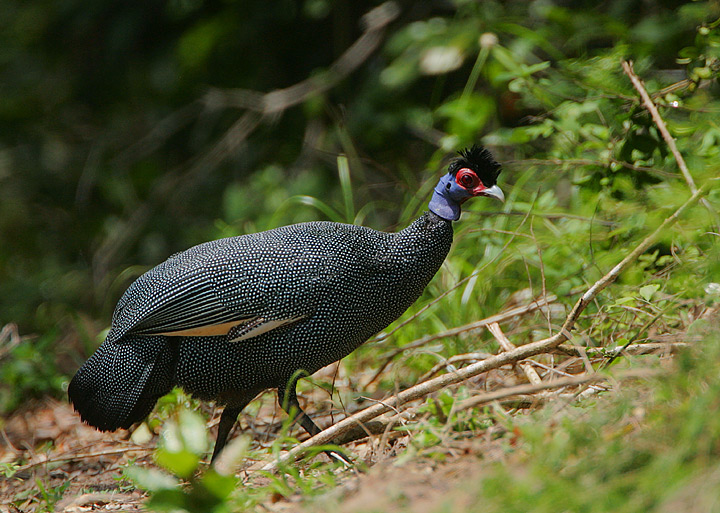
The Black Guineafowl is distinguished by its predominantly black plumage, which can appear glossy under direct sunlight. It possesses a bare neck and head, which are grayish, contributing to its unique appearance. The adult Black Guineafowl typically measures around 45-50 centimeters in length, allowing it to camouflage effectively within its forested habitat. Juveniles resemble adults but may have slightly duller plumage and less developed bare skin areas.
Males and females of the species are similar in appearance, making sex differentiation challenging in the field. However, males may sometimes be slightly larger with more robust bills. The Black Guineafowl's flight silhouette is relatively distinctive compared to other guineafowl species. Its wings are broad and rounded, suitable for short bursts of flight through dense forest canopies. When perched, the bird maintains an upright posture, often blending seamlessly with the dark understory.
Among similar species, confusion might arise with other guineafowl, such as the Helmeted Guineafowl. However, the Black Guineafowl lacks the distinctive helmet and white-spotted plumage that characterize the Helmeted Guineafowl. Observing the Black Guineafowl's behavior and preferred habitat can also aid in accurate identification.
Having trouble telling birds apart? Upload a photo to our bird identification tool for an instant species match.
Black Guineafowl Habitat and Range
Preferred Habitat
The Black Guineafowl thrives in the dense, humid lowland forests of West and Central Africa. These forests provide the cover and resources needed for its survival, including insects, seeds, and fruits. The bird generally avoids open areas, preferring the safety of the forest understory where it can forage and seek refuge from predators. It is typically found at elevations ranging from sea level to about 1,200 meters, although it may ascend higher in search of food during certain times of the year.
While it predominantly inhabits undisturbed forest areas, the Black Guineafowl can occasionally be found in secondary growth forests, especially those that have been left to regenerate. However, it remains absent from urban environments, reflecting its dependence on pristine forest conditions. Seasonal habitat shifts are minimal due to its non-migratory nature, but it may alter its foraging locations within the forest depending on food availability.
Geographic Range
The Black Guineafowl's range is restricted to parts of West and Central Africa. Its core distribution includes countries like Liberia, Sierra Leone, Guinea, the Ivory Coast, and Ghana. In Central Africa, it can be found in the rainforests of Cameroon and the Democratic Republic of the Congo. This bird is not migratory, so it remains within these regions year-round, relying on the stable conditions of the equatorial forests.
Population density is generally higher in undisturbed forests where human activity is limited, allowing the Black Guineafowl to thrive. It tends to avoid areas with extensive deforestation or high human population density. While its range is somewhat limited geographically, the bird often occupies large continuous areas of suitable habitat within its distribution. Conservation efforts focus on maintaining these vital forested areas to support the species.
Want to know which birds visit your area? Browse our backyard birds by location guides for region-specific species lists.
What Does the Black Guineafowl Eat?
The Black Guineafowl primarily feeds on a diverse array of seeds, fruits, and insects. Its diet is opportunistic and varies with seasonal availability. During the rainy season, when insects and fruits are plentiful, the Guineafowl consumes a higher proportion of these items. Insects such as beetles, ants, and termites form a significant part of its diet, along with small invertebrates. This diet supports the bird's nutritional needs, particularly during the breeding season when energy demands are higher.
Foraging typically occurs on the forest floor, where the Black Guineafowl uses its strong legs and beak to scratch through leaf litter and soil. It exhibits a keen sense of sight and hearing to detect prey and food items, often foraging in small groups to increase efficiency. The bird's feeding schedule is primarily diurnal, with peak activity in the early morning and late afternoon when temperatures are cooler and food is more accessible.
The Black Guineafowl's foraging behavior also contributes to seed dispersal, as it occasionally ingests seeds that pass through its digestive system and are deposited elsewhere, aiding in plant propagation.
Want to attract Black Guineafowls to your yard? See our recommended feeders and seed types for the best results.
Black Guineafowl Behavior and Social Structure
The Black Guineafowl exhibits a range of social and territorial behaviors. It generally forages in small family groups or loose flocks, which can consist of up to 10 individuals. This social structure enhances their ability to detect predators and locate food sources. While foraging, the birds maintain contact with each other through vocalizations and visual cues.
Territorial behavior is evident during the breeding season, when pairs or small groups may become more defensive of their foraging ranges. Courtship displays are subtle compared to those of more flamboyant bird species, consisting of mutual preening and soft vocalizations between potential mates. Once a pair bond forms, they often remain together for life, contributing to the stability of their social units.
In response to predators, the Black Guineafowl relies on its ability to blend into the dense forest undergrowth. It rarely takes flight unless absolutely necessary, preferring to run swiftly through the forest floor to evade danger. Daily activity patterns are influenced by the availability of food and environmental conditions, with peak activity occurring during cooler parts of the day.
Black Guineafowl Nesting and Reproduction
The Black Guineafowl constructs its nest on the ground, often choosing locations with dense cover to conceal it from predators. Nests are shallow scrapes lined with leaves, twigs, and other forest debris. These nests are typically well-hidden under shrubs or fallen logs, providing additional protection.
The female lays a clutch of about 4 to 8 eggs, which she incubates for approximately 23 to 26 days. Both parents participate in raising the young, with the male often assuming a protective role while the female tends to the chicks. Once hatched, the chicks are precocial, meaning they are relatively mature and mobile shortly after birth, allowing them to forage with the parents soon after hatching.
The fledging period lasts around four to five weeks, during which the young guineafowl gradually develop the ability to fend for themselves. The family group remains together for several months, ensuring the young have ample time to learn vital survival skills. Typically, the Black Guineafowl produces one brood per year, although favorable conditions might allow for a second.
Black Guineafowl Sounds and Vocalizations
The Black Guineafowl's vocalizations play a crucial role in communication within the dense forest habitat it occupies. Its primary call consists of a series of low, resonant clucks that serve to maintain contact between flock members. These calls are rhythmic and somewhat repetitive, making them distinguishable from other forest sounds.
Alarm calls are sharper and more urgent, intended to alert others to potential threats. During the early morning and late afternoon, the Black Guineafowl may participate in a chorus of calls, creating a symphony of sounds that resonate through the forest. These vocalizations are less melodious compared to songbirds, but they serve their purpose effectively in the dense forest environment.
Interesting Facts About the Black Guineafowl
- 1The Black Guineafowl is one of the lesser-known members of the guineafowl family, known for its reclusive nature.
- 2Unlike its more colorful relatives, the Black Guineafowl's plumage is uniformly dark, aiding its camouflage.
- 3The species displays monogamous pair bonds, often lasting for life, which is relatively rare among guineafowl.
- 4Black Guineafowl have strong legs adapted for running, allowing them to swiftly navigate dense underbrush.
- 5Their diet includes insects and small invertebrates, making them important pest controllers in forest ecosystems.
- 6The Black Guineafowl's call is a series of deep clucks, distinct from the more raucous calls of other guineafowl.
- 7Despite its name, the Black Guineafowl does not migrate, remaining year-round in its forest home.
Black Guineafowl Conservation Status
The Black Guineafowl is currently classified as Near Threatened by the IUCN. Its population trend is declining, primarily due to habitat loss and hunting pressures. Deforestation for agriculture and logging has significantly reduced its available habitat, fragmenting populations and isolating them in smaller forest patches. Conservation efforts focus on protecting remaining forest areas and establishing reserves where the Black Guineafowl can thrive without human interference. Community-based conservation programs are also vital, involving local populations in sustainable practices that benefit both the wildlife and the people. Despite these challenges, ongoing efforts provide hope for stabilizing and potentially increasing the Black Guineafowl's populations in the future.
Attracting Black Guineafowls to Your Feeder
The Black Guineafowl is a regular visitor to backyard bird feeders across its range. At the Eye On The Fly feeding station, we observe Black Guineafowls regularly and capture footage with our feeder cameras.
Other Numididae Species


Birds Similar to the Black Guineafowl
These species are often confused with the Black Guineafowl due to similar appearance or overlapping range.