
Plumed Guineafowl
Guttera plumifera
Order: Galliformes / Family: Numididae

Wikimedia Commons
About the Plumed Guineafowl
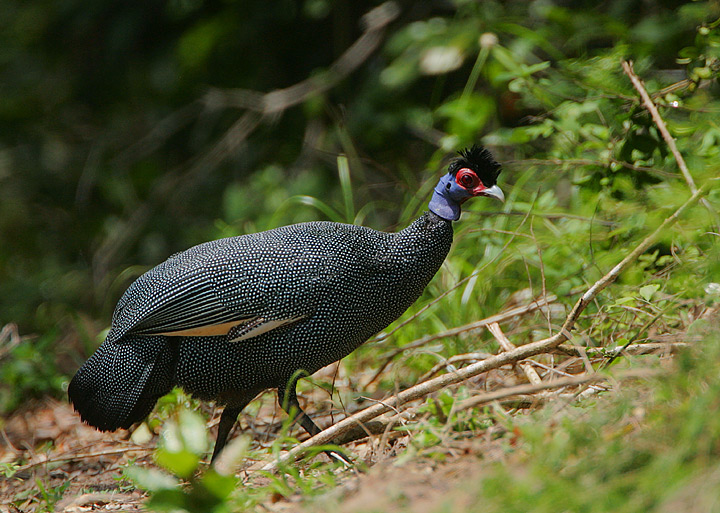
The Plumed Guineafowl (Guttera plumifera) is a striking member of the Numididae family, known for its unique appearance and behavior. This bird thrives in the lush, dense forests of Central Africa, particularly in countries like Cameroon, Gabon, and the Democratic Republic of the Congo. Its presence in these regions signifies the health of tropical forests, as it relies on the dense undergrowth for cover and foraging. The bird’s ecological role is significant, as it helps control insect populations and serves as prey for larger predators, maintaining the balance of the ecosystem. Seasonally, the Plumed Guineafowl may exhibit slight shifts in behavior, particularly during breeding times when it becomes more territorial. Despite its ability to adapt to various forested environments, it remains vulnerable to habitat destruction and hunting, which continue to threaten its populations. Its importance extends beyond ecological contributions, as indigenous cultures often regard the Plumed Guineafowl as a symbol of the forest, reflecting its deep-rooted significance in local traditions. The bird's striking appearance, with its characteristic head crest and intricate plumage patterns, makes it a subject of interest for birdwatchers and naturalists alike.
The Plumed Guineafowl belongs to the family Numididae, within the order Galliformes. These birds typically live typically around 12 years in the wild, with individuals occasionally reaching 15 years..
How to Identify a Plumed Guineafowl
Adult Plumed Guineafowl feature a distinctive blue-gray body with white spots and a unique head crest made of elongated feathers. Its head is largely bare, showing a dark bluish hue. Juveniles resemble adults but have less pronounced crests and slightly duller plumage. Males and females are similar in appearance, making sex differentiation challenging without close observation. Compared to other guineafowl species, such as the Helmeted Guineafowl, the Plumed Guineafowl's crest is a key distinguishing feature. In flight, it shows a rounded silhouette with broad wings. When perched, it often stands in a semi-upright position, showcasing its crest. This posture, along with its size and coloration, helps distinguish it from similar species in its range.
Having trouble telling birds apart? Upload a photo to our bird identification tool for an instant species match.
Plumed Guineafowl Habitat and Range
Preferred Habitat
The Plumed Guineafowl inhabits tropical and subtropical forests, showing a preference for dense, humid environments with abundant undergrowth. It thrives at elevations ranging from sea level to about 2000 meters. While primarily a forest dweller, it can occasionally be found at forest edges and in secondary growth areas. Seasonal habitat shifts are minimal, although during the dry season, the bird may venture closer to water sources. Unlike some guineafowl species, it rarely enters urban areas, remaining largely within rural and forested landscapes.
Geographic Range
Plumed Guineafowl are found in the tropical forests of Central Africa, with their range extending through Cameroon, Gabon, the Republic of the Congo, and the Democratic Republic of the Congo. They do not exhibit typical migratory behavior, remaining largely resident within these regions year-round. Population densities are highest in areas with minimal human disturbance, particularly in protected forest reserves. While not widely distributed, their presence is a strong indicator of pristine forest environments.
Want to know which birds visit your area? Browse our backyard birds by location guides for region-specific species lists.
What Does the Plumed Guineafowl Eat?
The diet of the Plumed Guineafowl primarily consists of insects, seeds, and small fruits, with a preference for beetles, ants, and termites. Seasonal variations occur, with an increase in fruit consumption during the wet season when fruits are more abundant. The bird forages on the forest floor, using its strong legs to scratch the leaf litter in search of food. It typically feeds in the early morning and late afternoon, avoiding the midday heat. Prey size varies, but the guineafowl usually targets insects and seeds less than 2 cm in size.
Plumed Guineafowl Behavior and Social Structure
Plumed Guineafowl are social birds, often seen in small flocks of up to 15 individuals. They exhibit a strong territorial instinct, particularly during the breeding season when males may become aggressive to defend their area. Courtship displays involve males showcasing their crests and engaging in a series of calls to attract females. While generally shy and elusive, these birds are known to form larger flocks in response to predation threats, showcasing a communal defense strategy. Daily activities include foraging, dust bathing, and preening, with peak activity during cooler parts of the day.
Plumed Guineafowl Nesting and Reproduction
The nesting habits of the Plumed Guineafowl involve ground nests made from dry leaves and other plant material, hidden in dense undergrowth. Preferred nest sites are secluded areas that offer protection from predators. A typical clutch consists of 4 to 8 eggs, which are incubated by the female for approximately 24 to 28 days. Post-hatching, both parents participate in feeding and protecting the chicks. The fledging period lasts about 4 weeks, after which the young begin to forage independently. Generally, one brood is raised per year, although favorable conditions may lead to a second.
Plumed Guineafowl Sounds and Vocalizations
The primary song of the Plumed Guineafowl is a series of rhythmic, high-pitched whistles, often heard at dawn and dusk. These calls serve as communication between flock members. Alarm calls are sharper and more urgent, used to warn others of potential danger. The guineafowl's vocalizations are not melodious but are distinctive and carry well through the dense forest canopy, making them an essential aspect of its communication repertoire.
Interesting Facts About the Plumed Guineafowl
- 1The Plumed Guineafowl's crest can measure up to 5 cm, making it one of the most distinctive features among guineafowl species.
- 2Unlike many birds, Plumed Guineafowl are ground-dwellers and rarely take to the air except when escaping predators.
- 3The species is known for its strong legs, adapted for extensive walking and foraging on the forest floor.
- 4Plumed Guineafowl have been observed using communal dust baths, a behavior that helps in parasite control.
- 5Their vocalizations can be heard up to 1 km away, allowing flocks to communicate over large distances in dense forests.
- 6The Plumed Guineafowl plays a crucial role in seed dispersal, aiding in forest regeneration.
- 7They are often hunted for their meat, which is considered a delicacy in some local communities.
Plumed Guineafowl Conservation Status
Currently classified as Least Concern by the IUCN, the Plumed Guineafowl faces threats from habitat destruction and hunting. Population trends appear stable, but localized declines occur due to deforestation and agricultural expansion. Conservation efforts focus on habitat preservation and protection within national parks and reserves. Historical population data suggest some resilience, yet continued monitoring is essential to ensure long-term survival.
Other Numididae Species


Birds Similar to the Plumed Guineafowl
These species are often confused with the Plumed Guineafowl due to similar appearance or overlapping range.