
White-breasted Guineafowl
Agelastes meleagrides
Order: Galliformes / Family: Numididae

Wikimedia Commons
About the White-breasted Guineafowl
The White-breasted Guineafowl, Agelastes meleagrides, inhabits the dense rainforests of West Africa, primarily found in countries such as Sierra Leone, Liberia, Ivory Coast, and Ghana. This bird plays a key ecological role by aiding in seed dispersal and insect control, contributing to forest health and biodiversity. The species is often elusive, spending much of its time on the forest floor where its dark plumage and distinctive white breast provide it with camouflage among the shadows and dappled sunlight. The guineafowl's habitat preferences lean towards undisturbed primary forests, although it can occasionally be found in logged areas if sufficient cover remains. Its preference for such environments highlights its role as an indicator species for forest health. Seasonally, the White-breasted Guineafowl might exhibit slight changes in behavior, such as forming larger foraging groups during the wet season when food is abundant. These groups help them efficiently locate and exploit food sources. However, the species is generally non-migratory, maintaining territories within a relatively consistent range year-round. The White-breasted Guineafowl contributes to the ecological balance by controlling insect populations and dispersing seeds of various forest plants. This activity supports plant diversity and forest regeneration, making the bird a crucial component of its ecosystem. Despite being well-adapted to its environment, the bird faces challenges due to habitat loss and hunting. As human activities increasingly encroach on its habitat, the guineafowl's numbers have seen a decline. Conservation efforts focus on protecting its natural habitat and educating local communities about its ecological importance. Understanding the White-breasted Guineafowl's role and needs is vital for preserving West Africa's rich biodiversity.
The White-breasted Guineafowl belongs to the family Numididae, within the order Galliformes. These birds typically live average lifespan is about 10 years in the wild, with some individuals reaching 15 years..
How to Identify a White-breasted Guineafowl
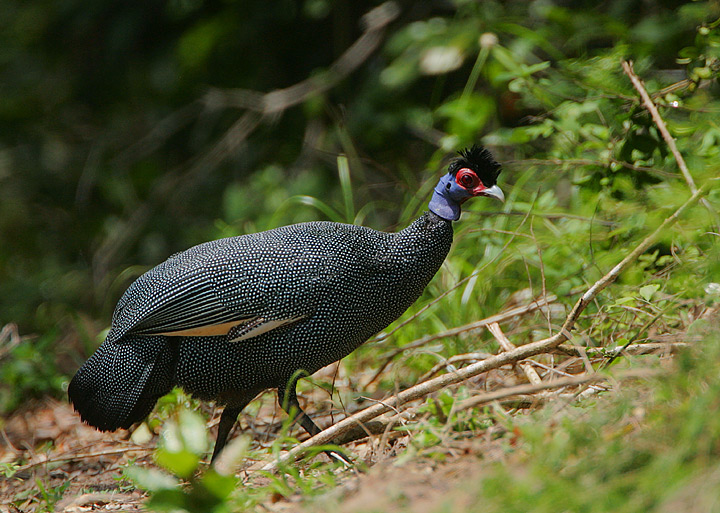
The White-breasted Guineafowl boasts a distinctive appearance that aids in its identification. Adults possess a striking white breast contrasted against a predominantly black and gray body. This stark contrast makes them relatively easy to distinguish from other guineafowl species, which typically lack the white breast. Their heads are featherless and dark, with a subtle red coloration on the skin around the eyes. Juveniles resemble adults but are generally duller, with less pronounced white areas. Both sexes appear similar, although males may be slightly larger in size. Compared to the more commonly known Helmeted Guineafowl, the White-breasted Guineafowl is smaller and lacks the helmet-like casque on its head. In flight, the guineafowl displays short, rounded wings that produce a rapid, whirring sound, contrasting with its typically terrestrial lifestyle. When perched, it often maintains an upright posture, making its white breast more conspicuous. This field mark, along with the bird's size and coloration, serves as the primary distinguishing feature for birdwatchers and researchers alike.
Having trouble telling birds apart? Upload a photo to our bird identification tool for an instant species match.
White-breasted Guineafowl Habitat and Range
Preferred Habitat
The White-breasted Guineafowl thrives in the dense lowland rainforests of West Africa, showing a preference for primary forests with rich undergrowth. It can also inhabit secondary forests, provided there is sufficient cover to offer protection and food resources. Typically found at elevations ranging from sea level to 1,000 meters, the bird requires dense foliage for foraging and nesting. Unlike some other guineafowl species, the White-breasted Guineafowl is not commonly found in open grasslands or savannahs, underscoring its dependence on the forest environment. Throughout the year, the guineafowl remains within these forested areas, showcasing a strong fidelity to its preferred habitat. Human disturbances such as logging and agriculture pose significant threats, reducing available habitat and forcing the bird into smaller and more isolated patches of forest.
Geographic Range
The White-breasted Guineafowl's range is limited to the West African region, specifically within the rainforests of Sierra Leone, Liberia, Ivory Coast, and Ghana. The bird's distribution is patchy, largely confined to areas where dense forest cover remains intact. Unlike migratory birds, the White-breasted Guineafowl is a resident species, maintaining territories year-round without extensive seasonal movements. Population density hotspots occur in protected areas and national parks, where human impact is minimized. The species' presence in these regions highlights the importance of forest conservation efforts to ensure its survival. As forests become increasingly fragmented, the range of the White-breasted Guineafowl is at risk of further reduction.
Want to know which birds visit your area? Browse our backyard birds by location guides for region-specific species lists.
What Does the White-breasted Guineafowl Eat?
The White-breasted Guineafowl's diet primarily consists of insects, seeds, and small invertebrates, making it an omnivorous bird. Insects such as ants, beetles, and termites form the bulk of its diet, particularly during the wet season when these prey items are most abundant. The bird also consumes a variety of seeds and fruits, contributing to seed dispersal within its habitat. Foraging occurs predominantly on the forest floor, where the guineafowl uses its strong legs and beak to scratch and peck through leaf litter in search of food. The bird's diet shows some seasonal variation, with a higher intake of seeds and fruits during the dry season when insects are less available. This dietary flexibility helps the White-breasted Guineafowl adapt to varying environmental conditions and resource availability.
White-breasted Guineafowl Behavior and Social Structure
The White-breasted Guineafowl exhibits social behavior, often forming small groups or flocks, especially during the wet season. These groups typically consist of family units or small flocks of up to a dozen individuals. The bird is generally shy and elusive, using the dense forest cover as protection from predators. Territorial behavior is observed, with groups maintaining and defending specific areas against intruders. During the breeding season, courtship displays include vocalizations and subtle physical gestures, though the specifics of these displays remain under-researched. The guineafowl is primarily diurnal, engaging in foraging activities during the early morning and late afternoon to avoid the heat of midday. In response to predators, the bird relies on its camouflage and rapid flight to escape, often retreating to thicker underbrush for safety.
White-breasted Guineafowl Nesting and Reproduction
The White-breasted Guineafowl nests on the ground, typically in a shallow scrape lined with leaves and other plant materials. Nesting sites are carefully selected to be well-hidden in dense undergrowth, offering protection from predators. The typical clutch size ranges from 4 to 8 eggs, with both parents often participating in incubation, which lasts approximately 24 to 28 days. After hatching, the chicks are precocial, leaving the nest shortly after birth to follow the parents. The fledging period is relatively short, with young birds becoming independent at around 4 to 5 weeks of age. The species generally has one to two broods per year, depending on environmental conditions and food availability.
White-breasted Guineafowl Sounds and Vocalizations
The White-breasted Guineafowl's vocalizations are a series of low, rhythmic calls that serve as contact calls within the flock. These calls are often described as repetitive and somewhat metallic in quality. The bird also emits sharp alarm calls when threatened, which serve to alert other group members of potential danger. While not known for a melodious song, the guineafowl participates in a dawn chorus, with groups collectively vocalizing to establish presence and territory in the early morning hours. Compared to common bird songs, its calls are more functional than musical.
Interesting Facts About the White-breasted Guineafowl
- 1The White-breasted Guineafowl is one of only two species in the genus Agelastes, the other being the Black Guineafowl.
- 2Despite its name, the White-breasted Guineafowl spends most of its life in the shadows of the forest floor.
- 3This species plays a significant role in seed dispersal, aiding in the regeneration of its rainforest habitat.
- 4The White-breasted Guineafowl is known for its secretive nature, making it a challenging bird to observe in the wild.
- 5Unlike many guineafowl, this species lacks the casque on its head, a feature seen in more common relatives like the Helmeted Guineafowl.
- 6The White-breasted Guineafowl's vocalizations are often used to maintain group cohesion within dense forest environments.
- 7This guineafowl species is notable for its reliance on pristine forest habitats, highlighting its vulnerability to deforestation.
White-breasted Guineafowl Conservation Status
Classified as Vulnerable by the IUCN, the White-breasted Guineafowl faces a declining population trend due to habitat loss and hunting pressures. Primary threats include deforestation for agriculture and logging, which reduce the bird's available habitat. Conservation efforts focus on habitat protection and sustainable forest management practices. Some regions have established protected areas and national parks to preserve critical habitats. Historical records indicate a larger range, but ongoing human activities continue to fragment and reduce suitable environments, underscoring the urgency of conservation actions.
Other Numididae Species


Birds Similar to the White-breasted Guineafowl
These species are often confused with the White-breasted Guineafowl due to similar appearance or overlapping range.