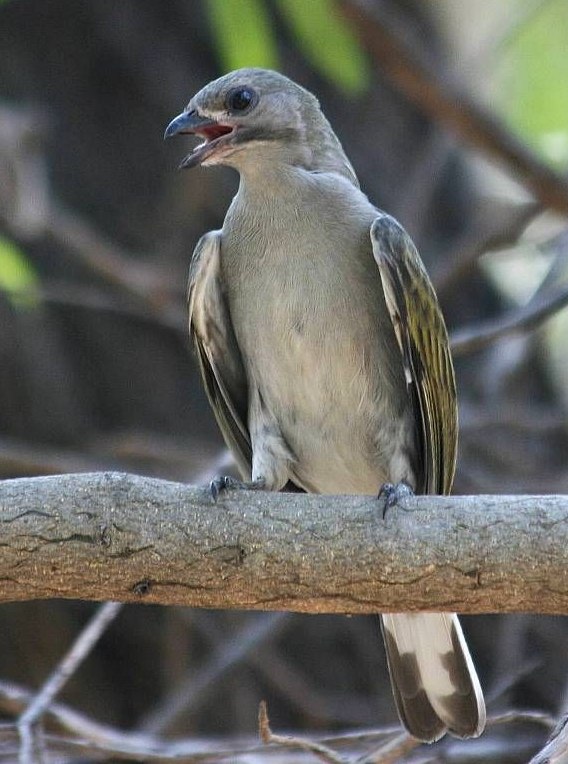
Blue-bearded Bee-eater
Nyctyornis athertoni
Order: Coraciiformes / Family: Meropidae

Wikimedia Commons
About the Blue-bearded Bee-eater
The Blue-bearded Bee-eater, scientifically known as Nyctyornis athertoni, belongs to the family Meropidae, which is renowned for its colorful and agile members. Native to the Indian subcontinent and regions of Southeast Asia, this species inhabits dense forests, open woodlands, and sometimes gardens, demonstrating remarkable adaptability. The Blue-bearded Bee-eater is a large bird, measuring approximately 34-38 cm in length, including its long tail. It stands out due to its vivid green body and distinctive blue beard that gives it its name. This bird plays a crucial ecological role as both predator and prey. By feeding on bees and other insects, it helps control pest populations, which is beneficial for the ecosystem and agricultural activities. Furthermore, the presence of this species can indicate the health of forest ecosystems, as they thrive in diverse and rich habitats. The Blue-bearded Bee-eater is primarily sedentary, though it may exhibit local movements in response to seasonal changes in food availability. During the breeding season, which typically spans from February to June, these birds become more vocal and conspicuous, engaging in aerial displays and vocalizations to establish territories and attract mates. Its vibrant plumage and distinctive calls make it a favorite among birdwatchers in its native regions. Notably, the Blue-bearded Bee-eater also participates in mixed-species flocks outside the breeding season, showcasing its social adaptability. This behavior is particularly common in the non-breeding season when these birds form loose associations with other insectivorous species, enhancing their foraging efficiency. The Blue-bearded Bee-eater showcases a fascinating example of evolutionary adaptation, both in terms of its striking appearance and its ecological interactions. It exemplifies the intricate balance within its habitat, contributing to the biodiversity of tropical and subtropical forests.
The Blue-bearded Bee-eater belongs to the family Meropidae, within the order Coraciiformes. These birds typically live average 7-12 years with a maximum recorded of 15 years..
How to Identify a Blue-bearded Bee-eater
The Blue-bearded Bee-eater is a striking bird, easily identified by its vibrant green plumage and the eponymous blue beard that extends from its throat. Adults display a rich green body with a bluish tinge on the head and throat, while the long tail features a slightly darker green hue. The blue beard is not just ornamental but also serves as a distinguishing feature, especially in identifying this species from other bee-eaters. Juveniles are similar in appearance but possess a duller and less pronounced blue beard, and their overall plumage may appear more muted. Male and female Blue-bearded Bee-eaters show little sexual dimorphism, making field identification based on sex challenging. However, males might be slightly larger in size. In flight, the bird's long wings and tail are evident, creating a sleek silhouette as it maneuvers through its forested habitats in pursuit of insects. Unlike some other bee-eaters, it is less likely to display flamboyant tail streamers, but its robust body and broad wings make it recognizable. When perched, the Blue-bearded Bee-eater adopts an upright posture, often on exposed branches, scanning for prey. Its stout bill, slightly curved and adapted for catching insects, is another key feature. The bird's sharp, alert eyes and confident posture add to its presence in its natural environment. Although it shares its habitat with other bee-eater species, the combination of size, color, and the distinctive blue beard typically prevent confusion with similar species, such as the Little Green Bee-eater or the Chestnut-headed Bee-eater.
Having trouble telling birds apart? Upload a photo to our bird identification tool for an instant species match.
Blue-bearded Bee-eater Habitat and Range
Preferred Habitat
The Blue-bearded Bee-eater thrives in a variety of habitats, primarily favoring dense, moist forests and open woodlands. These birds are regularly found in the lush tropical and subtropical forests stretching across the Indian subcontinent, including the Western Ghats and the Eastern Himalayas. They also inhabit forest edges and secondary growth areas, showing adaptability to slightly disturbed habitats. Occasionally, they venture into plantations and gardens, especially where forested areas are fragmented. This species typically occupies elevations from sea level up to about 2,000 meters, indicating its versatility in different altitudinal zones. Unlike some bee-eaters that prefer open skies, the Blue-bearded Bee-eater is comfortable in the forest canopy and often seen perched on high branches, from where it launches into impressive aerial pursuits of flying insects. While generally preferring rural and forested environments, these birds have been known to adapt to semi-urban areas if suitable habitats are available nearby. Seasonal shifts in habitat usage are minimal for the Blue-bearded Bee-eater, reflecting its largely sedentary nature. However, local movements may occur in response to changes in food supply, with the birds venturing into more open areas during certain times of the year.
Geographic Range
The range of the Blue-bearded Bee-eater spans across the Indian subcontinent and extends into Southeast Asia. These birds are resident in India, Nepal, Bhutan, Bangladesh, and parts of Myanmar, Thailand, and Laos. In India, they are found throughout the Western Ghats, the Eastern Ghats, and the Himalayan foothills, extending eastward into Assam and Arunachal Pradesh. Their distribution also includes regions of southern China, particularly in areas that border Myanmar. Within their range, these bee-eaters are generally non-migratory, but they may exhibit local movements in response to the availability of prey and seasonal climate variations. Population density hotspots include the rich biodiverse areas of the Western Ghats and northeastern India, where they benefit from the dense forest cover and abundant insect life. In areas where their habitat overlaps with that of other bee-eater species, the Blue-bearded Bee-eater maintains its niche by utilizing different ecological strategies and preferences, such as favoring more forested and less open areas. While not considered migratory, there is some evidence of altitudinal movements, with populations in higher elevations moving to lower altitudes during colder months.
Want to know which birds visit your area? Browse our backyard birds by location guides for region-specific species lists.
What Does the Blue-bearded Bee-eater Eat?
The Blue-bearded Bee-eater's diet primarily consists of bees and other flying insects, making it an adept aerial predator. It employs a foraging technique known as hawking, where it captures prey in flight with remarkable agility and precision. This bird is frequently observed hunting from a perch, launching into the air to snatch insects mid-flight before returning to the perch to consume its catch. While bees dominate its diet, it also targets other insects such as wasps, dragonflies, and butterflies, showcasing its adaptability to the available prey. Seasonal variations in diet occur, with the bee-eater consuming more diverse insect types when bee populations decline. Prey size varies, but the bird typically targets medium-sized insects that are manageable to capture and handle. Feeding usually occurs during daylight hours, with heightened activity in the early morning and late afternoon when insects are most active. The bee-eater's sharp, slightly curved bill is well-adapted for grasping and subduing its prey, allowing it to remove stingers from bees and wasps before consumption, minimizing the risk of injury. This dietary specialization not only underscores its role in controlling insect populations but also reflects the intricate ecological dynamics between predator and prey within its habitat.
Blue-bearded Bee-eater Behavior and Social Structure
The Blue-bearded Bee-eater exhibits a fascinating range of behaviors, reflecting its adaptability and ecological niche. These birds are generally solitary or found in pairs, particularly during the breeding season, when they establish territories and engage in elaborate courtship displays. Courtship involves aerial acrobatics and vocalizations, with males often bringing food to females as part of the bonding process. Outside of the breeding season, Blue-bearded Bee-eaters may form loose associations with other insectivorous birds, participating in mixed-species flocks to enhance foraging efficiency and predator avoidance. These flocks allow the bee-eaters to exploit food resources more effectively while benefiting from the collective vigilance of the group. The species exhibits strong territorial behavior during breeding, with pairs defending nesting sites from intruders. Their response to predators involves a combination of vocal alarms and evasive maneuvers, often retreating to dense foliage or high perches to avoid detection. Daily activity patterns are largely diurnal, with peak activity in the early morning and late afternoon, coinciding with the periods of highest insect activity. The Blue-bearded Bee-eater's ability to adapt to various social and environmental contexts highlights its role in the complex web of forest ecosystems.
Blue-bearded Bee-eater Nesting and Reproduction
Nesting for the Blue-bearded Bee-eater involves excavating tunnels in sandy banks or earthen cliffs, where they create burrows to lay their eggs. These birds are cavity nesters, and the burrow serves as a secure and concealed site for raising their young. The entrance to the tunnel is typically circular and may extend several feet into the bank, terminating in a nesting chamber where the eggs are laid. The clutch size generally ranges from 3 to 5 eggs, with both parents sharing the responsibilities of incubation and feeding. Incubation lasts about 21 to 24 days, after which the chicks hatch, altricial and dependent on parental care. Both male and female bee-eaters participate actively in feeding and protecting the chicks, ensuring a steady supply of insects to support their rapid growth. The fledging period lasts approximately 30 to 35 days, during which the young birds develop flight feathers and learn essential foraging skills. The Blue-bearded Bee-eater typically raises one brood per year, although favorable conditions may occasionally allow for a second. The choice of nesting sites in eroded banks or cliffs underscores the species’ reliance on specific habitat features, which can be impacted by environmental changes and human activities.
Blue-bearded Bee-eater Sounds and Vocalizations
The vocalizations of the Blue-bearded Bee-eater are distinctive, consisting of a series of loud, clear calls often described as a rapid 'kree-kree-kree.' These calls serve multiple functions, including mate attraction, territory establishment, and communication within pairs. The pitch is relatively high, and the rhythm can vary in pace, depending on the context of the vocalization. In addition to these primary calls, the bee-eater may emit softer chattering notes during social interactions or while perched. Alarm calls are sharper and more insistent, designed to alert nearby individuals to potential threats. The bird's vocal repertoire is not as varied or melodic as that of other songbirds, yet it plays a crucial role in maintaining pair bonds and coordinating activities. During the dawn chorus, the Blue-bearded Bee-eater is an active participant, contributing its voice to the vibrant soundscape of its forest habitat. The calls of the Blue-bearded Bee-eater are as much a part of its identity as its striking appearance, underscoring the importance of sound in its ecological interactions.
Interesting Facts About the Blue-bearded Bee-eater
- 1The Blue-bearded Bee-eater is the largest bee-eater species in Asia, measuring up to 38 cm in length.
- 2Unlike many other bee-eaters, the Blue-bearded Bee-eater is often solitary or found in pairs.
- 3This species can remove stingers from bees and wasps with its specialized bill before eating them.
- 4The Blue-bearded Bee-eater's vivid blue beard is a unique feature not shared by many of its relatives.
- 5These birds can dig burrows up to 1 meter long in sandy banks for nesting.
- 6Their loud calls are often among the first sounds heard at daybreak in their forest habitats.
- 7The Blue-bearded Bee-eater can be found in both lowland forests and montane regions up to 2,000 meters.
Blue-bearded Bee-eater Conservation Status
The Blue-bearded Bee-eater is currently classified as a species of Least Concern by the IUCN, indicating a stable population trend. However, like many forest-dependent species, it faces threats from habitat loss and degradation due to deforestation, agricultural expansion, and urban development. These pressures can lead to the fragmentation of habitats, which poses a significant risk to their ecological niche. Conservation efforts aimed at safeguarding forested areas and promoting sustainable land-use practices are crucial for preserving the habitats of the Blue-bearded Bee-eater. In regions such as the Western Ghats, protected areas and wildlife sanctuaries provide important refuges for this and other forest species. Historical population changes are not well-documented, but the bird's adaptability to slightly altered habitats suggests some resilience to environmental changes. Continued monitoring of population trends and habitat conditions is essential to ensure that the Blue-bearded Bee-eater remains a thriving component of its ecosystem.