
Blue Vanga
Cyanolanius madagascarinus
Order: Passeriformes / Family: Vangidae
Wikimedia Commons
About the Blue Vanga
The Blue Vanga, Cyanolanius madagascarinus, is a captivating bird species within the family Vangidae, native exclusively to Madagascar. This medium-sized passerine is notable for its vibrant blue plumage, making it a standout resident of the tropical forests it inhabits. It plays a crucial role in its ecosystem by controlling insect populations, which helps maintain the ecological balance of its habitat. The Blue Vanga thrives primarily in the eastern rainforests of Madagascar, where dense canopy layers provide both food and protection. This species is well-adapted to its environment, showcasing a remarkable ability to forage in the forest's complex structure. Throughout the year, the Blue Vanga displays different behavioral patterns aligned with seasonal changes. During the wetter months, it becomes more active in the upper canopy, taking advantage of the abundance of insects, whereas, in drier periods, it might venture into more open areas in search of food. Its ecological significance cannot be overstated, as the Blue Vanga contributes to the health of Madagascar's forest ecosystems. It is not only an indicator of the forest's overall health but also a critical component of the island's rich avian diversity. The bird's presence is a testament to the unique fauna that Madagascar supports, making its conservation essential for maintaining the island's biodiversity.
The Blue Vanga belongs to the family Vangidae, within the order Passeriformes. These birds typically live average 6-8 years with a max recorded of 12 years.
How to Identify a Blue Vanga
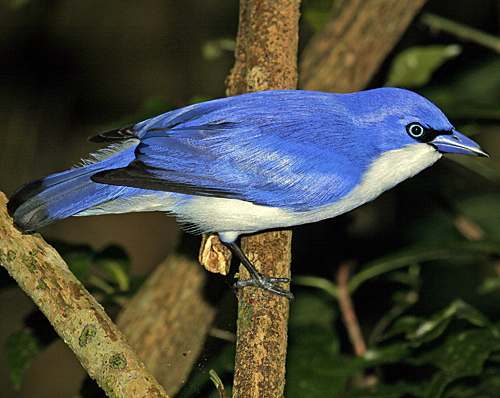
Adult Blue Vangas are easily identifiable by their cobalt blue upperparts and contrasting white underparts. The intensity of the blue is particularly striking and can vary slightly with light conditions. The males and females are similar in appearance, though males might exhibit slightly brighter plumage. Juveniles, however, often appear duller, with a more muted blue and a hint of brown on the wings and back. The Blue Vanga's stout, hooked bill is another distinctive feature, aiding in its insectivorous diet. It can be confused with other forest-dwelling birds, but its unique coloration and size, approximately 24 cm in length, help distinguish it from others. In flight, the Blue Vanga presents a compact silhouette with rapid, direct flight patterns. When perched, it often adopts a relaxed posture, blending seamlessly into the dense foliage unless its bright blue feathers catch the sunlight.
Having trouble telling birds apart? Upload a photo to our bird identification tool for an instant species match.
Blue Vanga Habitat and Range
Preferred Habitat
The Blue Vanga predominantly inhabits Madagascar's eastern rainforests, thriving in humid, densely wooded environments. It can be found from lowland areas up to mid-elevation forests, typically not exceeding 1,500 meters above sea level. This bird shows a strong preference for evergreen forests, where it navigates skillfully through the canopy. Though primarily a forest dweller, it occasionally appears at forest edges and secondary growth areas, especially when searching for food. Unlike some other species, the Blue Vanga is less common in urban or highly disturbed areas, preferring the tranquility and resources available in undisturbed natural habitats. Seasonally, there might be minor shifts within its habitat, but it rarely strays far from its preferred forest home.
Geographic Range
The Blue Vanga is endemic to Madagascar, with its range primarily concentrated along the island's eastern coast, from the northern regions near Antsiranana down to the southern forests near Tolagnaro. It does not undertake long migrations, instead remaining within its habitat throughout the year. However, some local movements may occur in response to food availability and climatic conditions. Dense populations are typically found in protected areas like the Masoala National Park and Ranomafana National Park, where conservation efforts help maintain suitable habitats. Outside these hotspots, the Blue Vanga's distribution can be patchy, with populations varying in density depending on habitat quality and human impact.
Want to know which birds visit your area? Browse our backyard birds by location guides for region-specific species lists.
What Does the Blue Vanga Eat?
The Blue Vanga primarily feeds on insects, which it captures with precision using its strong, hooked bill. Its diet includes a variety of arthropods such as beetles, caterpillars, and spiders. During the rainy season, when insect populations surge, the Blue Vanga takes advantage of the abundance, often engaging in active foraging sessions throughout the day. In drier months, it may expand its diet to include small fruits and seeds, ensuring a consistent nutritional intake. Its foraging technique involves methodically searching through leaves and branches, occasionally sallying out to catch flying insects. Prey size varies, but the Blue Vanga typically targets small to medium-sized insects, ensuring efficient consumption and minimal handling time.
Blue Vanga Behavior and Social Structure
The Blue Vanga exhibits a fascinating array of behaviors that reflect its adaptation to Madagascar's forests. It is generally a solitary or paired bird, particularly outside the breeding season. During this time, it establishes territories, often marked by vocal displays and physical presence. Courtship displays include mutual preening and soft call exchanges, strengthening pair bonds. While not highly social, the Blue Vanga may join mixed-species foraging flocks, benefiting from collective vigilance against predators. Its daily activities include foraging during the cooler morning and late afternoon hours, avoiding the midday heat. When threatened, the Blue Vanga relies on its agility to navigate the canopy swiftly, often vocalizing sharp alarm calls to alert others of potential dangers.
Blue Vanga Nesting and Reproduction
The Blue Vanga builds cup-shaped nests, meticulously constructed with twigs, leaves, and spider webs, which provide both structure and camouflage. These nests are typically situated high in the forest canopy, securely attached to the branches of tall trees. A typical clutch consists of two to three eggs, with both parents sharing incubation duties over a period of approximately 14 to 16 days. Once hatched, the chicks remain in the nest for another 18 to 20 days before fledging. Parental care continues post-fledging, with both adults involved in feeding and protecting the young. The Blue Vanga usually raises one brood per year, although in exceptionally favorable conditions, a second brood might be attempted.
Blue Vanga Sounds and Vocalizations
The Blue Vanga's song is a melodious series of short whistles and trills, often delivered from a concealed perch within the canopy. This song serves both as a territorial marker and a mating call, primarily heard during the early morning hours. Its call notes are brief and sharp, serving as contact calls between mates or family members. Alarm calls are more abrupt, designed to alert nearby birds of threats. During the dawn chorus, the Blue Vanga's song adds a clear, sweet tone to the symphony of the forest, standing out against the backdrop of other avian sounds.
Interesting Facts About the Blue Vanga
- 1The Blue Vanga is the only member of its genus Cyanolanius, highlighting its unique evolutionary path.
- 2It often forages with other species like the Madagascar Blue Pigeon, benefiting from group vigilance.
- 3Despite its vibrant colors, the Blue Vanga's nest is well-camouflaged, blending seamlessly into the foliage.
- 4The Blue Vanga's population is stable despite being restricted to Madagascar, thanks to effective conservation areas.
- 5The species' diet shift from insects to fruits in the dry season showcases its adaptability to Madagascar's climate.
Blue Vanga Conservation Status
The Blue Vanga currently holds a status of Least Concern according to the IUCN Red List, with populations considered stable. However, habitat destruction due to deforestation poses a significant threat to its future. Conservation efforts focus on habitat protection, particularly in Madagascar's national parks and reserves, where logging and land conversion are controlled. Historical population changes have shown resilience, but continued habitat degradation could alter this trend. Raising awareness and promoting sustainable land use practices are crucial to ensuring the long-term survival of this vibrant species.
Other Vangidae Species


Birds Similar to the Blue Vanga
These species are often confused with the Blue Vanga due to similar appearance or overlapping range.