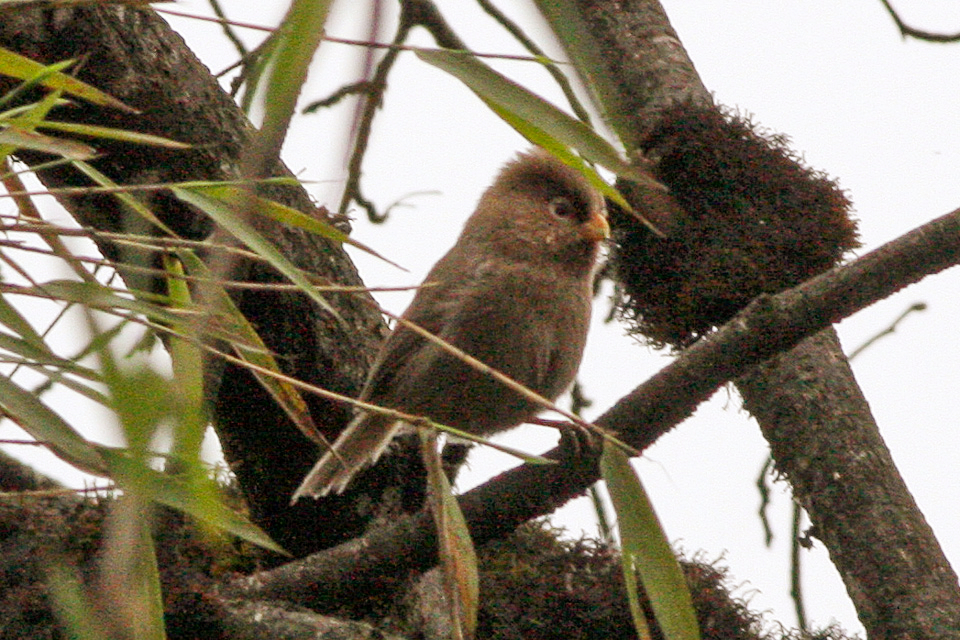
Brown Parrotbill
Cholornis unicolor
Order: Passeriformes / Family: Sylviidae

Wikimedia Commons
About the Brown Parrotbill
The Brown Parrotbill (Cholornis unicolor) is a captivating member of the Sylviidae family, a group of birds known for their vocal capabilities and complex social structures. Found primarily in the dense bamboo forests of the eastern Himalayas, this parrotbill plays a crucial role in the ecosystem by aiding in seed dispersal and maintaining insect populations. Its presence is particularly noted across regions such as Bhutan, Nepal, and parts of northeastern India. This bird thrives in environments with abundant undergrowth and dense foliage, which provide both food and protection from predators.
Ecologically, the Brown Parrotbill is significant as it forms a vital part of the food web. It preys on a variety of insects, thus controlling their populations, while also serving as prey for larger avian predators. The parrotbill's preference for bamboo forests has made it an important species for studying the ecological health of these unique habitats. During the breeding season, typically from April to June, these birds become particularly active, engaging in elaborate courtship displays and territorial defense.
Beyond its ecological contributions, the Brown Parrotbill is a bird of interest for ornithologists and bird watchers alike due to its unique vocalizations and social behaviors. The species exhibits a wide range of calls and songs, which they use to communicate within their flocks. These vocalizations are not only fascinating to study but also serve as a key characteristic for identifying the species in the wild. Understanding the behavior and ecology of the Brown Parrotbill can provide insights into the broader dynamics of forest ecosystems in the regions it inhabits.
The Brown Parrotbill belongs to the family Sylviidae, within the order Passeriformes. These birds typically live average 4-6 years, with a maximum recorded of 8 years..
How to Identify a Brown Parrotbill
The Brown Parrotbill is a medium-sized bird, measuring approximately 18 cm in length, with a predominantly brown plumage that provides excellent camouflage against the forest backdrop. Adults display a uniform brown coloration on the upperparts, with a slightly lighter, buffy tone on the underparts. This bird's stout bill is a defining feature, adapted for foraging among dense foliage.
Juveniles resemble adults but may show slightly duller plumage. There are no significant sexual dimorphisms; males and females appear similar in coloration and size, which can make field identification challenging without behavioral observation. However, during the breeding season, males may exhibit more pronounced vocal activity.
The Brown Parrotbill can be distinguished from similar species, such as the Fulvous Parrotbill, by its more uniform brown coloring and lack of prominent facial markings. In flight, it presents a somewhat chunky silhouette with rapid wingbeats, while perched, it often adopts an upright posture, clinging to vertical bamboo stalks.
Having trouble telling birds apart? Upload a photo to our bird identification tool for an instant species match.
Brown Parrotbill Habitat and Range
Preferred Habitat
The Brown Parrotbill inhabits dense bamboo forests, often found at elevations ranging from 1,500 to 3,500 meters. These forests provide the thick undergrowth necessary for nesting and foraging. In regions like the eastern Himalayas, the bird is particularly associated with mixed coniferous and broadleaf forests where bamboo species are prevalent.
Though the Brown Parrotbill primarily resides in these forested areas, it may occasionally venture into adjacent scrublands, especially during the non-breeding season. It shows a preference for rural over urban environments, as it requires the cover provided by dense vegetation for protection and feeding.
Geographic Range
The Brown Parrotbill's range extends across the eastern Himalayas, with established populations in Bhutan, northeastern India, and parts of Nepal. The bird's range may slightly shift in response to seasonal changes, though it is largely sedentary, with minimal long-distance migration observed. Population densities tend to be higher in regions where bamboo forests are dense and thriving, such as the protected areas in Bhutan and the Arunachal Pradesh region of India.
Want to know which birds visit your area? Browse our backyard birds by location guides for region-specific species lists.
What Does the Brown Parrotbill Eat?
Primarily insectivorous, the Brown Parrotbill feeds on a variety of insects, including beetles, caterpillars, and spiders. Its diet may vary seasonally, with a greater emphasis on insects during the breeding season when the demand for protein is high. During other times of the year, it may also consume seeds and small fruits, particularly those of bamboo plants.
The Brown Parrotbill employs an active foraging technique, often seen clambering through bamboo thickets in search of prey. It uses its strong, curved bill to pry insects from bark crevices and foliage. Foraging typically occurs during the cooler periods of the day, such as early morning and late afternoon.
Brown Parrotbill Behavior and Social Structure
The Brown Parrotbill is a highly social species, often observed in small flocks of up to 20 individuals. These flocks engage in cooperative foraging and exhibit intricate social interactions. During the breeding season, pairs become more territorial, defending nesting sites with vocal displays and physical confrontations.
Courtship involves a series of complex displays, including wing flicking and vocal duets, which strengthen pair bonds. The Brown Parrotbill is diurnal, with peak activity occurring during the cooler parts of the day. When threatened by predators, flocks employ a coordinated mobbing behavior, using loud alarm calls to deter intruders.
Brown Parrotbill Nesting and Reproduction
The Brown Parrotbill constructs its nest within dense bamboo clumps, using materials such as grass, leaves, and fine twigs. These cup-shaped nests are typically positioned several meters above ground, providing safety from ground-based predators. The typical clutch size ranges from two to four eggs, with both parents sharing incubation duties.
Incubation lasts approximately 14 days, followed by a fledging period of about two weeks. During this time, both parents actively feed and protect the chicks. The species may produce two broods per year, depending on environmental conditions and food availability.
Brown Parrotbill Sounds and Vocalizations
The primary song of the Brown Parrotbill is a series of melodious notes, often described as a bright, tinkling sequence that can be heard throughout its forest habitat. These songs serve both to establish territory and to strengthen pair bonds during the breeding season.
The bird also produces various call notes, including soft chips and whistles used in flock communication. Alarm calls are sharp and piercing, designed to alert other members of the flock to potential danger.
Interesting Facts About the Brown Parrotbill
- 1The Brown Parrotbill's strong bill is specifically adapted for prying into bamboo, a preferred foraging substrate.
- 2The species exhibits a unique cooperative breeding behavior, with younger birds often assisting in raising subsequent broods.
- 3Brown Parrotbills have been recorded living in flocks of up to 30 individuals outside of the breeding season.
- 4Their vocalizations are highly varied, with some local dialects unique to specific geographic regions.
- 5The Brown Parrotbill is one of the few bird species able to thrive in dense bamboo forests, which are often impenetrable to larger birds.
Brown Parrotbill Conservation Status
Currently, the IUCN lists the Brown Parrotbill as a species of Least Concern, with stable population trends. However, habitat destruction, particularly the clearing of bamboo forests, poses a significant threat. Conservation efforts focus on protecting these habitats through the establishment of reserves and sustainable forestry practices. Historical data suggest that while populations have faced pressure from habitat loss, they have shown resilience in protected areas.