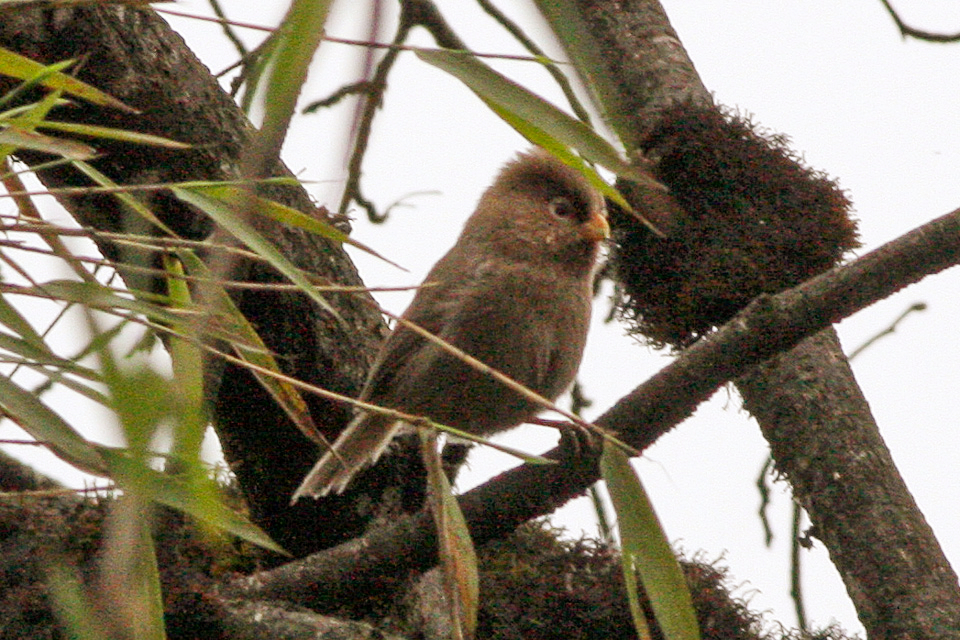
Brown-throated Fulvetta
Fulvetta ludlowi
Order: Passeriformes / Family: Sylviidae

Wikimedia Commons
About the Brown-throated Fulvetta
The Brown-throated Fulvetta (Fulvetta ludlowi) is a small songbird belonging to the Sylviidae family, found predominantly in the temperate and subtropical forests of Asia. This bird is a key component of the ecosystem, contributing to insect control and seed dispersal. The Brown-throated Fulvetta is a resident of mountainous regions, particularly favoring the dense undergrowth of forested areas. Its presence is notable in countries such as Bhutan, China, India, Myanmar, and Nepal, where it inhabits the elevations ranging from 1,500 to 2,700 meters. In these regions, the bird’s population thrives in the mixed deciduous and evergreen forests, areas rich in rhododendrons, oaks, and bamboo thickets. Seasonal behavior of the Brown-throated Fulvetta includes forming mixed-species flocks during the non-breeding season, which allows it to efficiently forage while reducing the risk of predation. As a social bird, the Brown-throated Fulvetta adapts well to seasonal changes, adjusting its foraging and nesting habits to the availability of resources. Its ecological role cannot be overstated; by feeding on insects, it helps to maintain a balanced ecosystem. This bird's presence serves as an indicator of healthy forest environments, as it tends to avoid disturbed habitats. The Brown-throated Fulvetta also partakes in the important role of seed dispersal, contributing to the regeneration of plant life in its habitat. Its adaptability to different food sources throughout the year showcases its resilience and importance in the forest ecosystems of Asia. Despite habitat changes, this species continues to play a vital role in its environment, showcasing a remarkable adaptability that ensures its survival and the health of the forests it inhabits.
The Brown-throated Fulvetta belongs to the family Sylviidae, within the order Passeriformes. These birds typically live average 5-6 years with a max recorded of 8 years.
How to Identify a Brown-throated Fulvetta
The Brown-throated Fulvetta is a small, agile bird with a length of approximately 13 to 14 centimeters. Adult plumage features a distinctive brown throat and a finely streaked crown, which sets it apart from similar species. The upperparts are a deep olive-brown, while the underparts are paler, often with a hint of buff. The tail is long, often held upright, displaying a narrow tip. Juveniles resemble adults but with slightly duller plumage and less pronounced streaking on the crown. Males and females are similar in coloration, offering little sexual dimorphism. However, males may appear slightly larger and bolder in the crown streaking during the breeding season. In flight, the Brown-throated Fulvetta displays a rapid, undulating pattern, characteristic of small passerines. When perched, it often adopts a horizontal stance, maintaining balance with its long tail. It can often be confused with other fulvettas, but its unique crown pattern and brown throat are distinguishing features.
Having trouble telling birds apart? Upload a photo to our bird identification tool for an instant species match.
Brown-throated Fulvetta Habitat and Range
Preferred Habitat
The Brown-throated Fulvetta primarily inhabits montane forests, thriving in areas with dense undergrowth and a mixture of deciduous and evergreen trees. It is commonly found in rhododendron and oak forests, as well as bamboo thickets. Its preferred elevation ranges from 1,500 to 2,700 meters, making it a characteristic species of mountainous regions. During seasonal shifts, the Brown-throated Fulvetta may descend slightly to lower elevations but generally remains within the forested areas. Unlike some bird species that venture into urban or heavily cultivated areas, this fulvetta remains closely tied to forest habitats, relying on the thick vegetation for foraging and nesting.
Geographic Range
The Brown-throated Fulvetta's range spans across several countries in Asia, predominantly within the Himalayan region. Its breeding range includes Bhutan, northeastern India, northern Myanmar, southern China, and Nepal. The bird is largely resident throughout its range, shifting only slightly in elevation in response to seasonal changes in food availability. It favors the forested regions of the eastern Himalayas and extends into parts of southwest China, particularly Yunnan and Sichuan provinces. Population density is highest in areas with dense forest cover, where it can find ample food and nesting sites. While not a migratory species, its movements are closely tied to the altitudinal gradients of its montane habitat.
Want to know which birds visit your area? Browse our backyard birds by location guides for region-specific species lists.
What Does the Brown-throated Fulvetta Eat?
The Brown-throated Fulvetta primarily feeds on insects, including caterpillars, beetles, and other arthropods, which it forages from the forest floor and low vegetation. During the breeding season, insects form the bulk of its diet, providing the necessary protein for chick development. In the non-breeding season, its diet diversifies to include seeds and berries, particularly from bamboo and rhododendron. The bird employs a gleaning foraging technique, picking insects off leaves and branches with precision. It is also known to join mixed-species flocks, which enhances its foraging efficiency. The fulvetta's feeding schedule is diurnal, peaking in the early morning and late afternoon.
Brown-throated Fulvetta Behavior and Social Structure
The Brown-throated Fulvetta exhibits a social and cooperative behavior, often seen in mixed-species foraging flocks during the non-breeding season. This flocking behavior reduces predation risk and increases foraging success. During the breeding season, however, it becomes more territorial, with pairs establishing and defending nesting territories. Courtship displays include song and visual displays, with males actively chasing females through the forest canopy. The Brown-throated Fulvetta is diurnal, with peak activity occurring in the morning and late afternoon. In the presence of predators, it emits a series of sharp alarm calls, prompting flocks to seek cover collectively. Its daily routine includes periods of active foraging interspersed with rest in dense foliage.
Brown-throated Fulvetta Nesting and Reproduction
The Brown-throated Fulvetta constructs its nest low to the ground, typically within dense shrubs or bamboo. The nest is cup-shaped, made from fine grass, rootlets, and leaves, lined with softer materials like feathers. Nesting sites are chosen for their concealment and proximity to food sources. The typical clutch consists of two to four eggs, which are incubated by the female for about 13 to 15 days. Both parents participate in feeding the chicks, which fledge approximately 12 to 14 days after hatching. The fulvetta usually raises one or two broods per year, depending on environmental conditions.
Brown-throated Fulvetta Sounds and Vocalizations
The Brown-throated Fulvetta's song is a series of high-pitched, melodious whistles and trills, often delivered from a concealed perch within the forest canopy. The song is variable in rhythm and pitch, providing a cheerful ambiance to its habitat. Its call notes are sharp and distinctive, serving as communication within mixed-species flocks. Alarm calls are urgent and repeated, signaling the presence of predators. During the dawn chorus, the fulvetta's song stands out as one of the more prominent voices, blending seamlessly with the symphony of the forest.
Interesting Facts About the Brown-throated Fulvetta
- 1The Brown-throated Fulvetta is known for forming mixed-species flocks, enhancing survival and foraging efficiency.
- 2Despite its small size, the Brown-throated Fulvetta can cover large territories in search of food, often up to 1.5 kilometers.
- 3The fulvetta's distinctive brown throat and streaked crown help camouflage it against the forest floor.
- 4This species is a proficient seed disperser, playing a crucial role in maintaining forest biodiversity.
- 5The Brown-throated Fulvetta's song is a common sound in Himalayan forests, often heard before the bird is seen.
Brown-throated Fulvetta Conservation Status
The Brown-throated Fulvetta holds a status of Least Concern according to the IUCN Red List, with populations considered stable across its range. Despite the pressures of habitat loss due to deforestation, it remains relatively resilient due to its adaptability to different forest types. However, continued conservation efforts are essential to maintain its habitat, particularly in areas facing rapid deforestation. Historical population levels have remained stable, but ongoing monitoring is necessary to ensure this species does not become threatened.