
Chestnut-bellied Cotinga
Doliornis remseni
Order: Passeriformes / Family: Cotingidae

Wikimedia Commons
About the Chestnut-bellied Cotinga
The Chestnut-bellied Cotinga (Doliornis remseni) is a captivating avian species belonging to the Cotingidae family, known for its vibrant plumage and enigmatic presence. This medium-sized bird inhabits the cloud forests of the Andes, primarily found in Colombia and Ecuador. These regions provide the dense, humid canopy that the species favors, offering both food and shelter. The Chestnut-bellied Cotinga plays an integral role in its ecosystem by aiding in seed dispersal, a crucial process for the maintenance of forest biodiversity. Due to its specialized habitat requirements, this cotinga serves as an indicator species for the health of Andean forest ecosystems.
The ecological significance of the Chestnut-bellied Cotinga extends beyond its role as a seed disperser. Its presence in the Andean cloud forests underscores the interconnectedness of species within these unique biomes. As a bird residing in high-altitude environments, it contributes to the overall avian diversity and richness of the region. These forests, characterized by their high humidity and persistent cloud cover, support a myriad of life forms, and the cotinga is a vital component of this intricate web.
Seasonal behaviors of the Chestnut-bellied Cotinga are closely linked to the availability of resources within the cloud forest. During the breeding season, which coincides with periods of fruit abundance, pairs can be observed engaging in courtship displays and nest building. In contrast, non-breeding seasons may see individuals foraging more extensively across their range, adjusting their movements in response to shifting food supplies. The cotinga's elusive nature and preference for dense forest cover make it a challenging species to study, yet its significance in the Andean ecosystem cannot be overstated.
The Chestnut-bellied Cotinga belongs to the family Cotingidae, within the order Passeriformes. These birds typically live averages 6-8 years, with a maximum recorded of 10 years..
How to Identify a Chestnut-bellied Cotinga
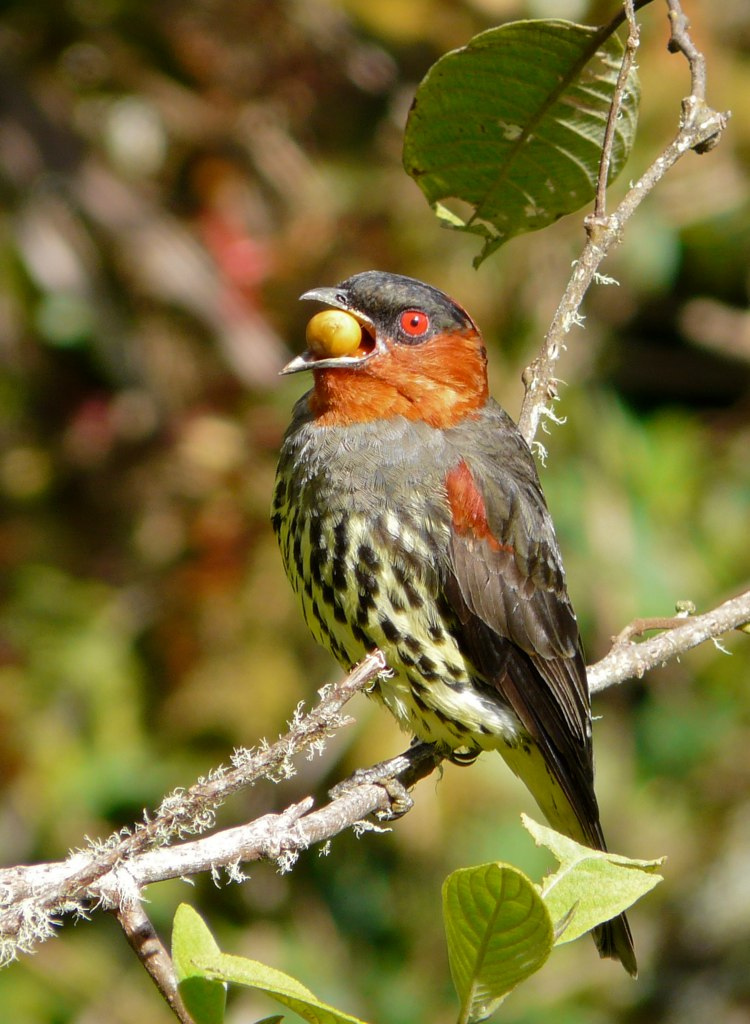
The Chestnut-bellied Cotinga exhibits striking plumage that makes it a distinctive species within its range. Adult males possess a deep chestnut-colored belly, contrasted by a darker bluish-gray head, back, and wings. This color combination is not only visually appealing but also serves as effective camouflage among the shadows and foliage of its forest habitat. Females and juveniles, while sharing similar patterns, display slightly duller coloration, with the chestnut regions appearing more muted. Juveniles often have more diffuse markings, lacking the crisp color separation seen in adults.
In terms of size, the Chestnut-bellied Cotinga measures approximately 18-20 cm in length, with a wingspan that allows for agile navigation through dense vegetation. The species' silhouette in flight is characterized by broad wings and a relatively short tail, features that facilitate maneuverability within its forested environment. When perched, the cotinga often adopts a slightly hunched posture, with its head held low, blending seamlessly into the branches and leaves.
While there may be potential for confusion with other members of the Cotingidae family, the chestnut belly and distinctive color pattern serve as reliable field marks. Compared to other sympatric cotingas, such as the Red-ruffed Fruitcrow or the Andean Cock-of-the-rock, Doliornis remseni is considerably smaller and less conspicuous, often requiring a keen eye and patience for successful identification.
Having trouble telling birds apart? Upload a photo to our bird identification tool for an instant species match.
Chestnut-bellied Cotinga Habitat and Range
Preferred Habitat
The Chestnut-bellied Cotinga primarily inhabits the montane cloud forests of the Andes, thriving at elevations ranging from 2,200 to 3,300 meters. These forests are characterized by their dense vegetation, high humidity, and persistent cloud cover, creating a unique microclimate that supports diverse flora and fauna. Within these habitats, the cotinga favors areas with abundant fruiting trees, which provide both food and nesting sites.
Seasonal shifts in habitat preference are subtle yet significant. During the breeding season, individuals may concentrate in regions with higher fruit availability, while outside of this period, they might range more widely to exploit different food sources. Unlike other avian species, the Chestnut-bellied Cotinga shows little tendency to move into urban or heavily disturbed areas, maintaining a strong preference for pristine forest environments.
The cotinga's reliance on specific habitat conditions highlights its sensitivity to environmental changes. As forests face pressures from human encroachment and climate change, the preservation of these high-altitude ecosystems becomes even more critical for the survival of species like the Chestnut-bellied Cotinga.
Geographic Range
The range of the Chestnut-bellied Cotinga is restricted to the Andes of northern South America, predominantly within Colombia and Ecuador. In Colombia, its presence is noted in regions such as the Eastern and Central Cordilleras, where the montane cloud forests provide ideal conditions for its survival. Moving southward, the bird's range extends into northern Ecuador, particularly in areas like the Pichincha and Imbabura provinces.
The cotinga is largely sedentary, with no significant long-distance migration patterns reported. However, there may be altitudinal movements in response to seasonal changes in food availability, with individuals potentially descending to slightly lower elevations during harsh weather conditions or when fruit is scarce at higher altitudes.
Population density is typically low, with the species being considered uncommon throughout much of its range. Specific hotspots, where the cotinga might be more frequently observed, include protected areas and national parks that conserve large tracts of cloud forest. The species' limited distribution and specific habitat requirements underscore its vulnerability to habitat loss and fragmentation.
Want to know which birds visit your area? Browse our backyard birds by location guides for region-specific species lists.
What Does the Chestnut-bellied Cotinga Eat?
The diet of the Chestnut-bellied Cotinga primarily consists of fruit, which it forages from the diverse array of fruiting trees within its cloud forest habitat. This frugivorous diet plays a crucial role in the cotinga's ecology, as it aids in the dispersal of seeds across the forest floor, facilitating plant regeneration and forest dynamics.
During the breeding season, when fruit is abundant, the cotinga can be observed actively feeding in the canopy, often plucking ripe fruit with precision. The size of the fruit consumed varies, but typically includes small to medium-sized berries and drupes. In periods of fruit scarcity, the cotinga may supplement its diet with insects, gleaned from leaves and branches, providing necessary protein.
The feeding schedule of the Chestnut-bellied Cotinga is influenced by the availability of food resources, with peak foraging activity occurring in the morning and late afternoon when temperatures are cooler and light conditions optimal. This feeding pattern allows the cotinga to maximize energy intake while minimizing exposure to potential predators.
Chestnut-bellied Cotinga Behavior and Social Structure
The Chestnut-bellied Cotinga exhibits a range of behaviors that are both fascinating and indicative of its ecological niche. Socially, the cotinga is typically observed alone or in pairs, especially during the breeding season when pairs engage in courtship displays. These displays often involve vocalizations and physical demonstrations, with individuals showcasing their plumage and agility.
Territoriality is a significant aspect of the cotinga's behavior, with males often defending specific areas rich in fruiting trees. This territorial defense is crucial during the breeding season, ensuring access to vital resources for themselves and their mates. Outside of the breeding season, the cotinga may exhibit more relaxed territorial boundaries, occasionally forming loose associations with other frugivorous birds when foraging.
In response to predators, the cotinga relies on its excellent camouflage and stealthy movements through the canopy. It tends to remain motionless when danger is perceived, blending into the foliage. Daily activity patterns show that the cotinga is most active during the early morning and late afternoon, with a period of rest during the hottest part of the day.
Chestnut-bellied Cotinga Nesting and Reproduction
The nesting habits of the Chestnut-bellied Cotinga are closely tied to its forest environment. Nests are typically cup-shaped and situated in the forks of trees, well-hidden among the leaves and branches to provide protection from predators. The construction of the nest involves the use of twigs, moss, and other plant materials, carefully woven together to create a secure site for egg-laying.
Clutch size for the Chestnut-bellied Cotinga is generally small, with females laying 1 to 2 eggs per breeding attempt. The incubation period is managed primarily by the female, lasting approximately 18 to 21 days. During this time, the male may assist by providing food and maintaining territory defenses.
Once hatched, the chicks remain in the nest for several weeks, with both parents sharing feeding and protection duties. Fledging occurs after about 3 to 4 weeks, although young birds may remain with their parents for some time post-fledging as they learn to forage and navigate their environment. Typically, the Chestnut-bellied Cotinga raises only one brood per year, reflecting the demanding conditions of its high-altitude habitat.
Chestnut-bellied Cotinga Sounds and Vocalizations
The vocalizations of the Chestnut-bellied Cotinga are an integral aspect of its behavior, particularly during the breeding season. Its primary song is a series of melodious whistles, characterized by a clear, flute-like quality and a rhythmic cadence that carries through the forest canopy. These calls serve both as a territorial marker and a courtship display, with males often repeating their songs at dawn and dusk.
In addition to its song, the cotinga produces various call notes, including soft chirps and more abrupt alarm calls when threatened. These sounds, although less conspicuous than its song, play a role in communication between mates and with offspring.
The cotinga's vocal repertoire is distinguished by its clarity and musicality, making it an auditory delight for those fortunate enough to hear it in its natural habitat. Comparatively, its song is less varied than some other cotingas, focusing instead on melodic purity and projection.
Interesting Facts About the Chestnut-bellied Cotinga
- 1The Chestnut-bellied Cotinga is one of the few bird species that inhabit the high-altitude cloud forests of the Andes.
- 2Its diet primarily consists of fruit, making it a key seed disperser in its ecosystem.
- 3Despite its striking plumage, the cotinga is surprisingly difficult to spot due to its elusive nature.
- 4The species is named after ornithologist John P. O'Neill, who first described it in 1981.
- 5The cotinga's call is a melodious whistle, often heard echoing through the misty forest canopy.
- 6Its limited range and specific habitat requirements make it a subject of conservation concern.
- 7The Chestnut-bellied Cotinga's vibrant chestnut belly is a unique feature among the Cotingidae family.
Chestnut-bellied Cotinga Conservation Status
The Chestnut-bellied Cotinga currently holds a status of Near Threatened on the IUCN Red List, reflecting concerns over its population trends and habitat stability. Habitat loss, driven by deforestation for agriculture and logging, poses a significant threat to the species, reducing the extent and quality of its forest home. Conservation efforts are underway to protect the montane cloud forests that the cotinga relies upon. These include the establishment and management of protected areas, as well as community-based initiatives aimed at sustainable land use practices. Historical population changes are difficult to quantify due to the species' elusive nature, but ongoing habitat loss suggests a potential decline in numbers. To safeguard the future of the Chestnut-bellied Cotinga, continued research and conservation action are essential, focusing on habitat preservation and the mitigation of anthropogenic threats.
Other Cotingidae Species



Birds Similar to the Chestnut-bellied Cotinga
These species are often confused with the Chestnut-bellied Cotinga due to similar appearance or overlapping range.

