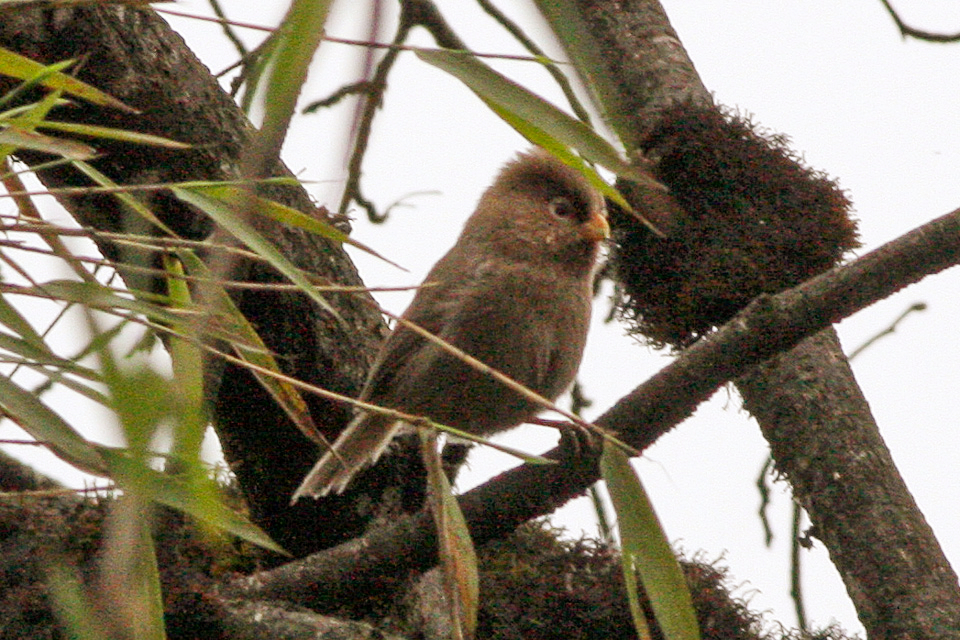
Chinese Fulvetta
Fulvetta striaticollis
Order: Passeriformes / Family: Sylviidae

Wikimedia Commons
About the Chinese Fulvetta
The Chinese Fulvetta, Fulvetta striaticollis, is a small passerine bird native to the mountainous regions of Asia. This species is part of the Sylviidae family, commonly known for their adaptability and singing proficiency. Chinese Fulvettas are predominantly found in the temperate forests of China, where they play a critical role in controlling insect populations and facilitating seed dispersal. Their ecological significance lies in their ability to thrive in dense undergrowth, thereby contributing to the ecosystem's health by keeping insect numbers in check and assisting in the propagation of various plant species. During the breeding season, which spans from April to July, these birds are especially active, displaying increased vocalization and territorial behaviors. The Chinese Fulvetta is a non-migratory species, remaining within its range year-round. However, it may exhibit altitudinal movements, descending to lower elevations during the harsh winter months. This behavior ensures their survival in varying climatic conditions and highlights their adaptability to different environmental challenges. The species is most commonly observed in regions such as Sichuan, Yunnan, and Tibet, where they frequent mixed deciduous and coniferous forests. These birds are known for their secretive nature, often staying hidden within dense foliage. Despite this, their presence is often betrayed by their distinctive calls and songs, which echo through the forest understory. The Chinese Fulvetta's role in the forest ecosystem extends beyond pest control, as they also contribute to pollination and seed dispersal. Their interactions with various plant species facilitate genetic diversity and help maintain forest dynamics. As a result, they are considered an indicator species for the health of their habitat. Conservation efforts for the Chinese Fulvetta are crucial due to habitat fragmentation and degradation, primarily driven by deforestation and human encroachment. Ensuring the preservation of their natural habitats is vital not only for the survival of the species but also for the broader ecological networks they support.
The Chinese Fulvetta belongs to the family Sylviidae, within the order Passeriformes. These birds typically live up to 8 years in the wild, with a maximum recorded lifespan of 10 years..
How to Identify a Chinese Fulvetta
The Chinese Fulvetta can be identified by its modest size, measuring approximately 12-14 cm in length. Its plumage is primarily a warm brown, with a paler underbelly and sides. A key distinguishing feature is its finely streaked throat, which stands out against the otherwise plain coloration. The streaks are subtle yet noticeable upon closer inspection, especially when the bird is perched. Juveniles resemble adults but may display slightly duller plumage and less distinct streaking on the throat. There is minimal sexual dimorphism in this species, with males and females appearing similar in size and color. However, during the breeding season, males may exhibit slightly more vivid plumage as part of their courtship display. When observed in flight, the Chinese Fulvetta exhibits a short, rounded wing shape typical of many forest-dwelling passerines. Its perching posture is often upright, allowing for optimal scanning of its surroundings while foraging. The Chinese Fulvetta can sometimes be confused with similar species such as the Rufous-vented Yuhina, but the latter has a distinct rufous vent and lacks the streaked throat. Careful observation of these field marks can assist bird watchers in accurate identification.
Having trouble telling birds apart? Upload a photo to our bird identification tool for an instant species match.
Chinese Fulvetta Habitat and Range
Preferred Habitat
Chinese Fulvettas predominantly inhabit temperate forests with dense undergrowth. They are commonly found in mixed deciduous and coniferous forests, thriving in areas with abundant foliage and a rich understory. These birds favor elevations ranging from 1,500 to 3,500 meters, often occupying the mid-montane zones of regions such as Sichuan and Yunnan. During winter, they may descend to lower elevations, especially in areas where snowfall and extreme cold temperatures limit their food supply. The Chinese Fulvetta is generally more prevalent in rural and semi-natural landscapes, avoiding heavily urbanized areas. They are well-adapted to the forest environment, using the dense vegetation for cover from predators and as a foraging ground. Seasonal habitat shifts are mostly influenced by temperature and food availability, with altitudinal movements allowing them to exploit different ecological niches throughout the year.
Geographic Range
The breeding range of the Chinese Fulvetta is primarily concentrated in the mountainous regions of central and southern China. This includes provinces such as Sichuan, Yunnan, and Tibet, where they inhabit the lush forested areas. As a non-migratory species, they maintain a relatively stable year-round presence within these regions. However, some populations may engage in short-distance altitudinal migrations, descending to lower elevations during winter for better foraging opportunities. Within their range, the Chinese Fulvetta is considered locally common, with certain areas acting as population density hotspots, particularly those with optimal forest conditions and minimal human disturbance. Despite their relatively restricted range, they are an integral part of the avian community in these mountainous habitats.
Want to know which birds visit your area? Browse our backyard birds by location guides for region-specific species lists.
What Does the Chinese Fulvetta Eat?
The diet of the Chinese Fulvetta primarily consists of insects and other small invertebrates, making them effective insectivores. During the warmer months, they actively forage for caterpillars, beetles, and spiders, which are abundant in their forest habitats. In addition to insects, they consume a variety of berries and seeds, particularly during the late summer and autumn months when these food sources are more plentiful. This dietary shift helps them prepare for the winter season when insect availability decreases. Chinese Fulvettas employ a gleaning foraging technique, meticulously picking food items from the undersides of leaves and branches. They often forage in mixed-species flocks, which increases their efficiency and reduces the risk of predation. Their foraging activity peaks during early morning and late afternoon, with periods of rest and preening occurring midday.
Chinese Fulvetta Behavior and Social Structure
Chinese Fulvettas exhibit a highly social behavior, often forming small flocks outside the breeding season. These flocks can include other small passerines, which provides safety in numbers and enhances foraging efficiency. During the breeding season, pairs become territorial, with males actively defending their nesting sites through song and display flights. Courtship involves a series of vocalizations and subtle displays, where the male fluffs his feathers and hops around the female. Despite their generally inconspicuous nature, Chinese Fulvettas can become quite vocal during territorial disputes, using a range of calls and songs to assert dominance. Their response to predators involves swift retreats into dense vegetation, where they remain motionless until the danger has passed. Daily activity patterns include periods of intensive foraging interspersed with bouts of rest and preening.
Chinese Fulvetta Nesting and Reproduction
The nesting habits of the Chinese Fulvetta involve constructing a cup-shaped nest made of grass, moss, and small twigs. These nests are typically situated in dense shrubs or low tree branches, well-hidden from predators. The female lays a clutch of 3-5 eggs, which she incubates for about 12-14 days. During this period, the male assists by providing food and standing guard. Once the chicks hatch, both parents are involved in feeding and caring for the young. The fledging period lasts approximately 10-12 days, after which the young birds gradually gain independence. Chinese Fulvettas usually have one to two broods per year, with the timing closely linked to food availability and environmental conditions.
Chinese Fulvetta Sounds and Vocalizations
The primary song of the Chinese Fulvetta is a series of melodious whistles, characterized by a rhythmic and ascending pitch. This song is often delivered from a concealed perch within the undergrowth. In addition to their primary song, they produce a variety of call notes, including short, sharp chips used for communication within flocks. Alarm calls are more rapid and harsh, serving as an effective warning system against predators. During the dawn chorus, the Chinese Fulvetta's song contributes to the acoustic tapestry of the forest, blending with the calls of other avian species. Their vocalizations, while not as loud as some songbirds, carry well in the forest environment, making them more easily detected than seen.
Interesting Facts About the Chinese Fulvetta
- 1The Chinese Fulvetta has a relatively limited range, confined mainly to central and southern China, making it a species of interest for regional birdwatchers.
- 2Despite its small size, the Chinese Fulvetta plays a crucial ecological role, helping to control insect populations in its forest environment.
- 3The Chinese Fulvetta's song is less complex than that of some other Sylviidae family members, but its melodic whistles are a distinctive feature of its vocal repertoire.
- 4In mixed-species flocks, Chinese Fulvettas are often seen with other small songbirds, allowing them to benefit from increased vigilance against predators.
- 5The altitudinal movements of the Chinese Fulvetta demonstrate their adaptability, as they adjust to environmental conditions by shifting to lower elevations during winter.
- 6Chinese Fulvettas are known to be monogamous, with pairs forming strong bonds that are maintained throughout the breeding season.
- 7The finely streaked throat of the Chinese Fulvetta is not only a key identification feature but also aids in camouflage within the dappled light of its forest habitat.
Chinese Fulvetta Conservation Status
The Chinese Fulvetta is currently listed as Least Concern by the IUCN, with a stable population trend. Despite this, habitat loss due to deforestation and human expansion poses a significant threat. Conservation efforts focus on protecting their natural habitats through the establishment of nature reserves and the promotion of sustainable forestry practices. Historically, population numbers have fluctuated in response to environmental changes and human activities, but recent trends suggest a stabilization thanks to increased awareness and conservation initiatives.