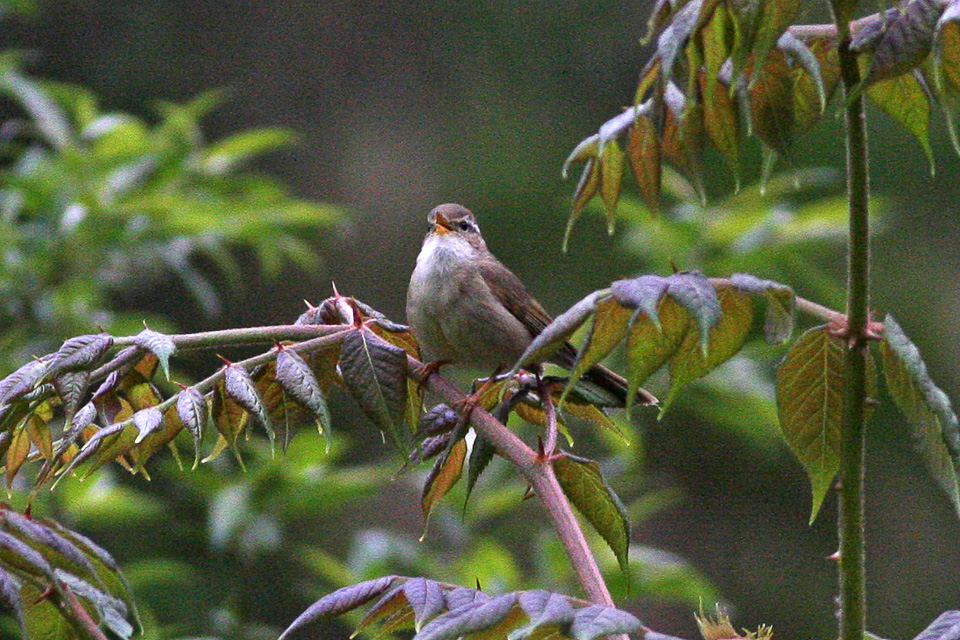
Claudia's Leaf Warbler
Phylloscopus claudiae
Order: Passeriformes / Family: Phylloscopidae

Wikimedia Commons
About the Claudia's Leaf Warbler
Claudia's Leaf Warbler, scientifically named Phylloscopus claudiae, is a small, active passerine bird belonging to the family Phylloscopidae. This warbler predominately inhabits the lush, subtropical forests of Southeast Asia, particularly in countries like China, Vietnam, and Laos. Known for its restless nature, this species plays a vital role in its ecosystem by controlling insect populations and serving as a prey item for larger birds. Claudia's Leaf Warbler is a migratory bird, undertaking seasonal movements primarily within its regional range. During the breeding season, typically from March to July, it occupies dense woodlands at elevations ranging from 500 to 2,000 meters. These areas provide optimal conditions for breeding and rearing young, offering abundant food sources and protection from predators. As autumn approaches, the warbler migrates to lower elevations, often moving to evergreen forests and mixed woodlands, where it can find sustenance during the winter months. Unlike many other warbler species, Claudia's Leaf Warbler is adept at adapting to various forest conditions, from dense thickets to open woodland edges. This adaptability allows it to exploit different microhabitats throughout the year. The ecological role of this warbler extends beyond its immediate environment. By preying on insects, it helps maintain a balance in the ecosystem, reducing the prevalence of pests that can affect both native plant species and human agricultural interests. Moreover, its vibrant presence contributes to the biodiversity of its habitat, supporting a healthy and dynamic forest ecosystem. Claudia's Leaf Warbler's significance is further highlighted by its interactions with other avian species. It often participates in mixed-species foraging flocks, especially outside of the breeding season. These flocks, which may include other warblers, tits, and babblers, enhance foraging efficiency and provide safety in numbers against potential predators. This behavior underscores the warbler's role as an integral component of the avian community in its native forests.
The Claudia's Leaf Warbler belongs to the family Phylloscopidae, within the order Passeriformes. These birds typically live average 3-5 years with a maximum recorded of 8 years..
How to Identify a Claudia's Leaf Warbler
Claudia's Leaf Warbler is a small bird, measuring approximately 9 to 11 centimeters in length. Its plumage is primarily a vibrant shade of green, which provides excellent camouflage among the leaves of its forest habitat. The upperparts are a rich olive-green, while the underparts present a paler, yellowish hue. Key field marks include a distinct yellowish-white supercilium and two light wing bars that stand out against the darker green wings. The crown may display faint gray streaks, particularly in adults, which can aid in identification. Juvenile Claudia's Leaf Warblers generally resemble adults but may appear slightly duller with less defined wing bars. There is little sexual dimorphism in this species, meaning males and females look similar, although males may exhibit slightly more vibrant plumage during the breeding season. In flight, Claudia's Leaf Warbler presents a rapid, fluttery wingbeat and a slightly undulating flight path. Its perching posture is characteristically upright, often accompanied by a flick of the wings or tail. When compared to similar species, such as the Yellow-browed Warbler, Claudia's Leaf Warbler can be distinguished by its more pronounced supercilium and overall greener appearance. Observers must also note its vocalizations, which play a crucial role in confirming identification. The warbler's song and calls are unique and often heard before the bird is seen, especially in dense foliage.
Having trouble telling birds apart? Upload a photo to our bird identification tool for an instant species match.
Claudia's Leaf Warbler Habitat and Range
Preferred Habitat
Claudia's Leaf Warbler primarily inhabits subtropical and temperate forests, favoring areas with dense understory vegetation. These forests provide the necessary cover and food resources, making them ideal habitats for breeding and foraging. In its preferred environment, the warbler can be found at elevations from 500 to 2,000 meters, often in broadleaf evergreen forests and mixed coniferous woodlands. Seasonal shifts in habitat occur as the warbler migrates to lower elevations during the non-breeding season. It adapts well to diverse forest conditions, from dense thickets to more open woodland edges. While generally preferring rural and forested areas, Claudia's Leaf Warbler is occasionally observed in urban green spaces and parks, particularly during migration periods. However, such sightings are less common, as the species tends to avoid heavily urbanized areas. Its adaptability to different forest types and microhabitats underscores its ecological flexibility, allowing it to thrive across a broad range of settings within its geographic range.
Geographic Range
Claudia's Leaf Warbler is primarily found in Southeast Asia, with a breeding range that encompasses southern and central China, including provinces such as Yunnan and Sichuan. During the breeding season, it occupies mountainous regions, exploiting the rich resources found at elevations between 500 and 2,000 meters. As a migratory species, the warbler travels to lower elevations in the winter, moving to regions such as Vietnam, Laos, and parts of southern China. Migration corridors often follow the natural topography of the region, utilizing river valleys and forested ridges. Population density hotspots are most notable in forested regions of central and southern China, where the species is often observed in mixed-species flocks. Wintering grounds, on the other hand, may see a more scattered distribution, as the warbler spreads out in search of suitable habitats. Despite its widespread range, Claudia's Leaf Warbler is less commonly observed outside its primary regions, making it a sought-after species for bird watchers visiting Southeast Asia.
Want to know which birds visit your area? Browse our backyard birds by location guides for region-specific species lists.
What Does the Claudia's Leaf Warbler Eat?
The diet of Claudia's Leaf Warbler primarily consists of small insects and arachnids, which it actively forages from foliage and branches. Common prey items include caterpillars, beetles, and flies. The warbler employs a gleaning technique, deftly picking insects off leaves and twigs, an activity often accompanied by rapid movements and wing flicks. During the breeding season, the demand for protein-rich food increases, prompting the warbler to focus on the most abundant insect populations available in its habitat. In winter, when insect availability diminishes, Claudia's Leaf Warbler may supplement its diet with small fruits and seeds, adapting its foraging behavior to the changing season. Prey size is generally small, with the warbler favoring insects that are easily manageable given its size. Feeding typically occurs throughout the daylight hours, with peak activity during early morning and late afternoon when insect activity is highest. This feeding schedule ensures optimal energy intake while minimizing competition with other foraging birds.
Claudia's Leaf Warbler Behavior and Social Structure
Claudia's Leaf Warbler exhibits a range of behaviors characteristic of its active lifestyle. It is a solitary forager during the breeding season, with individuals vigorously defending their territories to ensure access to food and nesting sites. This territorial behavior is often accompanied by vocal displays, with males singing from prominent perches to ward off rivals and attract mates. During courtship, Claudia's Leaf Warbler engages in dynamic displays that include rapid flight chases and wing fluttering, designed to impress potential partners. Outside of the breeding season, the warbler demonstrates a more social disposition, frequently joining mixed-species foraging flocks. These flocks provide increased foraging efficiency and protection against predators, allowing the warbler to exploit a variety of food sources. The warbler's response to predators includes alarm calls and evasive maneuvers, often retreating to dense foliage for cover. Daily activity patterns are largely diurnal, with the warbler being most active during the cooler parts of the day. Its constant motion and energetic foraging make it a lively presence in its forest habitat.
Claudia's Leaf Warbler Nesting and Reproduction
Claudia's Leaf Warbler constructs its nest in the dense understory of forests, often at a height of 1 to 3 meters above the ground. The nest is a cup-shaped structure made from a variety of materials, including grass, moss, and spider silk, which are skillfully woven together to provide stability and insulation. Preferred nesting sites are well-concealed within dense foliage, offering protection from predators. The typical clutch size ranges from 3 to 5 eggs, which are incubated by the female for a period of about 12 to 14 days. During this time, the male plays a crucial role in providing food for the incubating female. Once the eggs hatch, both parents participate in feeding the chicks, which fledge approximately 14 to 16 days after hatching. Claudia's Leaf Warbler usually raises one brood per year, although in favorable conditions, a second brood may be attempted. Parental roles are well-defined, with both sexes contributing to nest maintenance and chick rearing.
Claudia's Leaf Warbler Sounds and Vocalizations
The primary song of Claudia's Leaf Warbler is a series of high-pitched, melodious notes delivered in rapid succession. This song, often described as sweet and fluid, can be heard echoing through the forest during the breeding season. The warbler also produces a variety of call notes, including a sharp 'tsee-tsee' used for communication between mates and as an alarm call when predators are nearby. Compared to similar species, the song of Claudia's Leaf Warbler is more musical and less harsh, making it a distinctive sound in its environment. During the dawn chorus, the warbler's song is particularly prominent, as males assert their presence and establish territories. These vocalizations not only serve as a tool for mate attraction but also play a key role in maintaining social bonds and coordinating movements within foraging flocks.
Interesting Facts About the Claudia's Leaf Warbler
- 1Claudia's Leaf Warbler was first described in 1923 and named after Claudia von Seebach, a renowned ornithologist.
- 2This warbler's supercilium is more pronounced than in many similar species, aiding in identification.
- 3Despite its small size, Claudia's Leaf Warbler is a prolific insect predator, consuming thousands of insects each year.
- 4The warbler's ability to adapt to different forest conditions allows it to exploit a range of habitats across Southeast Asia.
- 5Its melodious song is not only a mating call but also serves to establish its territory in dense forest environments.
- 6Claudia's Leaf Warbler often joins mixed-species flocks, benefiting from the increased foraging success and predator vigilance.
- 7The species' migratory patterns are influenced by seasonal changes in food availability and forest cover in its range.
Claudia's Leaf Warbler Conservation Status
Claudia's Leaf Warbler is currently listed as Least Concern by the IUCN. The population trend appears stable, with no immediate threats posing a significant risk to its numbers. However, habitat loss due to deforestation and land conversion for agriculture remains a potential threat that could impact local populations. Conservation efforts aimed at preserving forest habitats are critical to ensuring the warbler's long-term survival. Historical data indicates that while some local declines may have occurred, the overall population has remained resilient. Continued monitoring and habitat protection are essential to maintaining healthy populations of Claudia's Leaf Warbler across its range.