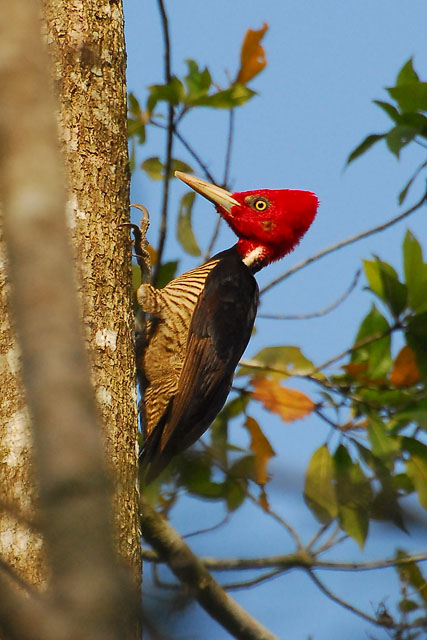
Cream-backed Woodpecker
Campephilus leucopogon
Order: Piciformes / Family: Picidae

Wikimedia Commons
About the Cream-backed Woodpecker
The Cream-backed Woodpecker, Campephilus leucopogon, is a striking bird, renowned for its bold contrasting plumage. This species inhabits the subtropical and tropical forests of South America, particularly within Argentina, Brazil, and Paraguay. It plays a key ecological role as a cavity-nester, contributing significantly to forest dynamics by creating nesting sites utilized by various other woodland species. The woodpecker's presence often indicates a healthy, mature forest ecosystem. Predominantly found in lowland rainforests, the Cream-backed Woodpecker is a year-round resident in these regions, showcasing little migratory behavior. During the breeding season, typically from September to December, its activity peaks as it engages in nesting and territorial displays. Its large size and loud drumming resonate through the forest, echoing off the towering tree trunks where it forages and nests. Understanding the Cream-backed Woodpecker's habits and habitat preferences offers insight into the health of the forest ecosystems it inhabits. This woodpecker contributes to insect population control, feeding on wood-boring insects that can affect the health of trees. The species' reliance on older, undisturbed forests places it at risk from deforestation and habitat fragmentation. Protecting these habitats not only preserves the Cream-backed Woodpecker but also the myriad of species that share its environment. Despite these challenges, the Cream-backed Woodpecker remains a resilient species, adapting to various forested landscapes across its range. Conservation efforts are crucial in ensuring the continued survival of this remarkable bird and the rich biodiversity it supports.
The Cream-backed Woodpecker belongs to the family Picidae, within the order Piciformes. These birds typically live average 6-8 years with a maximum recorded of 11 years..
How to Identify a Cream-backed Woodpecker
The Cream-backed Woodpecker is a large, striking bird, measuring about 36 to 38 centimeters in length. Its most distinctive feature is its creamy white back, which contrasts sharply with the black wings and tail. The head is adorned with bold red plumage in males, while females display a mix of black and white with some red around the nape. Juvenile birds resemble adults but have a duller appearance, with less vivid red tones and a more muted white back. In flight, the woodpecker's long wings and tail create a distinctive silhouette, with strong, deep wing beats. When perched, it often clings vertically to tree trunks, its powerful claws gripping the bark securely. This species can be confused with other large woodpeckers, such as the Lineated Woodpecker, but the latter is smaller and lacks the striking white back. The Cream-backed Woodpecker's robust bill, used for drumming and chiseling into wood, is another identifying feature. Observers can often spot the bird by its methodical pecking and listen for its drumming, which is slower and more deliberate than that of smaller woodpecker species.
Having trouble telling birds apart? Upload a photo to our bird identification tool for an instant species match.
Cream-backed Woodpecker Habitat and Range
Preferred Habitat
The Cream-backed Woodpecker primarily inhabits mature subtropical and tropical forests, favoring areas with abundant dead or dying trees that offer rich foraging opportunities. It prefers lowland forests up to an elevation of about 1,500 meters, avoiding higher montane regions. While it thrives in primary forests, it can also be found in secondary forests and forest edges, particularly in regions where dense, continuous forest tracts remain undisturbed. This species is rarely seen in urban environments, as it requires large trees for nesting and foraging. Seasonal habitat shifts are minimal, as the woodpecker generally remains within its range year-round. Its presence often correlates with old-growth forest characteristics, making habitat preservation crucial for its sustained survival.
Geographic Range
The Cream-backed Woodpecker's range encompasses parts of southern Brazil, eastern Paraguay, and northern Argentina. It primarily occupies the Atlantic Forest region, though its range extends into the subtropical forests of the Chaco and other nearby areas. Within this range, populations tend to be patchily distributed, focusing on regions with substantial forest cover. Unlike many woodpecker species, the Cream-backed Woodpecker does not exhibit significant migratory behavior, residing within its breeding range throughout the year. Certain areas, such as the Atlantic Forest of Brazil, serve as population density hotspots, though habitat fragmentation has caused localized declines. The bird's distribution highlights the importance of cross-border conservation efforts between Argentina, Brazil, and Paraguay.
Want to know which birds visit your area? Browse our backyard birds by location guides for region-specific species lists.
What Does the Cream-backed Woodpecker Eat?
The diet of the Cream-backed Woodpecker primarily consists of insects, particularly wood-boring beetles and larvae, which it extracts from beneath tree bark with its powerful bill. During the breeding season, this woodpecker may increase its consumption of protein-rich insects to support the nutritional needs of its young. It also consumes ants and other small invertebrates, supplementing its diet with fruits and nuts when available. The woodpecker employs a technique known as 'gleaning,' where it carefully examines tree surfaces to locate and extract prey. Foraging typically occurs during daylight hours, with the bird frequently observed moving methodically up and down tree trunks and large branches. Its diet and foraging behavior play a crucial role in controlling insect populations and maintaining forest health.
Cream-backed Woodpecker Behavior and Social Structure
The Cream-backed Woodpecker exhibits solitary or paired living arrangements, particularly during the breeding season. It is known for its territorial behavior, with pairs vigorously defending their nesting sites from intruders. Courtship displays include drumming, head bobbing, and mutual preening, solidifying pair bonds. During non-breeding periods, these woodpeckers might form loose associations, although they predominantly remain solitary. Their response to predators includes aggressive drumming and loud calls to warn others of potential threats. Daily activities revolve around foraging and territory maintenance, with peak activity in the early morning and late afternoon. Despite its size, the Cream-backed Woodpecker is a proficient climber, using its tail feathers for support as it navigates tree trunks in search of food.
Cream-backed Woodpecker Nesting and Reproduction
The Cream-backed Woodpecker nests in cavities excavated in large, often dead trees. The male typically initiates cavity excavation, with the female assisting in later stages. Nesting locations are chosen carefully, usually high above the ground to deter predators. The clutch size ranges from 2 to 4 eggs, with both parents sharing incubation duties over approximately two weeks. Once hatched, the chicks remain in the nest for about 30 to 35 days before fledging. During this period, both parents actively feed and protect their young. This species generally raises one brood per year, though favorable conditions may allow for a second. Parental roles are well-defined, with both sexes engaging in feeding and teaching fledglings essential survival skills.
Cream-backed Woodpecker Sounds and Vocalizations
The Cream-backed Woodpecker's primary vocalization is a sharp, repeated call, often described as 'kik-kik-kik,' which serves as both a contact call and territorial marker. Its drumming is deliberate and powerful, resonating through the forest as a signal of presence and strength. Alarm calls are more rapid and high-pitched, alerting other birds to potential danger. During the dawn chorus, this woodpecker's vocalizations can be heard echoing through the forest, often accompanied by the sounds of other early risers. The rhythmic drumming and vocal calls of the Cream-backed Woodpecker play a vital role in communication and territory establishment.
Interesting Facts About the Cream-backed Woodpecker
- 1The Cream-backed Woodpecker is one of the largest woodpecker species in South America, reaching up to 38 centimeters in length.
- 2Despite its striking appearance, the Cream-backed Woodpecker can be elusive, often blending into its forest environment.
- 3This woodpecker's powerful bill can exert substantial force, allowing it to excavate deep into tree trunks for food and nesting.
- 4The Cream-backed Woodpecker's drumming can be heard over great distances, serving as an effective territorial marker.
- 5Unlike many woodpeckers, the Cream-backed Woodpecker shows little to no migratory behavior, residing within its range year-round.
- 6The species plays a crucial role in its ecosystem by controlling insect populations and providing nesting sites for other animals.
- 7The Cream-backed Woodpecker's habitat preferences make it an important indicator species for forest health and biodiversity.
Cream-backed Woodpecker Conservation Status
The Cream-backed Woodpecker is currently listed as 'Least Concern' by the IUCN, though its population faces pressures from habitat loss due to deforestation and agricultural expansion. While numbers appear stable, localized declines in heavily deforested regions pose significant threats. Conservation efforts focus on preserving large tracts of mature forest and advocating for sustainable land-use practices. Historical population data suggest that this species has maintained a relatively stable presence, although ongoing habitat loss requires continued conservation attention. Protecting critical habitats across its range remains essential for ensuring the long-term survival of the Cream-backed Woodpecker.
Other Picidae Species


Birds Similar to the Cream-backed Woodpecker
These species are often confused with the Cream-backed Woodpecker due to similar appearance or overlapping range.