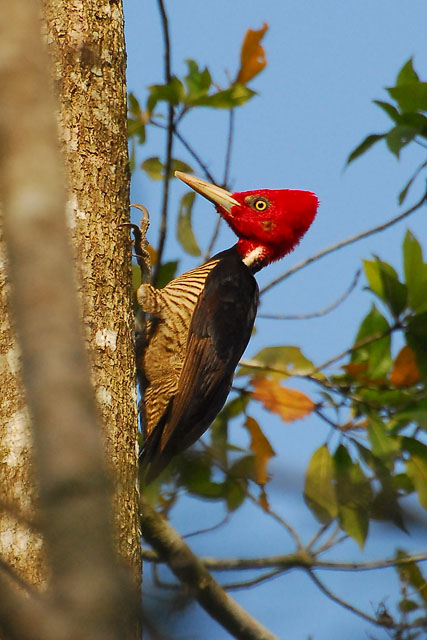
Pale-billed Woodpecker
Campephilus guatemalensis
Order: Piciformes / Family: Picidae
Wikimedia Commons
About the Pale-billed Woodpecker
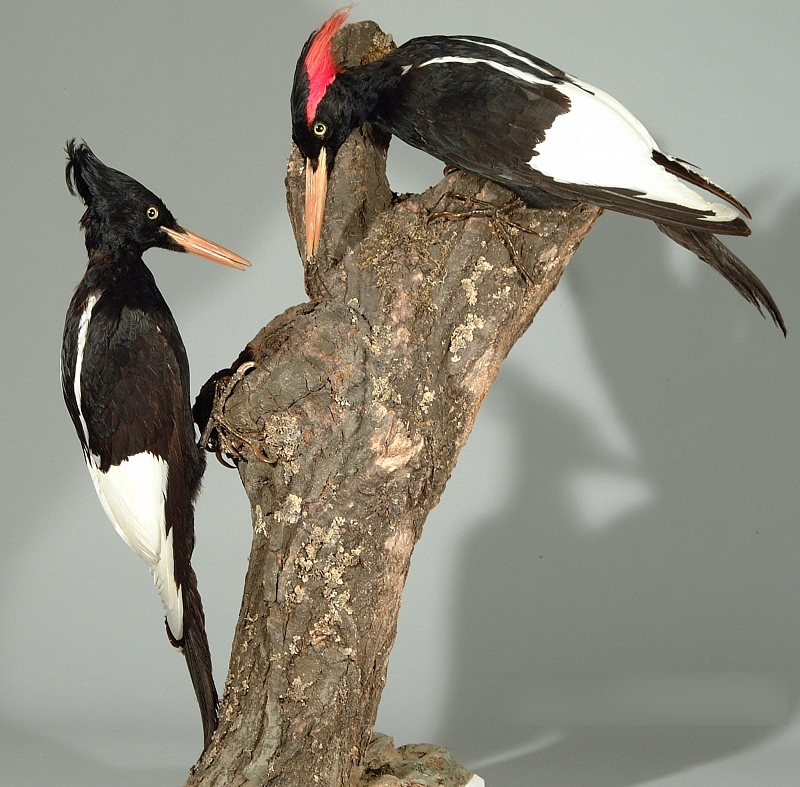
The Pale-billed Woodpecker, scientifically named Campephilus guatemalensis, stands out as one of the most impressive woodpecker species inhabiting Central and South America. This bird is a vital part of its ecosystem, primarily inhabiting dense forests, both tropical and subtropical, ranging from southern Mexico through Central America and into parts of South America, notably in Colombia and Ecuador. Its presence signifies a healthy forest ecosystem, as it plays a crucial role in controlling insect populations and facilitating the decomposition of dead trees. The Pale-billed Woodpecker is known for its large size, which can reach up to 36 cm in length. Its vibrant plumage, particularly the bright red head in males, makes it unmistakable. Females also display a notable red crest, albeit smaller, distinguishing them from other woodpecker species. The bird's ecological role extends beyond pest control. As it forages for insects beneath tree bark, it inadvertently creates habitats for other species by leaving behind holes in trees. These cavities become valuable nesting sites for various birds and small mammals, contributing to the forest's biodiversity. The woodpecker's loud drumming and vocalizations are distinctive auditory signatures of the forest, often signaling the presence of other wildlife. In terms of seasonal behavior, the Pale-billed Woodpecker remains relatively sedentary, with no significant migratory movements. However, it may shift its foraging activities depending on resource availability, moving to different parts of the forest as food sources fluctuate. This adaptability ensures its survival even as environmental conditions change, underscoring its resilience and adaptability. The Pale-billed Woodpecker is also a subject of interest due to its taxonomic proximity to the legendary, though likely extinct, Ivory-billed Woodpecker. This connection draws birdwatchers and researchers who hope to learn more about forest ecology and evolution by studying these magnificent birds.
The Pale-billed Woodpecker belongs to the family Picidae, within the order Piciformes. These birds typically live average 6-8 years with a maximum recorded of 12 years..
How to Identify a Pale-billed Woodpecker
The Pale-billed Woodpecker is a large bird, with adults reaching lengths of up to 36 cm and sporting a wingspan of approximately 50 cm. Its striking appearance features a predominantly black body with a white line running down the neck and extending onto the back. The most distinctive feature is its pale, ivory-colored bill, which contrasts sharply with the bright red head and crest of the males. Females also have a red crest but possess a more subdued coloration around the face, often showing some black mixed with red. Juveniles resemble adults but usually have duller plumage and a shorter crest, making them less conspicuous in the dense canopy. In flight, the Pale-billed Woodpecker displays a strong and direct pattern, with its broad wings and rhythmic flapping. When perched, it often adopts an upright posture, using its strong tail feathers to brace against tree trunks as it hammers into the wood. This behavior, combined with its size and coloration, helps differentiate it from other woodpecker species. While there are similar species within its range, such as the Lineated Woodpecker, the Pale-billed Woodpecker's larger size and distinctive bill make it relatively easy to identify once seen clearly.
Having trouble telling birds apart? Upload a photo to our bird identification tool for an instant species match.
Pale-billed Woodpecker Habitat and Range
Preferred Habitat
The Pale-billed Woodpecker predominantly inhabits humid tropical and subtropical forests, thriving in both lowland and montane regions. It is commonly found at elevations ranging from sea level up to 2,000 meters, although it prefers the dense canopy of mature forests. This bird is less frequently seen in secondary growth forests or degraded habitats, as it relies on large trees both for feeding and nesting. The woodpecker's habitat does not significantly change with the seasons, as it is a non-migratory species. However, it might shift to different areas within the forest in response to food availability. While primarily a forest-dwelling bird, it can occasionally be observed in more open areas adjacent to forests, particularly if large trees are present. The Pale-billed Woodpecker is rarely found in urban environments, as its habitat requirements are not compatible with urban development.
Geographic Range
The range of the Pale-billed Woodpecker spans from southern Mexico through Central America, including Belize, Guatemala, Honduras, Nicaragua, Costa Rica, and Panama. In South America, its presence has been confirmed in Colombia and Ecuador, where it favors the western slopes of the Andes. The bird's range is predominantly limited to areas with suitable forest habitats, limiting its distribution to regions where mature forests remain intact. There is no significant migratory pattern associated with the Pale-billed Woodpecker, as it tends to remain within its established range year-round. Within its range, population densities vary, with higher concentrations typically found in regions with extensive forest cover. Conservation efforts in parts of its range have focused on preserving these habitats to ensure the continued survival of not only the Pale-billed Woodpecker but also the myriad of other species that rely on these ecosystems.
Want to know which birds visit your area? Browse our backyard birds by location guides for region-specific species lists.
What Does the Pale-billed Woodpecker Eat?
The Pale-billed Woodpecker's diet primarily consists of insects, particularly wood-boring beetles and their larvae, which it extracts from beneath tree bark using its powerful bill. It also consumes a variety of ants, termites, and occasionally fruits and nuts, supplementing its diet as needed. Seasonal changes in food availability can influence its diet, with fruit becoming a more significant component during certain times of the year when insects are less abundant. The woodpecker employs a methodical foraging technique, moving systematically up and down tree trunks and large branches to uncover hidden prey. It uses its strong bill not only to peck into wood but also to pry off bark and reach insects within crevices. This bird often forages alone or in pairs, with peak feeding activity occurring in the early morning and late afternoon. The size of prey varies, but the Pale-billed Woodpecker is adept at handling relatively large and tough-skinned insects, which provides a significant source of protein.
Pale-billed Woodpecker Behavior and Social Structure
The Pale-billed Woodpecker exhibits a largely solitary lifestyle, although it can be observed in pairs, particularly during the breeding season. It is highly territorial, with pairs defending their chosen area vigorously from intrusions by other woodpeckers. Vocalizations and drumming are essential components of its territorial displays, communicating presence and warding off potential rivals. Courtship behavior involves mutual drumming and calling, as well as the display of the red crest. These displays strengthen pair bonds and facilitate coordination between mates. Unlike some woodpecker species that form flocks, the Pale-billed Woodpecker remains solitary or in pairs throughout the year. Its response to predators includes staying close to tree trunks and using its strong bill in defense if necessary. Daily activity patterns show peaks in the early morning and late afternoon, corresponding with foraging periods when insect activity is highest. The bird's drumming, a key component of its behavior, not only aids in communication but also in locating insects within trees.
Pale-billed Woodpecker Nesting and Reproduction
The Pale-billed Woodpecker typically nests in large tree cavities, which it excavates using its powerful bill. Preferred nesting trees are often dead or dying, as the softer wood facilitates easier excavation. The nest site is usually situated high above the ground, sometimes as high as 12 meters, providing safety from ground predators. Nest construction involves both members of the pair, with each taking turns chiseling out the cavity. The typical clutch consists of two to three eggs, which both parents incubate over a period of approximately 15 to 17 days. After hatching, both parents actively participate in feeding the nestlings, regurgitating food items until the young fledge. The fledging period lasts about 24 to 28 days, during which the young develop the skills necessary for independence. The Pale-billed Woodpecker usually raises one brood per year, although in areas with abundant resources, a second brood may occasionally be attempted. Parental care extends beyond fledging, with adults continuing to feed and protect the young until they are fully capable of foraging on their own.
Pale-billed Woodpecker Sounds and Vocalizations
The primary vocalization of the Pale-billed Woodpecker is a loud, resonant drumming that can be heard over great distances. This drumming serves as both a territorial signal and a means of communication between mates. The bird's call notes are sharp and penetrating, often described as a series of short, repeated 'kuk-kuk-kuk' sounds. These calls are frequently used during interactions with other woodpeckers or in response to disturbances. Alarm calls are more rapid and higher-pitched, intended to alert mates or deter predators. The Pale-billed Woodpecker is also known for its contribution to the dawn chorus, adding a rhythmic percussion to the symphony of forest sounds. Its drumming is often compared to the sound of a distant jackhammer, both in volume and intensity, underscoring the bird's formidable presence in its environment.
Interesting Facts About the Pale-billed Woodpecker
- 1The Pale-billed Woodpecker's drumming can be heard up to 1 kilometer away, making it one of the loudest woodpeckers in its range.
- 2Despite its size, the Pale-billed Woodpecker can cling vertically to tree trunks for extended periods without fatigue, thanks to its specialized tail feathers.
- 3This woodpecker is known to use its strong bill not only for foraging but also to carve out nest cavities, which can take several weeks to complete.
- 4The Pale-billed Woodpecker's ivory-colored bill is not made of bone but of keratin, the same material that makes up human fingernails.
- 5During breeding season, the male and female Pale-billed Woodpecker will engage in duet drumming, a rare behavior among woodpeckers.
- 6Unlike many bird species, both male and female Pale-billed Woodpeckers share the responsibility of incubating eggs and feeding the young.
- 7The Pale-billed Woodpecker can excavate a nest cavity up to 50 cm deep, providing a secure environment for its eggs and chicks.
Pale-billed Woodpecker Conservation Status
Currently, the Pale-billed Woodpecker is classified as Least Concern by the IUCN, with its population considered stable. However, ongoing habitat destruction, particularly deforestation in its range, poses a significant threat to its future. Conservation efforts focus on preserving large tracts of forest and promoting sustainable land management practices. Historical data suggest that while the population has faced pressures from logging and land conversion, it remains resilient in areas where forest habitat is protected. Continued monitoring and habitat preservation are critical to ensuring the species does not become threatened in the future.
Other Picidae Species


Birds Similar to the Pale-billed Woodpecker
These species are often confused with the Pale-billed Woodpecker due to similar appearance or overlapping range.