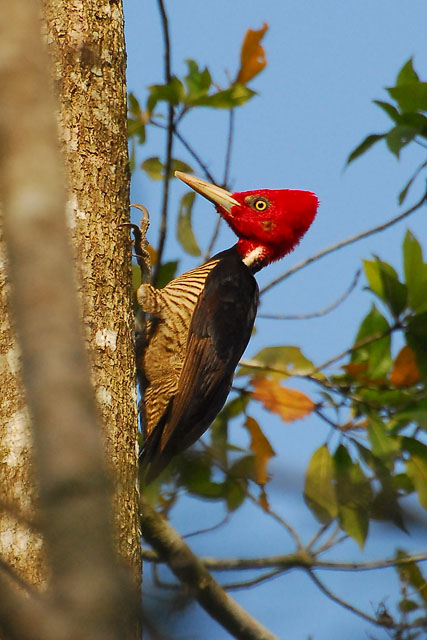
Guayaquil Woodpecker
Campephilus gayaquilensis
Order: Piciformes / Family: Picidae

Wikimedia Commons
About the Guayaquil Woodpecker
The Guayaquil Woodpecker (Campephilus gayaquilensis) stands as a symbol of the vibrant forest life in western Ecuador and northern Peru. This large woodpecker, which belongs to the family Picidae, showcases a striking appearance with its vivid red feathers and contrasting black and white markings. These birds inhabit tropical and subtropical moist broadleaf forests, where they play a critical ecological role by controlling insect populations and aiding in seed dispersal through their foraging activities. The Guayaquil Woodpecker's presence is a vital indicator of forest health, as it often thrives in well-preserved, mature forests. Its preference for unfragmented habitats underscores the importance of conserving these areas. Seasonally, the Guayaquil Woodpecker remains relatively sedentary, although some local movements occur in response to food availability. Their role in the ecosystem extends beyond mere aesthetic appeal; these woodpeckers significantly impact the forest structure and diversity. By excavating nesting cavities in trees, they provide essential nesting sites for other cavity-dependent species, including various birds and small mammals. As primary excavators, they influence the availability of these critical resources. Furthermore, the Guayaquil Woodpecker's feeding habits help regulate insect populations, contributing to the ecological balance of their habitat. These attributes, combined with their striking appearance, make the Guayaquil Woodpecker an integral part of the avian community in its range.
The Guayaquil Woodpecker belongs to the family Picidae, within the order Piciformes. These birds typically live average 5-7 years with a maximum recorded of 10 years..
How to Identify a Guayaquil Woodpecker
The Guayaquil Woodpecker is notable for its striking plumage, which aids in its identification. Adults exhibit a predominantly red head and crest, a bright red belly, and a black back with white wing patches that are visible in flight. The male and female show similar coloration, although the male typically displays a slightly larger crest. Juveniles, on the other hand, can be distinguished by their duller coloration and shorter crests. When perched, the Guayaquil Woodpecker maintains an upright posture typical of woodpeckers, often clinging to the trunks of large trees. In flight, its broad wings and undulating flight pattern are distinctive. This species could be confused with other large woodpeckers in the region, such as the Crimson-bellied Woodpecker, but the Guayaquil Woodpecker's larger size and distinct head pattern serve as reliable differentiators.
Having trouble telling birds apart? Upload a photo to our bird identification tool for an instant species match.
Guayaquil Woodpecker Habitat and Range
Preferred Habitat
The Guayaquil Woodpecker thrives in lowland tropical and subtropical moist broadleaf forests, particularly those with a rich diversity of tree species. These woodpeckers prefer habitats that offer mature trees for nesting and foraging. Within these forests, they are frequently found at elevations ranging from sea level to approximately 1500 meters. While primarily forest-dwelling, they can occasionally be seen in nearby agricultural areas, provided large trees are present. They show limited adaptability to urban environments, as they require extensive forest cover and large trees for nesting and feeding.
Geographic Range
The Guayaquil Woodpecker's range is confined to the western regions of Ecuador and the northern parts of Peru. Within these countries, they are primarily found in coastal and near-coastal forest areas. The bird does not undertake long migratory journeys, but local movements occur in search of food. Population density varies, with higher concentrations in regions where mature forests remain intact. In Ecuador, areas like Esmeraldas and Manabí are known hotspots, while in Peru, Tumbes and Piura provide suitable habitats.
Want to know which birds visit your area? Browse our backyard birds by location guides for region-specific species lists.
What Does the Guayaquil Woodpecker Eat?
The diet of the Guayaquil Woodpecker primarily consists of insects, particularly beetle larvae, which they extract from beneath the bark of trees. They also consume ants, termites, and occasionally small fruits and seeds. Seasonal variations impact their diet, with increased fruit consumption during periods when insect availability declines. The Guayaquil Woodpecker employs a powerful foraging technique, using its strong bill to excavate wood and bark. It often forages in pairs or small family groups, and feeding occurs throughout the day, peaking during the cooler hours of early morning and late afternoon.
Guayaquil Woodpecker Behavior and Social Structure
The Guayaquil Woodpecker exhibits a strong territorial behavior, particularly during the breeding season. Pairs vigorously defend their territory from intruders, using vocalizations and drumming on trees as deterrents. Courtship involves elaborate displays, with both members of the pair participating in synchronized drumming and vocalizations. Outside the breeding season, these woodpeckers may form small family groups, but they rarely join larger mixed-species flocks. Their response to predators includes a series of alarm calls and evasive flight. Daily activities follow a predictable pattern, with active foraging periods interspersed with rest during the heat of midday.
Guayaquil Woodpecker Nesting and Reproduction
The Guayaquil Woodpecker typically nests in cavities excavated in large, dead trees or branches. The selection of nesting sites favors dense forests with a good supply of deadwood. Nest construction involves both sexes, with the excavation process taking several weeks. Clutch size usually ranges from 2 to 4 eggs, with both parents sharing incubation duties, which last for about two weeks. After hatching, the nestlings remain in the cavity for approximately a month before fledging. Both parents continue to feed and care for the fledglings until they are independent. Generally, the Guayaquil Woodpecker raises one brood per year.
Guayaquil Woodpecker Sounds and Vocalizations
The Guayaquil Woodpecker's call is a series of sharp, high-pitched notes that resemble a rapid clattering. Its primary song consists of rhythmic, repetitive drumming sounds produced by striking trees with its bill. During the dawn chorus, these drumming sequences often resonate throughout the forest. Alarm calls are more abrupt and louder, serving as an alert to nearby threats. Compared to other woodpeckers, the Guayaquil Woodpecker's vocalizations are distinct yet subtle, playing an essential role in maintaining territory and communication between mates.
Interesting Facts About the Guayaquil Woodpecker
- 1The Guayaquil Woodpecker's drumming can be heard over half a mile away in dense forests.
- 2Despite its size, the Guayaquil Woodpecker can cling to vertical surfaces with ease, thanks to its specialized tail feathers.
- 3The species was first described scientifically in the 19th century and has fascinated ornithologists ever since.
- 4A Guayaquil Woodpecker's nest cavity can take several weeks to excavate, highlighting their strong work ethic.
- 5They are one of the few woodpecker species that show a preference for specific tree species when nesting.
- 6The Guayaquil Woodpecker contributes to forest health by controlling beetle populations that can damage trees.
- 7Both male and female Guayaquil Woodpeckers participate equally in raising their young, showcasing their cooperative nature.
Guayaquil Woodpecker Conservation Status
The Guayaquil Woodpecker currently holds a status of Least Concern according to the IUCN Red List. However, its population trend is decreasing due to habitat loss and fragmentation. Deforestation for agriculture and development poses the most significant threat to its habitat. Conservation efforts focus on protecting remaining forested areas and promoting sustainable land-use practices. Historically, the species enjoyed a more extensive range, but logging and land conversion have led to its current restricted distribution.
Other Picidae Species


Birds Similar to the Guayaquil Woodpecker
These species are often confused with the Guayaquil Woodpecker due to similar appearance or overlapping range.