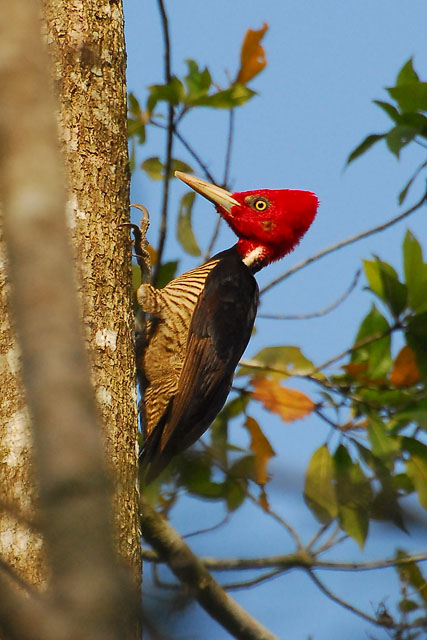
Crimson-bellied Woodpecker
Campephilus haematogaster
Order: Piciformes / Family: Picidae

Wikimedia Commons
About the Crimson-bellied Woodpecker
The Crimson-bellied Woodpecker, known scientifically as Campephilus haematogaster, is a striking and relatively large woodpecker of the Picidae family, found predominantly in the dense, humid forests of South America. This species is particularly notable for its vivid red underparts, which contrast sharply with its otherwise black and white plumage. The Crimson-bellied Woodpecker inhabits lowland and subtropical forests primarily in regions such as the Amazon Basin, with sightings confirmed in countries like Brazil, Colombia, Ecuador, and Peru. Its presence in these biodiverse areas underscores its ecological role as both a predator and a contributor to forest regeneration.
The significance of the Crimson-bellied Woodpecker lies in its role within the forest ecosystem. By feeding on wood-boring insects, this woodpecker helps control insect populations that might otherwise damage trees, thereby maintaining forest health. Furthermore, its habit of excavating nest cavities in trees provides essential nesting sites for other species, such as certain parrots and small mammals, which rely on these abandoned cavities.
Ecologically, the Crimson-bellied Woodpecker is an essential participant in the complex web of forest life. Seasonal behaviors of this species include breeding primarily during the wet season when insect prey is most abundant. This breeding strategy ensures that food availability aligns with the increased nutritional demands of raising young. The woodpecker's territorial calls and drumming can often be heard echoing through the forest, a testament to its active involvement in maintaining its territorial boundaries and family units.
The Crimson-bellied Woodpecker belongs to the family Picidae, within the order Piciformes. These birds typically live average 5-7 years with a maximum recorded of 9 years..
How to Identify a Crimson-bellied Woodpecker
The Crimson-bellied Woodpecker is easily identifiable by its striking plumage. Adult males and females both display a vivid crimson-red belly, contrasting with their predominantly black upperparts. The males have a distinctive red crown, while the females exhibit a black crown with only the nape showing red, creating a key sexual dimorphism in plumage. Juvenile birds resemble adults but with more subdued coloration and less defined markings.
In flight, the Crimson-bellied Woodpecker shows a typical woodpecker silhouette with strong, direct wingbeats and a slightly undulating pattern. The wings display a characteristic white patch at their base, making the bird easy to identify even when airborne. When perched, this woodpecker often assumes a vertical stance, gripping tree trunks with its zygodactyl feet.
Confusion with similar species may occur with other members of the Campephilus genus, such as the Powerful Woodpecker. However, the distinct red belly and specific crown patterns of the Crimson-bellied Woodpecker serve as reliable field marks to differentiate it from its relatives. Its large size and bold coloration make it a prominent figure in its forest habitats, aiding significantly in identification.
Having trouble telling birds apart? Upload a photo to our bird identification tool for an instant species match.
Crimson-bellied Woodpecker Habitat and Range
Preferred Habitat
The Crimson-bellied Woodpecker primarily inhabits tropical lowland rainforests, favoring dense, humid environments where it can find ample foraging opportunities. These woodpeckers thrive in primary forests, often at elevations ranging from sea level up to about 1200 meters. They are typically absent from highly fragmented or heavily disturbed forest patches, indicating their preference for intact forest ecosystems.
Seasonal habitat shifts are minimal due to their relatively stable tropical environment. However, they may occasionally venture into secondary forests or forest edges, especially when searching for food or new nesting sites. While primarily forest-dwelling, Crimson-bellied Woodpeckers are rarely seen in urban or suburban settings, as they require large territories with old-growth trees to sustain their ecological needs.
Geographic Range
The Crimson-bellied Woodpecker's range is predominantly confined to the Amazon Basin, covering parts of several South American countries. Its breeding range includes extensive areas of northern Brazil, eastern Peru, southern Colombia, and parts of Ecuador. These regions provide the humid, forested environments that are crucial for their survival.
Unlike many bird species, the Crimson-bellied Woodpecker does not undertake long-distance migrations. Instead, it remains mostly sedentary within its established range, relying on the stable climate and abundant resources of the Amazonian forests. Population density is typically higher in areas with minimal human disturbance, where old-growth forests remain intact. While generally widespread throughout its range, certain regions, especially those undergoing significant deforestation, may see decreased local populations.
Want to know which birds visit your area? Browse our backyard birds by location guides for region-specific species lists.
What Does the Crimson-bellied Woodpecker Eat?
Primarily, the diet of the Crimson-bellied Woodpecker consists of insects, particularly wood-boring beetles and their larvae. This preference helps regulate insect populations, benefiting the forest ecosystem. Additionally, the woodpecker supplements its diet with various fruits and nuts, foraging mostly on tree trunks and branches.
Seasonal changes in diet are minimal due to the consistent availability of food sources in tropical forests. However, during the wet season, when insect activity peaks, the woodpecker's diet becomes more insect-centric. Employing its powerful bill, the Crimson-bellied Woodpecker chisels into wood to extract prey, often leaving conspicuous holes in the process. Foraging mainly occurs during daylight hours, with peaks in activity during the cooler morning and late afternoon periods.
Crimson-bellied Woodpecker Behavior and Social Structure
The Crimson-bellied Woodpecker exhibits a primarily solitary or paired social structure, with pairs maintaining and defending territories throughout the year. Territorial behavior is pronounced, with individuals using drumming and vocalizations to assert dominance and ward off intruders.
Courtship involves elaborate displays, including synchronized drumming and mutual preening, which reinforce pair bonds. During the breeding season, pairs may be more visibly active as they search for suitable nesting sites and engage in frequent communication.
Despite their solitary tendencies, these woodpeckers occasionally join mixed-species flocks, especially during foraging. This behavior may provide mutual benefits, such as increased predator awareness. In response to predators, the Crimson-bellied Woodpecker relies on alarm calls and swift, erratic flight patterns to evade capture. Daily activity patterns reflect a diurnal lifestyle, with peak activities concentrated in the early morning and late afternoon.
Crimson-bellied Woodpecker Nesting and Reproduction
Nesting for the Crimson-bellied Woodpecker involves the excavation of cavities in dead or decaying trees, a task undertaken by both male and female. The pair selects a site with softened wood, which allows easier excavation. The entrance hole is typically round, leading to a chamber where the clutch of 2 to 4 eggs is laid.
The incubation period lasts about 14 days, with both parents sharing responsibilities. After hatching, the chicks remain in the nest for approximately 24 to 28 days until they fledge. During this period, both parents diligently feed and protect the young.
The number of broods per year is generally limited to one, aligning with the availability of resources and optimal breeding conditions. Parental care extends beyond fledging, as the young remain dependent on their parents for several weeks after leaving the nest.
Crimson-bellied Woodpecker Sounds and Vocalizations
The primary sound of the Crimson-bellied Woodpecker is a resonant drumming, achieved by rapid pecking on tree trunks to establish territory and communicate with mates. Their drumming is steady and rhythmic, often compared to the sound of a distant drumbeat. In addition to drumming, these woodpeckers produce a series of sharp, high-pitched calls varying in intensity and duration.
Alarm calls serve as a warning to potential threats and are sharper and more insistent than typical communication calls. During the dawn chorus, the Crimson-bellied Woodpecker can often be heard above the forest's cacophony, its calls contributing to the vibrant soundscape.
Interesting Facts About the Crimson-bellied Woodpecker
- 1The Crimson-bellied Woodpecker's drumming can be heard over half a mile away, showcasing its powerful impact and role in communication.
- 2This species can excavate a cavity in as little as two weeks, creating essential nesting sites for many forest-dwelling species.
- 3Despite its striking appearance, the Crimson-bellied Woodpecker's cryptic behavior and preference for dense forests make it a challenge to observe in the wild.
- 4The woodpecker's tongue can extend up to three times the length of its bill, allowing it to extract insects deep within tree bark.
- 5Pairs of Crimson-bellied Woodpeckers often remain together for life, exhibiting strong pair bonds through mutual preening and cooperative nesting.
Crimson-bellied Woodpecker Conservation Status
The Crimson-bellied Woodpecker is currently listed as Least Concern by the IUCN, with populations considered relatively stable across its range. However, ongoing threats such as deforestation and habitat fragmentation pose significant risks to its habitat. Conservation efforts focus on preserving intact forest ecosystems and mitigating habitat loss through sustainable land-use practices. Historical data suggest that populations have remained relatively stable, but continued environmental pressures could impact future numbers.
Other Picidae Species


Birds Similar to the Crimson-bellied Woodpecker
These species are often confused with the Crimson-bellied Woodpecker due to similar appearance or overlapping range.