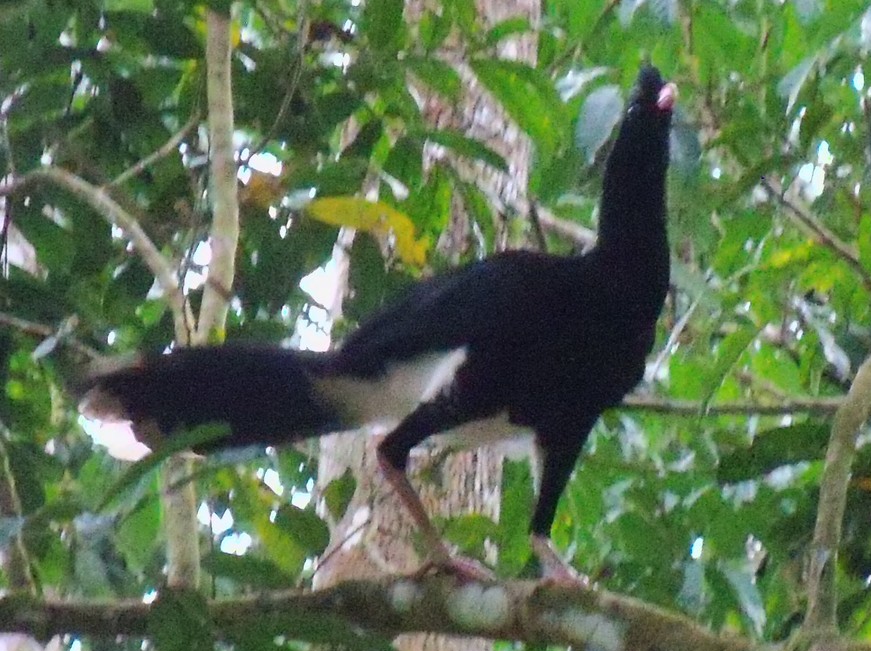
Crestless Curassow
Mitu tomentosum
Order: Galliformes / Family: Cracidae

Wikimedia Commons
About the Crestless Curassow
The Crestless Curassow, scientifically known as Mitu tomentosum, is a large bird belonging to the family Cracidae. This species inhabits the dense tropical forests of northern South America, particularly found in the Amazon Basin, encompassing regions of Brazil, Colombia, and Venezuela. The bird’s significance lies in its role as a seed disperser within its ecosystem, contributing to the forest's health and regeneration. As a ground-dwelling bird, it plays a crucial role in the understorey dynamics, influencing the composition and structure of the forest floor. Unlike many other birds, the Crestless Curassow does not migrate, maintaining a stable presence in its native habitat year-round.
The ecological importance of the Crestless Curassow cannot be overstated. It primarily feeds on fruits, seeds, and small insects, serving as a key participant in the seed dispersal process. This activity helps in maintaining the biodiversity and structural complexity of the rainforest. The bird's behavior reflects its adaptation to the forest environment, as it is mostly found in areas with thick vegetation that provide ample cover and foraging opportunities. During the dry season, the availability of resources may change, requiring the curassow to adapt its foraging strategies accordingly.
Despite its ecological value, the Crestless Curassow faces threats from habitat destruction and hunting. Deforestation for agriculture and logging significantly reduces the available habitat for this species. Conservation efforts focus on preserving large tracts of continuous forest, which are essential for the curassow's survival. Protected areas and sustainable land-use practices are critical to ensuring that the population of the Crestless Curassow remains stable. Additionally, the species acts as an indicator of forest health, with its presence often signifying a well-functioning ecosystem.
The Crestless Curassow belongs to the family Cracidae, within the order Galliformes. These birds typically live 15-20 years in the wild.
How to Identify a Crestless Curassow
The Crestless Curassow is unmistakable due to its large size and glossy black plumage. Adult birds exhibit a uniform black coloration with a subtle greenish sheen, which can be particularly evident in sunlight. Unlike other curassows, the Crestless Curassow lacks the prominent crest, as its name suggests. Instead, it sports a smooth head, giving it a distinctive silhouette among its relatives. Juvenile birds resemble adults but may display a slightly duller plumage. Both males and females look similar, although males tend to be marginally larger.
A key identification feature is the bird's bright red bill and legs, which provide a striking contrast against its dark feathers. When in flight, the Crestless Curassow's broad wings and long tail are evident, though it is not known for long-distance flight, preferring to stay within the forested areas and navigate through the underbrush.
The Crestless Curassow can be confused with similar species such as the Wattled Curassow or the Razor-billed Curassow. However, the absence of any crest and the uniformly black plumage help distinguish it from these relatives. Its posture is upright when perching or walking on the forest floor, exuding an air of confidence and alertness.
Having trouble telling birds apart? Upload a photo to our bird identification tool for an instant species match.
Crestless Curassow Habitat and Range
Preferred Habitat
The Crestless Curassow inhabits the tropical rainforests of the Amazon Basin, thriving in dense, lowland forests with ample cover. It prefers areas with a thick undergrowth where it can forage for food and find refuge from predators. These birds are typically found at elevations up to 500 meters, although they can inhabit slightly higher altitudes if the forest conditions are favorable.
Seasonal shifts in habitat are minimal, as the curassow remains in the forest throughout the year, taking advantage of the variety of food resources available in different seasons. Unlike some other species, the Crestless Curassow does not adapt well to urban or heavily disturbed areas, requiring vast tracts of contiguous forest to thrive. This preference underscores the importance of preserving large, undisturbed forest ecosystems for the survival of the species.
Geographic Range
The breeding and resident range of the Crestless Curassow includes the vast Amazon Basin, covering parts of northern Brazil, southern Venezuela, and eastern Colombia. This range represents some of the most biodiverse regions on the planet. The species is non-migratory, residing within its established range year-round. Unlike migratory birds, the Crestless Curassow does not travel far from its home territories, making its presence heavily dependent on the availability of suitable habitat within these regions.
Population densities are highest in regions where the forest is least disturbed by human activities, often within protected areas or remote parts of the Amazon. Areas such as the Amazonian National Parks in Brazil and Colombia serve as crucial strongholds for this species. In contrast, areas experiencing high rates of deforestation show declining populations, highlighting the impact of human encroachment on its habitat.
Want to know which birds visit your area? Browse our backyard birds by location guides for region-specific species lists.
What Does the Crestless Curassow Eat?
The diet of the Crestless Curassow primarily consists of a wide variety of fruits and seeds. It forages on the forest floor, using its stout bill to pick up fallen fruits and cracked seeds. The bird also supplements its diet with small insects and invertebrates, which it finds in the leaf litter. During the wet season, when fruits are abundant, the curassow focuses heavily on frugivory, playing an essential role in seed dispersal.
In the dry season, fruits may become scarcer, prompting the curassow to expand its diet to include more insects and small animals. This dietary flexibility allows it to thrive in the fluctuating conditions of the rainforest. The bird typically forages during the cooler parts of the day, such as early morning and late afternoon, avoiding the midday heat.
Crestless Curassow Behavior and Social Structure
The Crestless Curassow tends to be solitary or found in pairs, displaying a territorial behavior that helps avoid competition for resources. When threatened, it may emit a series of low-pitched calls to alert others of potential dangers. These birds are generally non-aggressive but will defend their territory if necessary.
Courtship involves vocalizations and displays, where the male showcases its plumage and calls to attract a mate. Once paired, the birds remain together for the breeding season, cooperating in raising their young. The curassow's daily activities are primarily focused on foraging and resting, with peak activity in the cooler parts of the day. The bird's response to predators includes remaining motionless to avoid detection or quickly retreating into dense cover.
Crestless Curassow Nesting and Reproduction
Crestless Curassows build their nests on the ground, using a mixture of leaves, twigs, and other forest debris. The female lays a clutch of two to three eggs, which she incubates for approximately 28 days. Both parents are involved in raising the young, with the male often taking on the role of protector while the female tends to the chicks.
The chicks are precocial, leaving the nest shortly after hatching to follow their parents and learn crucial survival skills. Parental care continues for several weeks until the young are capable of independent foraging. The species typically raises one brood per year, although this can vary depending on environmental conditions and resource availability.
Crestless Curassow Sounds and Vocalizations
The primary vocalization of the Crestless Curassow is a low, resonant call that carries through the forest. This call consists of a series of deep, rhythmic notes that serve as a means of communication between individuals, particularly during the breeding season. The bird also produces softer calls when interacting with its mate or offspring.
Alarm calls are sharper and more urgent, designed to warn others of imminent danger. The Crestless Curassow does not typically participate in a dawn chorus, as its vocalizations are more sporadic and context-dependent. Its calls can be compared to the low, booming sounds made by other members of the Cracidae family.
Interesting Facts About the Crestless Curassow
- 1The Crestless Curassow can weigh up to 3.5 kilograms, making it one of the larger members of the Cracidae family.
- 2Despite its size, the Crestless Curassow is a proficient runner, often choosing to escape predators on foot rather than by flight.
- 3This species relies heavily on fruit for its diet, consuming up to 70% of its food as fruits during the wet season.
- 4The Crestless Curassow's call can be heard over a kilometer away, a testament to its powerful vocal abilities.
- 5These birds are known to live for over 15 years in the wild, provided their habitat remains undisturbed.
- 6The Crestless Curassow is an indicator species, with its presence often signifying a healthy, intact rainforest ecosystem.
- 7Unlike many birds, the Crestless Curassow forms long-term pair bonds, often remaining with the same mate for several breeding seasons.
Crestless Curassow Conservation Status
The Crestless Curassow is currently classified as Near Threatened on the IUCN Red List. The population trend is decreasing, primarily due to habitat destruction and hunting pressures. Deforestation for agriculture, logging, and infrastructure development poses significant threats to its habitat. Conservation efforts focus on protecting large areas of rainforest through the establishment of national parks and wildlife reserves. Community-based conservation initiatives also play a role in reducing hunting pressures by promoting sustainable practices and alternative livelihoods. Historical population declines highlight the need for continued vigilance and proactive measures to ensure the species' survival.
Other Cracidae Species


Birds Similar to the Crestless Curassow
These species are often confused with the Crestless Curassow due to similar appearance or overlapping range.