
Curl-crested Manucode
Manucodia comrii
Order: Passeriformes / Family: Paradisaeidae
Wikimedia Commons
About the Curl-crested Manucode
The Curl-crested Manucode, Manucodia comrii, belongs to the family Paradisaeidae, a group more commonly known as the birds of paradise. Native to the tropical regions of Papua New Guinea, specifically the islands of Fergusson, Normanby, and Goodenough in the D'Entrecasteaux Archipelago, this bird thrives in the dense, humid forests that blanket these islands. The species plays a crucial role in its ecosystem as a seed disperser, contributing to the health and regeneration of its forest habitat. Its iridescent plumage, which reflects light in shimmering shades of green, blue, and purple, serves not only as a visual delight but also as an indicator of a healthy ecosystem. The curls on its crest are not mere decoration; they likely play a role in mate attraction, signaling health and genetic fitness to potential partners. Despite its flamboyant appearance, the Curl-crested Manucode is often heard before it is seen, its calls echoing through the forest canopy. This bird is non-migratory, maintaining a consistent presence in its native habitat throughout the year. Its diet primarily consists of fruits and small insects, making it an integral part of the food web in its environment. The bird's presence indicates a thriving and diverse ecosystem, as it relies on a wide range of plant species for sustenance. The Curl-crested Manucode is a testament to the biodiversity of the tropics, embodying the complexity and interconnectedness of life in these rich environments. As deforestation and habitat loss threaten many species within its range, the conservation of its habitat is critical not just for the bird itself but for the myriad organisms that share its home.
The Curl-crested Manucode belongs to the family Paradisaeidae, within the order Passeriformes. These birds typically live average 6-10 years with a maximum recorded of 13 years.
How to Identify a Curl-crested Manucode
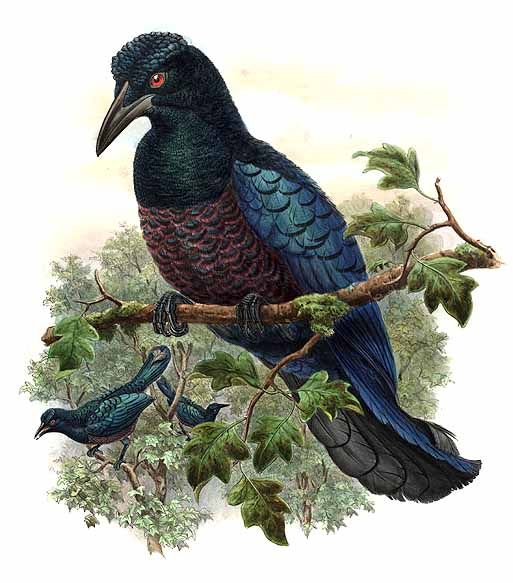
The Curl-crested Manucode is medium-sized, measuring about 42 cm in length. Both males and females exhibit the species' characteristic iridescent plumage, which can appear variously blue, green, or purple depending on the angle of light. The bird's defining feature is its unique twisted crest, which resembles curls. Males and females are similar in appearance, though males may have slightly more pronounced crests and vivid coloration. Juveniles resemble adults but are somewhat duller, lacking the full iridescent sheen and crest development of mature birds. In flight, the Curl-crested Manucode displays a sleek silhouette with elongated, rounded wings, and a long tail that aids in agile maneuverability through dense forest canopies. While perched, its posture is upright, with the curling crest and iridescent feathers making it a striking sight against the dark green foliage. Although there are other manucodes within its range, the Curl-crested Manucode is unique in its crest and can be identified by its vocalizations as well.
Having trouble telling birds apart? Upload a photo to our bird identification tool for an instant species match.
Curl-crested Manucode Habitat and Range
Preferred Habitat
The Curl-crested Manucode inhabits lowland and montane rainforests, primarily at elevations from sea level to around 1,100 meters. It favors dense, undisturbed forests where the canopy is lush, providing ample food sources and nesting sites. While it is predominantly a forest dweller, it occasionally ventures into forest edges but generally avoids open or heavily disturbed areas. The bird's reliance on intact forest ecosystems means that it is not commonly found in urban or suburban settings. Its habitat preferences remain stable year-round as it does not undertake seasonal migrations. Protecting these habitats is critical for its survival, as deforestation poses a significant threat.
Geographic Range
The Curl-crested Manucode is endemic to Papua New Guinea, specifically the D'Entrecasteaux Archipelago, including Fergusson, Normanby, and Goodenough islands. Within these islands, it occupies forested regions, maintaining a relatively stable presence across its limited range. Unlike many other bird species, the Curl-crested Manucode does not migrate and is considered a resident species within its habitat. Population densities can vary, with certain areas of primary forest supporting higher numbers due to favorable food availability and fewer disturbances. Conservation of these forested regions is crucial for maintaining its population.
Want to know which birds visit your area? Browse our backyard birds by location guides for region-specific species lists.
What Does the Curl-crested Manucode Eat?
The diet of the Curl-crested Manucode consists predominantly of fruits, with figs being a significant component. It supplements its diet with small insects and other invertebrates, which it gleans from foliage. The bird forages primarily in the canopy, using its strong bill to pluck fruits and insects. Its feeding activity peaks in the early morning and late afternoon, aligning with the availability of its primary food sources. During the wet season, when fruit abundance is at its peak, the manucode exhibits increased foraging activity. In contrast, during drier periods, it may rely more on insects to supplement its diet. The bird's foraging behavior supports seed dispersal, crucial for forest regeneration.
Curl-crested Manucode Behavior and Social Structure
The Curl-crested Manucode exhibits a largely solitary lifestyle, although it occasionally forms loose associations with conspecifics, particularly during feeding. Territorial behavior is evident, with males defending feeding areas and displaying their vibrant plumage and vocal prowess to assert dominance. Courtship involves elaborate displays where males showcase their iridescent feathers and perform subtle dances to attract females. These displays are essential for mate selection, as females choose partners based on the quality of their plumage and display. The bird's daily routine includes periods of rest interspersed with active foraging, primarily in the early morning and late afternoon. The manucode is generally non-aggressive, with social interactions typically limited to courtship and territorial disputes. In response to predators, it relies on its agility and dense foliage for protection, often giving alarm calls to alert others of danger.
Curl-crested Manucode Nesting and Reproduction
The Curl-crested Manucode builds its nest high in the forest canopy, typically choosing a sturdy branch with ample cover from foliage. The nest is a cup-shaped structure made from twigs, leaves, and other plant materials, lined with softer fibers for insulation. The female lays a clutch of one to two eggs, which she incubates for approximately 20 days. During incubation, the male may assist by providing food to the female. Once hatched, the chicks remain in the nest for about 25 days, during which both parents participate in feeding and caring for the young. The species typically raises one brood per year, with nesting timed to coincide with periods of abundant food availability.
Curl-crested Manucode Sounds and Vocalizations
The primary vocalization of the Curl-crested Manucode is a series of melodious whistles, with a rhythmic pattern that carries through the dense forest. These whistles vary in pitch and tone, creating a complex acoustic signature that distinguishes it from other species. Its calls serve multiple purposes, including territory defense, mate attraction, and communication with conspecifics. During the dawn chorus, the manucode's calls are particularly prominent, contributing to the rich tapestry of sounds in its habitat. Alarm calls are sharper and more abrupt, designed to alert others of potential threats.
Interesting Facts About the Curl-crested Manucode
- 1The Curl-crested Manucode is one of only a few birds of paradise found outside mainland New Guinea.
- 2Unlike many birds of paradise, the Curl-crested Manucode does not exhibit stark sexual dimorphism; both sexes share similar plumage.
- 3Its iridescent feathers can appear nearly black in low light, a contrast to their vibrant hues in sunlight.
- 4The Curl-crested Manucode's calls can be heard over half a mile away, a testament to their strength and resonance.
- 5This bird's diet largely consists of figs, making it an important seed disperser in its forest ecosystem.
- 6The species' crest feathers curl due to a unique structural composition, contributing to its name and distinct appearance.
- 7It is one of the few birds capable of using its tongue to manipulate and consume fruit, an adaptation to its frugivorous diet.
Curl-crested Manucode Conservation Status
The Curl-crested Manucode is currently listed as Least Concern by the IUCN, though its population trend is decreasing due to deforestation and habitat degradation. The primary threat to its survival is the loss of rainforest habitat, driven by logging and agricultural expansion. Conservation efforts focus on protecting remaining forest areas and implementing sustainable land-use practices. Maintaining these habitats is vital not only for the manucode but also for the broader ecosystem. Historically, the species' population was more stable, but recent pressures highlight the need for continued conservation action.


