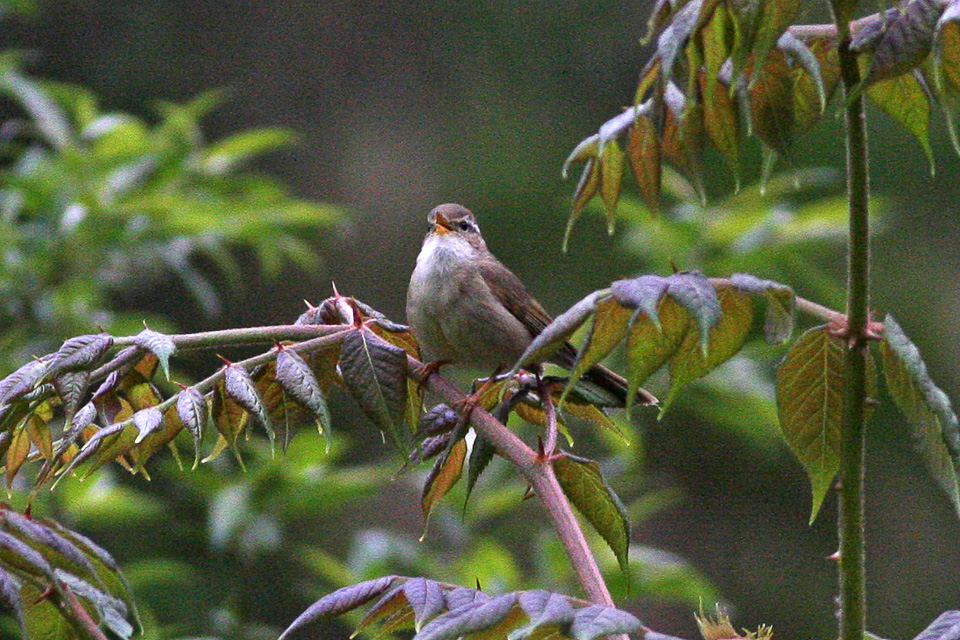
Davison's Leaf Warbler
Phylloscopus intensior
Order: Passeriformes / Family: Phylloscopidae

Wikimedia Commons
About the Davison's Leaf Warbler
The Davison's Leaf Warbler, Phylloscopus intensior, is a small yet distinct bird that is predominantly found in the subtropical and tropical forests of Southeast Asia. This warbler is renowned for its lively presence, flitting energetically among the dense foliage of evergreen and deciduous forests. It plays a critical ecological role as an insectivore, helping to maintain the balance of insect populations within its habitat.
This species is commonly observed in the countries of Thailand, Myanmar, and Laos, though it occasionally extends its range into the southern regions of China and northern parts of Vietnam. During the breeding season, which typically occurs from March to July, Davison's Leaf Warblers become more vocal and active, engaging in courtship displays amidst the lush forest canopy. The bird's preference for high-elevation forests, often between 600 to 2000 meters, provides it with a relatively stable and less disturbed environment, particularly in protected areas such as national parks.
Ecologically, the Davison's Leaf Warbler contributes to the forest ecosystem by interacting with various plant species through seed dispersal and pollination, albeit indirectly, as it searches for food. During the winter months, the bird may migrate short distances in search of food, descending to lower elevations where temperatures are milder and insects more plentiful. This seasonal movement helps to distribute its ecological impact over a wider area, reinforcing its role as a keystone insectivore in the forest ecosystem.
The Davison's Leaf Warbler belongs to the family Phylloscopidae, within the order Passeriformes. These birds typically live typically 2-3 years with a maximum recorded of 5 years..
How to Identify a Davison's Leaf Warbler
Adult Davison's Leaf Warblers are characterized by their bright green upperparts and contrasting yellow underparts, which make them relatively easy to distinguish from other Phylloscopus species. The bird measures approximately 10-11 centimeters in length, with a wingspan of about 16-20 centimeters. It has a distinctively short and slightly rounded tail, which it often flicks when agitated or in search of food.
Males and females appear similar in plumage, though males may exhibit slightly more vibrant coloring during the breeding season. Juveniles resemble adults but have duller plumage, with less pronounced yellow on their underparts. In flight, the Davison's Leaf Warbler displays a rapid, undulating flight pattern typical of small passerines, with quick bursts of wingbeats followed by gliding.
The main identification challenge lies in differentiating this species from other leaf warblers, such as the Blyth's Leaf Warbler. However, the Davison's Leaf Warbler's brighter green plumage and more pronounced yellow underparts can serve as reliable distinguishing traits. When perched, it often adopts a horizontal stance, which, combined with its active foraging behavior, can help birdwatchers identify it.
Having trouble telling birds apart? Upload a photo to our bird identification tool for an instant species match.
Davison's Leaf Warbler Habitat and Range
Preferred Habitat
The Davison's Leaf Warbler primarily inhabits subtropical and tropical forests, thriving in environments with dense undergrowth and abundant foliage. These birds are most comfortable in forested regions at elevations ranging from 600 to 2000 meters. They prefer areas with a mix of deciduous and evergreen trees, which provide ample opportunities for foraging and nesting.
During the breeding season, the Davison's Leaf Warbler is commonly found in high-elevation forests, where it can take advantage of the relatively stable climate and reduced competition from other bird species. In contrast, during the non-breeding months, it may move to lower elevations or more open forested areas in search of food, indicating a degree of adaptability in its habitat preferences.
While they are most often associated with remote, natural forest environments, Davison's Leaf Warblers occasionally venture into more disturbed areas, such as forest edges or secondary growth, particularly if these areas are adjacent to more pristine habitats. However, they are generally absent from urban environments, preferring the solitude and resources offered by forested regions.
Geographic Range
The Davison's Leaf Warbler has a relatively limited range, confined to the subtropical and tropical regions of Southeast Asia. It primarily breeds in northern Thailand, Myanmar, and Laos, with occasional occurrences in southern China and northern Vietnam. The bird's breeding range is characterized by high-elevation forests, typically from 600 to 2000 meters, where it finds suitable nesting sites and abundant food resources.
During the non-breeding season, some populations may migrate short distances, descending to lower elevations as they search for food. This seasonal movement can extend their range into the lower mountain slopes and foothills, where temperatures are warmer and insect prey is more accessible. Despite these movements, the Davison's Leaf Warbler remains largely restricted to forested regions throughout the year.
Population densities of the Davison's Leaf Warbler are generally higher in protected areas, such as national parks and wildlife reserves, where forest habitats remain intact. These areas offer vital refuges for the species, protecting it from habitat loss and other anthropogenic threats. In contrast, the bird is less commonly found in heavily deforested regions, which lack the necessary resources for sustaining its populations.
Want to know which birds visit your area? Browse our backyard birds by location guides for region-specific species lists.
What Does the Davison's Leaf Warbler Eat?
The Davison's Leaf Warbler relies primarily on a diet of insects and other small invertebrates, making it a crucial player in controlling insect populations within its ecosystem. Its diet consists mostly of caterpillars, beetles, and spiders, which it gleans from leaves and branches as it forages through the forest canopy.
Seasonal variations in food availability influence the warbler's diet. During the breeding season, when insect populations peak, the bird focuses on high-protein prey like caterpillars to support the energy demands of raising young. In contrast, during the winter months, its diet may diversify to include more adult insects and other arthropods, as well as the occasional berry or fruit.
The Davison's Leaf Warbler employs a variety of foraging techniques, including gleaning, hovering, and sometimes flycatching, to capture its prey. It typically feeds during the early morning and late afternoon, taking advantage of cooler temperatures and reduced competition from other insectivores. The bird's active and agile foraging style allows it to exploit a wide range of microhabitats within the forest.
Davison's Leaf Warbler Behavior and Social Structure
Davison's Leaf Warblers are predominantly solitary or found in pairs, particularly during the breeding season when they become highly territorial. Males vigorously defend their territories through song and displays, ensuring access to resources and attracting mates. These birds exhibit strong site fidelity, often returning to the same territories each breeding season.
Outside of the breeding season, the warbler may join mixed-species foraging flocks, benefiting from increased vigilance against predators and enhanced foraging opportunities. These associations typically occur during the non-breeding months when the need for territorial defense diminishes.
The courtship displays of Davison's Leaf Warblers are subtle yet intricate, involving a combination of vocalizations and physical displays. Males may sing persistently from prominent perches, occasionally engaging in aerial displays that showcase their agility and vibrant plumage. The bird's daily activity patterns involve periods of intense foraging interspersed with rest and preening, reflecting its energetic lifestyle.
The warbler's response to predators, such as raptors or larger birds, includes alarm calls and evasive maneuvers. It relies on its agility and familiarity with the forest environment to evade capture, often retreating into dense foliage or joining mixed-species flocks to reduce individual predation risk.
Davison's Leaf Warbler Nesting and Reproduction
Davison's Leaf Warblers construct cup-shaped nests, typically placed in the fork of a tree or shrub, well-concealed by surrounding foliage. The choice of nesting site is crucial, as it must provide both camouflage and protection from predators and environmental elements.
The nest is constructed from a variety of materials, including grasses, leaves, and rootlets, lined with softer materials like feathers or animal hair. The female primarily undertakes nest construction, investing significant time and effort to ensure its structural integrity and insulation.
A typical clutch consists of 3-5 eggs, which are creamy white with fine speckling. The incubation period lasts approximately 12-14 days, during which the female incubates the eggs while the male provides food and protection. After hatching, both parents participate in feeding the chicks, which fledge after about 12-15 days.
The Davison's Leaf Warbler usually raises one brood per year, though in optimal conditions, a second brood may be attempted. Parental care extends beyond fledging, with parents continuing to feed and protect the young until they become independent.
Davison's Leaf Warbler Sounds and Vocalizations
The primary song of the Davison's Leaf Warbler is a series of high-pitched, melodious notes delivered in rapid succession. The rhythm is lively and fluid, often described as a 'trill' or 'warble.' This song serves as a key identifier for the species, particularly during the breeding season when males sing prominently to establish territories and attract mates.
In addition to its primary song, the Davison's Leaf Warbler emits a range of call notes, including short 'chip' sounds and soft 'tseep' calls. These vocalizations facilitate communication between individuals, particularly in dense forest environments where visual contact is limited.
Alarm calls are sharper and more urgent, designed to alert conspecifics to the presence of potential predators. During the dawn chorus, the Davison's Leaf Warbler becomes especially vocal, contributing to the symphony of forest sounds as it competes with other birds for auditory space.
Interesting Facts About the Davison's Leaf Warbler
- 1Davison's Leaf Warblers are named after William Davison, a 19th-century Scottish naturalist.
- 2These warblers can consume up to 80% of their body weight in insects daily during breeding.
- 3Despite their small size, Davison's Leaf Warblers have a powerful song that carries well in dense forests.
- 4The species exhibits site fidelity, often returning to the same breeding territory year after year.
- 5Davison's Leaf Warblers are highly agile, capable of rapid maneuvers to catch flying insects mid-air.
- 6They play a crucial role in controlling pest populations, benefiting the forest ecosystem as a whole.
- 7In mixed-species flocks, they often act as sentinels, alerting other birds to the presence of predators.
Davison's Leaf Warbler Conservation Status
The Davison's Leaf Warbler is currently listed as Least Concern by the IUCN, with stable population trends across its range. However, habitat loss due to deforestation poses a significant threat to its long-term survival. The conversion of forested areas to agricultural land and urban development continues to reduce available habitat, particularly in regions outside protected areas. Conservation efforts focus on preserving and restoring natural forest habitats, with emphasis on maintaining the ecological integrity of protected areas. National parks and wildlife reserves play a crucial role in safeguarding the warbler's habitat, allowing for continued breeding and population maintenance. Past population declines have been mitigated by increased awareness and conservation initiatives, which have helped stabilize numbers. Ongoing monitoring and habitat protection remain essential to ensure that the Davison's Leaf Warbler continues to thrive in its natural environment.