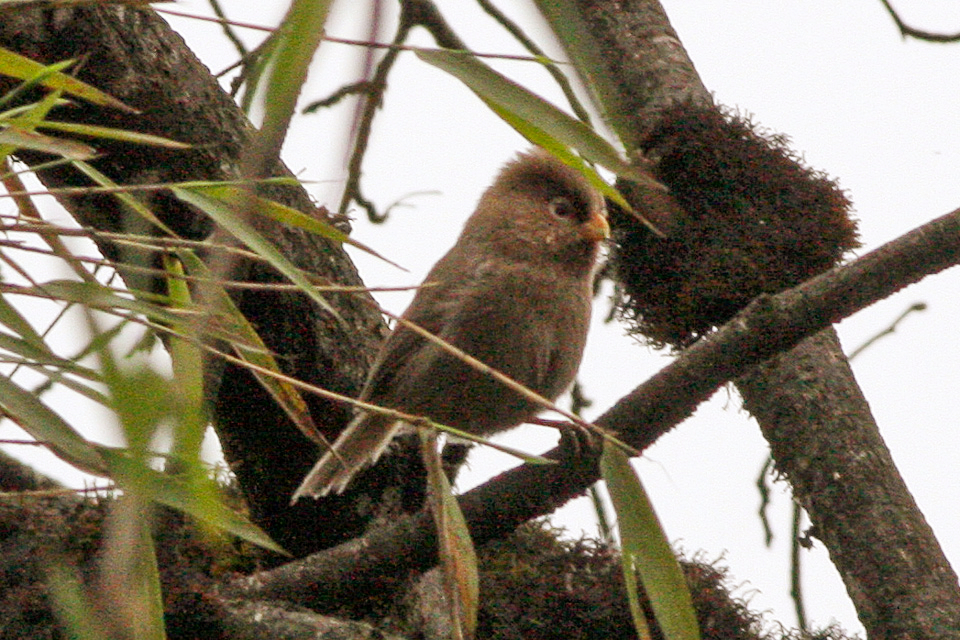
Dohrn's Thrush-Babbler
Horizorhinus dohrni
Order: Passeriformes / Family: Sylviidae

Wikimedia Commons
About the Dohrn's Thrush-Babbler
The Dohrn's Thrush-Babbler, scientifically known as Horizorhinus dohrni, is a small, enigmatic songbird endemic to the island of São Tomé, part of the Gulf of Guinea off the coast of Central Africa. This species is of great interest to ornithologists due to its limited distribution and specialized habitat preferences. It inhabits tropical primary forest, secondary growth, and some plantation areas, although it is most commonly observed in undisturbed forest regions. These birds play an essential role in their ecosystem as insectivores, contributing to the control of insect populations. The Dohrn's Thrush-Babbler is known for its secretive nature, often skulking through dense underbrush and rarely venturing into open areas, making it a challenge to observe in the wild. Despite its elusive behavior, this bird remains significant for biodiversity studies in the region. Seasonal behaviors of the Dohrn's Thrush-Babbler include periods of increased vocal activity during the breeding season, when males are more likely to sing to establish and defend territories. This period typically occurs during the rainy season, when food availability is at its peak. The bird's presence is a key indicator of forest health, as it relies heavily on intact ecosystems. Conservation efforts are crucial for maintaining this species, as habitat degradation poses a significant threat to its survival. The Dohrn's Thrush-Babbler is a focal point for conservationists working to preserve the unique avian diversity of São Tomé.
The Dohrn's Thrush-Babbler belongs to the family Sylviidae, within the order Passeriformes. These birds typically live typically around 6 years in the wild, with the potential to reach 8 years..
How to Identify a Dohrn's Thrush-Babbler
Identifying the Dohrn's Thrush-Babbler involves noting its distinctive rusty-brown plumage, which is consistent across both sexes, with no significant sexual dimorphism. The bird measures approximately 16 cm in length, making it a medium-sized songbird within its habitat. Its upperparts are a rich, warm brown, while the underparts are slightly paler, featuring subtle streaking that can be difficult to discern in dim lighting. Juvenile birds resemble adults but may display a slightly duller coloration, with less defined streaks on the underparts. In terms of similar species, the Dohrn's Thrush-Babbler is unlikely to be confused with other birds on São Tomé due to its unique color and pattern. Its flight silhouette is characterized by a short, rounded tail and relatively broad wings, which it uses adeptly to navigate through dense forest canopy. When perched, the bird adopts a horizontal posture, often remaining motionless for extended periods to avoid detection. This bird’s song, along with its distinctive plumage, serves as a reliable field mark for those fortunate enough to encounter it.
Having trouble telling birds apart? Upload a photo to our bird identification tool for an instant species match.
Dohrn's Thrush-Babbler Habitat and Range
Preferred Habitat
The Dohrn's Thrush-Babbler primarily inhabits the dense tropical forests of São Tomé, thriving in both primary and secondary growth areas. It prefers elevations ranging from sea level up to 1,400 meters, often frequenting moist, shaded environments where undergrowth provides ample cover. The species demonstrates some adaptability, occasionally venturing into plantations, particularly those interspersed with native forest patches. Despite this adaptability, the bird is rarely found in urban settings, which lack the necessary vegetation density. Seasonal shifts in habitat use are minimal, as the bird remains a year-round resident within its limited range. Preservation of its forest habitat is critical, as deforestation poses a significant threat to its continued survival.
Geographic Range
The Dohrn's Thrush-Babbler is endemic to São Tomé, an island located in the Gulf of Guinea, off the western equatorial coast of Africa. Its range is restricted to this island, where it occupies several distinct forested regions. There is no evidence of migration, with the species being a permanent resident throughout its range. The bird's population density is highest in areas of primary forest, where food resources and suitable nesting sites are abundant. Although São Tomé is small, the varied topography and microhabitats on the island create diverse ecological niches that support this unique species. Conservation efforts focus on protecting these critical habitats to ensure the continued presence of the Dohrn's Thrush-Babbler.
Want to know which birds visit your area? Browse our backyard birds by location guides for region-specific species lists.
What Does the Dohrn's Thrush-Babbler Eat?
The Dohrn's Thrush-Babbler primarily feeds on a diet of insects and other small invertebrates, which it gleans from foliage and leaf litter in the forest understory. During the rainy season, the abundance of insects allows for increased foraging activity, with the birds becoming more vocal and visible. Its diet may include beetles, caterpillars, ants, and spiders, exploiting the rich biodiversity of its forest environment. The bird employs a methodical foraging technique, moving deliberately through dense underbrush and using its bill to probe and flick aside leaves. Prey size typically ranges from small to medium, with the bird showing a preference for easily manageable items. While primarily insectivorous, the Dohrn's Thrush-Babbler may occasionally consume small fruits or berries when insects are scarce.
Dohrn's Thrush-Babbler Behavior and Social Structure
The Dohrn's Thrush-Babbler exhibits solitary behavior, with individuals or pairs often maintaining small territories within their forested habitats. Territorial disputes can occur, particularly during the breeding season, when males become more vocal and aggressive in defending their space. Courtship displays are subtle, often involving vocalizations and mutual preening between mates. The species is not known for flocking, preferring instead to remain inconspicuous within dense vegetation. Its response to predators involves remaining still and silent, relying on its cryptic plumage for camouflage. The bird is most active during the early morning and late afternoon, avoiding the heat of midday. Its daily activities revolve around foraging and territory maintenance, with less emphasis on social interactions compared to some other songbird species.
Dohrn's Thrush-Babbler Nesting and Reproduction
Dohrn's Thrush-Babbler constructs a cup-shaped nest using twigs, leaves, and grasses, typically placing it low in dense shrubbery or small trees. Nest location is chosen to provide concealment from potential predators and to shield from environmental elements. The typical clutch size consists of two to three eggs, which are incubated by both parents for approximately two weeks. Upon hatching, the nestlings remain in the nest for another two weeks before fledging. Both parents share responsibilities in feeding and caring for the young, ensuring a high degree of parental investment. The species generally raises one brood per year, although favorable conditions may occasionally allow for a second.
Dohrn's Thrush-Babbler Sounds and Vocalizations
The Dohrn's Thrush-Babbler's song is a series of melodious, flute-like notes, delivered in a steady, rhythmic pattern. Each phrase is clear and carries well through the dense forest foliage. In addition to its primary song, the bird produces a variety of call notes, including sharp, high-pitched alarms used to signal potential threats. During the dawn chorus, males are particularly vocal, using their songs to establish presence and attract mates. The bird's vocalizations are reminiscent of other thrushes but possess a distinct clarity and rhythmic beauty, making them a delight to hear in its forest habitat.
Interesting Facts About the Dohrn's Thrush-Babbler
- 1The Dohrn's Thrush-Babbler was first described in 1884 by German ornithologist Anton Reichenow.
- 2Despite its small range, the Dohrn's Thrush-Babbler shares its habitat with over 140 bird species endemic to São Tomé and Príncipe.
- 3The Dohrn's Thrush-Babbler is named after the German naturalist Carl Dohrn, who was known for his diverse contributions to zoology.
- 4The bird's elusive nature makes it a prized sighting for birdwatchers visiting São Tomé.
- 5It is one of the few thrush-babblers adapted to life in dense tropical forests, a testament to its evolutionary adaptability.
Dohrn's Thrush-Babbler Conservation Status
The Dohrn's Thrush-Babbler is currently listed as Near Threatened on the IUCN Red List, with habitat loss due to deforestation being the primary threat to its survival. Population trends indicate a gradual decline, driven by logging activities and agricultural expansion on São Tomé. Conservation efforts focus on preserving existing forest habitats and promoting sustainable land-use practices. Historical data suggest that the population was once more robust, but increased human activity on the island has led to significant habitat degradation. Continued conservation actions are necessary to prevent further decline and to ensure the survival of this unique species.