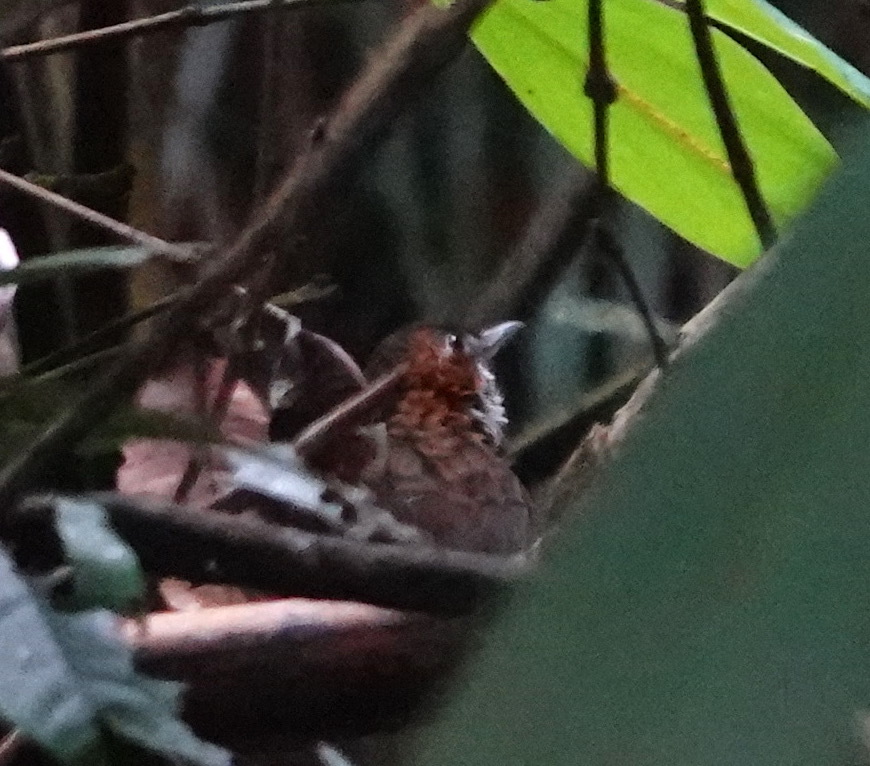
Eyebrowed Wren-Babbler
Napothera epilepidota
Order: Passeriformes / Family: Pellorneidae

Wikimedia Commons
About the Eyebrowed Wren-Babbler
The Eyebrowed Wren-Babbler (Napothera epilepidota) inhabits the lush forest undergrowth of Southeast Asia, specifically in countries like Thailand, Malaysia, and Vietnam. This small, secretive bird is part of the Pellorneidae family and is a quintessential member of the passerine order. The Eyebrowed Wren-Babbler plays a significant ecological role as both a predator of small invertebrates and a prey species for larger birds and mammals. Its presence in the ecosystem indicates a healthy, biodiverse environment.
In the dense jungles where the Eyebrowed Wren-Babbler resides, its understated plumage provides excellent camouflage, allowing it to flit among the shadows unnoticed. Despite its muted coloration, the bird's distinctive white eyebrow stripe offers a key identification point for avid birders. The species thrives in subtropical and tropical moist lowland forests and occasionally ventures into subtropical or tropical moist montane forests, adapting to elevations ranging from sea level to about 1800 meters.
During the breeding season, which varies slightly across its range but generally peaks from April to July, the Eyebrowed Wren-Babbler becomes more vocal, utilizing a series of clear, melodious whistles to establish territory and attract mates. The bird's ecological role extends beyond its dietary habits, as it also assists in the dispersal of seeds and the control of insect populations, contributing to the overall health and function of its habitat.
The Eyebrowed Wren-Babbler forms an integral part of the avian community within its range, often found in mixed-species flocks during the non-breeding season. This behavior not only aids in protection against predators but also enhances foraging efficiency. These flocks typically roam the forest understory, a bustling community that adds vibrancy and complexity to the forest ecosystem.
The Eyebrowed Wren-Babbler belongs to the family Pellorneidae, within the order Passeriformes. These birds typically live typically 5-6 years, with some living up to 8 years..
How to Identify a Eyebrowed Wren-Babbler
Identifying the Eyebrowed Wren-Babbler in the field requires keen observation. Adults sport a rich brown plumage with subtle streaks, but the defining feature is the prominent white eyebrow stripe, which contrasts sharply with its darker face and crown. Juveniles resemble adults but have a slightly duller appearance with less distinct streaking.
Although males and females appear similar, subtle differences can be noted upon close inspection. Males may exhibit slightly brighter plumage, particularly during the breeding season, which can assist in sexual selection. In comparison to similar species like the Streaked Wren-Babbler, the Eyebrowed Wren-Babbler's eyebrow stripe is more pronounced, serving as a critical field mark.
When perched, the Eyebrowed Wren-Babbler adopts a horizontal posture, often flicking its tail nervously. Its small size and propensity to stay close to the ground make it less conspicuous, but once in flight, the bird exhibits a rapid, buzzing flight pattern. This flight silhouette, combined with its vocalizations, aids birders in locating it within dense vegetation.
Having trouble telling birds apart? Upload a photo to our bird identification tool for an instant species match.
Eyebrowed Wren-Babbler Habitat and Range
Preferred Habitat
The Eyebrowed Wren-Babbler predominantly inhabits subtropical and tropical moist lowland forests, favoring dense undergrowth and forest edges. In places like the forests of northern Thailand and peninsular Malaysia, it thrives in the thick, humid understory where visibility is limited. This bird also inhabits subtropical or tropical moist montane forests, adapting to elevations between 500 and 1800 meters.
Seasonal habitat shifts occur as the bird follows food availability, though it generally remains within forested regions. The Eyebrowed Wren-Babbler tends to avoid urban areas, preferring the seclusion and protection offered by dense foliage. Unlike some forest birds, it does not readily adapt to heavily disturbed habitats, making it a reliable indicator species for forest health.
Geographic Range
The Eyebrowed Wren-Babbler's range extends across several Southeast Asian countries, including Thailand, Myanmar, Laos, Vietnam, Malaysia, and parts of Indonesia. It is a non-migratory species, residing year-round within these regions. However, local altitudinal movements may occur in response to seasonal changes in food availability.
The bird's breeding range is primarily within the lower and middle elevations of these countries, often closely tied to specific forest types. While it does not engage in long-distance migration, the Eyebrowed Wren-Babbler may undertake short movements within its range to exploit different forest areas as seasonal conditions dictate. Population density hotspots include the rich, biodiverse forests of northern Thailand and the Malaysian Peninsula, where dense understory provides ample foraging opportunities.
Want to know which birds visit your area? Browse our backyard birds by location guides for region-specific species lists.
What Does the Eyebrowed Wren-Babbler Eat?
The Eyebrowed Wren-Babbler primarily feeds on small invertebrates, including insects and spiders, foraging methodically through leaf litter and undergrowth. Its diet consists mainly of ants, beetles, caterpillars, and other small arthropods, which it captures with its sharp, probing bill.
During the breeding season, the bird may increase its intake of protein-rich insects to support energy demands. Foraging typically occurs during the cooler hours of the day, early morning and late afternoon, when insect activity peaks. Although invertebrates constitute its primary food source, the Eyebrowed Wren-Babbler may occasionally consume seeds and small fruits, particularly when insect abundance is low.
The bird's foraging technique involves a mix of ground gleaning and low, active searching among dense foliage. By turning over leaves and probing crevices, it efficiently locates hidden prey. This strategy not only fulfills its dietary needs but also plays a role in controlling insect populations within its forest habitat.
Eyebrowed Wren-Babbler Behavior and Social Structure
The Eyebrowed Wren-Babbler exhibits a solitary or paired lifestyle, often maintaining well-defined territories during the breeding season. Territorial calls, consisting of clear whistles and trills, serve both to ward off rivals and to attract mates. Courtship displays are subtle but may include wing flicking and soft vocalizations.
Outside of breeding periods, the bird may join mixed-species flocks, a strategy that enhances foraging success and predator vigilance. These flocks, often composed of various insectivorous species, traverse the forest understory in search of food.
In response to predators, the Eyebrowed Wren-Babbler employs cryptic behavior, often freezing in place or retreating into dense cover. Its daily activity peaks during dawn and dusk, aligning with periods of increased insect activity. Despite its generally elusive nature, the bird's vocalizations provide a reliable auditory cue for locating it in its dense forest habitat.
Eyebrowed Wren-Babbler Nesting and Reproduction
The Eyebrowed Wren-Babbler constructs a well-concealed nest, often choosing a secluded spot among dense undergrowth or in low shrubs. Nests are cup-shaped, crafted from leaves, grasses, and twigs, held together with spider silk or plant fibers. This construction provides both camouflage and protection from the elements.
Clutch size generally ranges from two to four eggs, with both parents sharing incubation duties over approximately 12 to 14 days. Once hatched, the chicks remain in the nest for about 10 to 12 days before fledging. The fledging period involves intensive parental care, including feeding and protection from predators.
Parental roles are shared, though the female primarily handles incubation. The Eyebrowed Wren-Babbler typically raises one or two broods per year, depending on food availability and environmental conditions. The nesting cycle is a critical period, demanding high energy investment from both parents to ensure the survival of their offspring.
Eyebrowed Wren-Babbler Sounds and Vocalizations
The Eyebrowed Wren-Babbler is best known for its clear, melodious song, which consists of a series of whistles and trills. These vocalizations, often delivered from a concealed perch, serve to establish territory and attract mates. The primary song features a rhythmic pattern, often starting with a few slow notes followed by a rapid trill that descends in pitch.
In addition to its song, the bird emits soft contact calls while foraging or when in the company of a mate or mixed-species flock. Alarm calls, triggered by the presence of predators, are sharper and more urgent, serving as a warning to nearby birds.
The Eyebrowed Wren-Babbler contributes to the dawn chorus, its song interweaving with those of other forest inhabitants. This auditory presence is essential for communication within its dense, visually obstructive habitat.
Interesting Facts About the Eyebrowed Wren-Babbler
- 1The Eyebrowed Wren-Babbler's white eyebrow stripe is not just ornamental; it plays a vital role in its communication, especially during territorial disputes.
- 2Despite its small size, the Eyebrowed Wren-Babbler can produce a song audible from over 100 meters away, an impressive feat given its densely vegetated habitat.
- 3The species belongs to the Pellorneidae family, which includes some of the most vocal and intricate songsters among the tropical Asian bird groups.
- 4The Eyebrowed Wren-Babbler's nesting success largely depends on the strategic placement of its nest, often hidden among thick foliage to avoid predators.
- 5This bird is often found in mixed-species flocks, benefiting from the 'many eyes' effect to spot predators and share foraging information.
- 6The Eyebrowed Wren-Babbler is non-migratory but may exhibit local altitudinal movements in response to seasonal changes in food availability.
- 7In addition to its insectivorous diet, the Eyebrowed Wren-Babbler occasionally consumes small fruits and seeds, contributing to seed dispersal in its habitat.
Eyebrowed Wren-Babbler Conservation Status
The Eyebrowed Wren-Babbler holds a conservation status of Least Concern according to the IUCN, owing to its relatively stable population across its range. However, habitat loss due to deforestation poses a significant threat, particularly in regions where logging and agricultural expansion encroach on forested areas. Conservation efforts focus on preserving the bird's natural habitat, emphasizing the importance of protected forest reserves. Historical population data suggest that while the species has faced localized declines, its overall numbers remain resilient when suitable habitat is maintained. Raising awareness about the ecological role of the Eyebrowed Wren-Babbler and its habitat needs is crucial for its continued survival. Efforts include habitat restoration projects and community engagement to promote sustainable land-use practices.
Other Pellorneidae Species


Birds Similar to the Eyebrowed Wren-Babbler
These species are often confused with the Eyebrowed Wren-Babbler due to similar appearance or overlapping range.