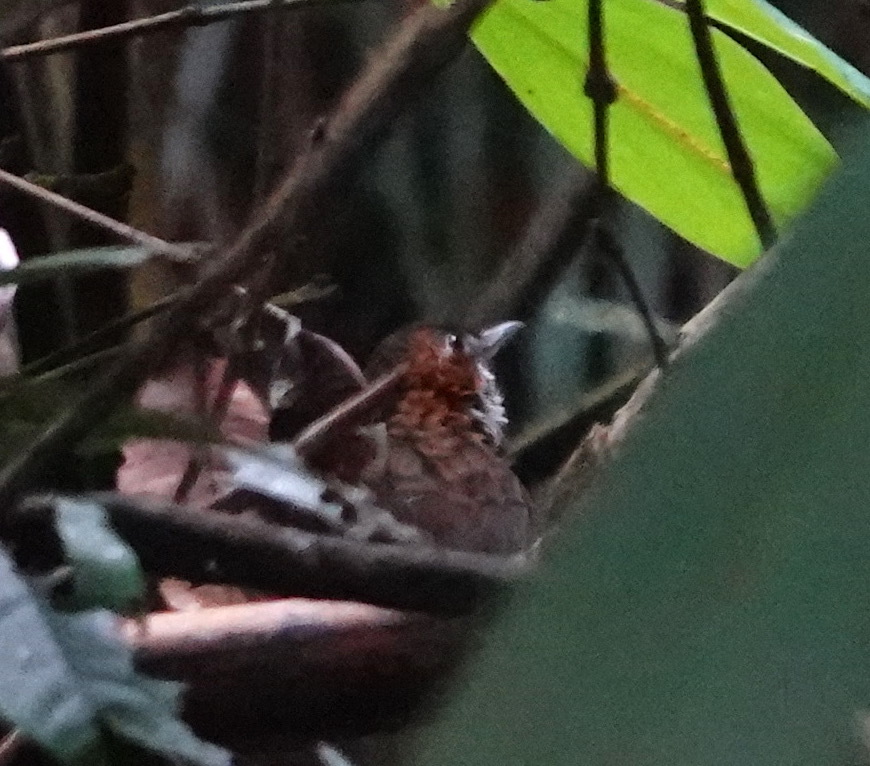
Large Wren-Babbler
Napothera macrodactyla
Order: Passeriformes / Family: Pellorneidae

Wikimedia Commons
About the Large Wren-Babbler
The Large Wren-Babbler, scientifically known as Napothera macrodactyla, is a distinctive bird found primarily in Southeast Asia. This species is a part of the Pellorneidae family, which is renowned for its rich vocalizations and ground-dwelling habits. The bird is predominantly found in the humid lowland forests of Malaysia, Thailand, and parts of Indonesia. Its preference for dense understory and leaf litter environments makes it an essential component of its ecosystem, aiding in seed dispersal and insect population control through its foraging activities.
Ecologically, the Large Wren-Babbler plays a vital role in its habitat. As an insectivore, it contributes to the regulation of insect populations, which helps maintain the health of the forest. Its diet mainly includes ants, beetles, and spiders, which it skillfully extracts from the leaf litter and underbrush. The bird's long toes are particularly adapted to navigating the uneven forest floor, allowing it to scratch and dig effectively.
Seasonal behaviors of the Large Wren-Babbler include slight shifts in feeding patterns and territory establishment. During the breeding season, which typically occurs in the wetter months, these birds become more vocal and territorial. They engage in complex vocal duets, which serve to strengthen pair bonds and delineate territory boundaries. Outside the breeding season, they may roam more widely in search of food, sometimes forming loose, mixed-species foraging flocks.
Conservation-wise, the Large Wren-Babbler is currently not listed as threatened, but its dependence on intact forest habitats makes it vulnerable to deforestation and habitat fragmentation. Preservation of its natural habitat is crucial, as these forests are rapidly diminishing due to logging and agricultural expansion. Efforts to protect these environments are vital to ensuring the survival of this unique and ecologically significant bird.
The Large Wren-Babbler belongs to the family Pellorneidae, within the order Passeriformes. These birds typically live typically 5-7 years, with some individuals living up to 9 years..
How to Identify a Large Wren-Babbler
The Large Wren-Babbler is a medium-sized bird, measuring approximately 17 cm in length. It possesses a predominantly brown plumage, which provides excellent camouflage against the leaf litter of its forest habitat. The bird's upperparts display a rich, warm brown, while its underparts tend to be paler with subtle streaking, particularly on the breast and flanks. A notable field mark is its long toes, which are particularly adapted for foraging among the forest floor detritus.
Juvenile Large Wren-Babblers resemble adults but often have slightly duller plumage and less defined streaking. There is little sexual dimorphism in this species, meaning males and females appear alike in the field. This can make individual identification challenging without close observation or vocalization analysis. The bird's stout bill and short wings are additional identifying features, consistent with its ground-dwelling lifestyle.
In flight, the Large Wren-Babbler's silhouette is less commonly observed, as the bird prefers to stay close to the ground. When it does take to the air, it typically flies short distances with rapid wing beats. Its perching posture is often hunched, with the bird appearing somewhat squat, which aids in its cryptic lifestyle.
Having trouble telling birds apart? Upload a photo to our bird identification tool for an instant species match.
Large Wren-Babbler Habitat and Range
Preferred Habitat
The Large Wren-Babbler primarily inhabits lowland tropical forests, where it thrives in dense undergrowth and areas with abundant leaf litter. These habitats provide the cover and food resources necessary for the bird's survival. Typical elevation ranges for this species are from sea level to approximately 1,200 meters, with a preference for flatter, more humid areas.
While primarily associated with primary forests, the Large Wren-Babbler can also be found in secondary growth forests, provided there is sufficient understory cover. It rarely ventures into open or heavily degraded areas, preferring the continuous canopy and thick ground cover that intact forests provide.
Seasonal habitat shifts are minimal, as the bird's range remains relatively constant throughout the year. The species is predominantly found in rural, forested regions rather than urban environments.
Geographic Range
The Large Wren-Babbler's range is predominantly within Southeast Asia. It is found across several countries, including Malaysia, Thailand, and parts of Indonesia such as Sumatra and Borneo. These regions provide the humid, forested environments that the species requires.
During the breeding season, the bird's range remains largely consistent, as it does not undertake long-distance migrations. Instead, it may perform local movements within its established territories to optimize breeding and feeding conditions.
Population densities are highest in protected forest reserves where logging and habitat destruction are minimized. In these areas, the bird can be relatively common, although overall population trends suggest a gradual decline due to habitat pressures. The species' range does not extend into northern or western habitats, remaining confined to tropical Southeast Asia.
Want to know which birds visit your area? Browse our backyard birds by location guides for region-specific species lists.
What Does the Large Wren-Babbler Eat?
The diet of the Large Wren-Babbler consists primarily of small invertebrates, with ants, beetles, and spiders forming the bulk of its intake. This bird is an adept forager, using its elongated toes to sift through leaf litter and uncover hidden prey. Its stout bill is well-suited for probing and extracting insects from the soil and underbrush.
Seasonal dietary shifts are minimal, as the bird's tropical habitat provides a relatively constant supply of invertebrates throughout the year. However, during wetter months, when insect abundance peaks, the Large Wren-Babbler may consume more soft-bodied insects such as caterpillars.
Foraging typically occurs during daylight hours, with peak activity in the early morning and late afternoon when temperatures are cooler and prey is more active. The bird often forages alone or in pairs, although it may join mixed-species flocks during non-breeding seasons to exploit food resources more efficiently.
Large Wren-Babbler Behavior and Social Structure
The Large Wren-Babbler exhibits a range of behaviors typical of ground-dwelling passerines. It is generally solitary or found in pairs, especially during the breeding season when it becomes strongly territorial. Territorial defense involves vocal displays and chasing of intruders, ensuring a safe and resource-rich environment for rearing young.
Courtship displays are subtle yet vocal, with pairs engaging in antiphonal duets that serve to strengthen pair bonds. These duets, complex and melodious, are also a means of advertising territory occupancy to other conspecifics. The Large Wren-Babbler's vocalizations are a key aspect of its behavior, used not only for communication but also as a deterrent to potential rivals.
In terms of daily activity, the bird is diurnal, with most activities concentrated in the early morning and late afternoon. During these periods, it forages actively, often methodically covering its territory in search of food. In response to predators, the bird employs cryptic behavior, relying on its camouflaged plumage and remaining motionless to avoid detection.
Large Wren-Babbler Nesting and Reproduction
The nesting habits of the Large Wren-Babbler are closely tied to its forest environment. Nests are typically constructed on or near the ground, concealed within dense vegetation or under the cover of fallen logs and debris. The nest itself is an open cup made of twigs, leaves, and roots, carefully woven to provide stability and protection.
Clutch sizes generally consist of 2 to 4 eggs, with incubation carried out primarily by the female. The incubation period lasts approximately 14 to 16 days, during which time the male may assist by providing food to the incubating female. After hatching, both parents participate in feeding and caring for the chicks.
Fledging occurs around 12 to 15 days after hatching, with the young leaving the nest to join their parents in foraging activities. The species typically raises one or two broods per year, depending on environmental conditions and food availability. Parental roles are relatively balanced, with both sexes contributing to chick rearing and territory defense.
Large Wren-Babbler Sounds and Vocalizations
The primary song of the Large Wren-Babbler is a rich, melodious series of whistles and trills, delivered in a rhythmic pattern. This song is used primarily during the breeding season for mate attraction and territory defense. Each individual possesses a slightly unique variation, allowing birds to recognize one another by sound.
In addition to its melodic song, the Large Wren-Babbler produces a range of call notes, including soft chirps and harsher alarm calls. These vocalizations serve various functions, from maintaining contact with mates to alerting others of potential threats.
During the dawn chorus, the bird is particularly vocal, contributing to the symphony of sounds that mark the beginning of the day in its forest habitat. This behavior underscores its role in the acoustic landscape of its environment.
Interesting Facts About the Large Wren-Babbler
- 1The Large Wren-Babbler's long toes are a distinctive adaptation, aiding in its ability to forage efficiently on the forest floor.
- 2Unlike many songbirds, the Large Wren-Babbler tends to remain within a consistent home range throughout the year, avoiding long migrations.
- 3Vocal duets between pairs of Large Wren-Babblers are not only for bonding but serve as a territorial defense mechanism.
- 4The bird's plumage provides excellent camouflage against the leaf litter, making it a master of stealth in its forest environment.
- 5Despite being non-migratory, the Large Wren-Babbler can adjust its range slightly in response to seasonal food availability.
- 6In some regions of Southeast Asia, the Large Wren-Babbler is a prominent participant in the dawn chorus, adding to the early morning cacophony.
- 7The habitat preference for dense undergrowth makes the Large Wren-Babbler an indicator species for forest health and biodiversity.
Large Wren-Babbler Conservation Status
Currently, the Large Wren-Babbler holds a conservation status of Least Concern according to the IUCN. However, its population trend is declining, primarily due to habitat loss from deforestation and land conversion for agriculture. The rapid depletion of lowland forests in Southeast Asia poses a significant threat to this species. Conservation efforts focus on habitat protection and the establishment of nature reserves, which provide safe havens for the bird and other forest-dependent species. Efforts to curb illegal logging and promote sustainable land-use practices are crucial for preserving the Large Wren-Babbler's habitat. Historically, population levels of the Large Wren-Babbler were more robust, but ongoing environmental pressures necessitate continued monitoring and conservation action to prevent future declines.
Other Pellorneidae Species


Birds Similar to the Large Wren-Babbler
These species are often confused with the Large Wren-Babbler due to similar appearance or overlapping range.