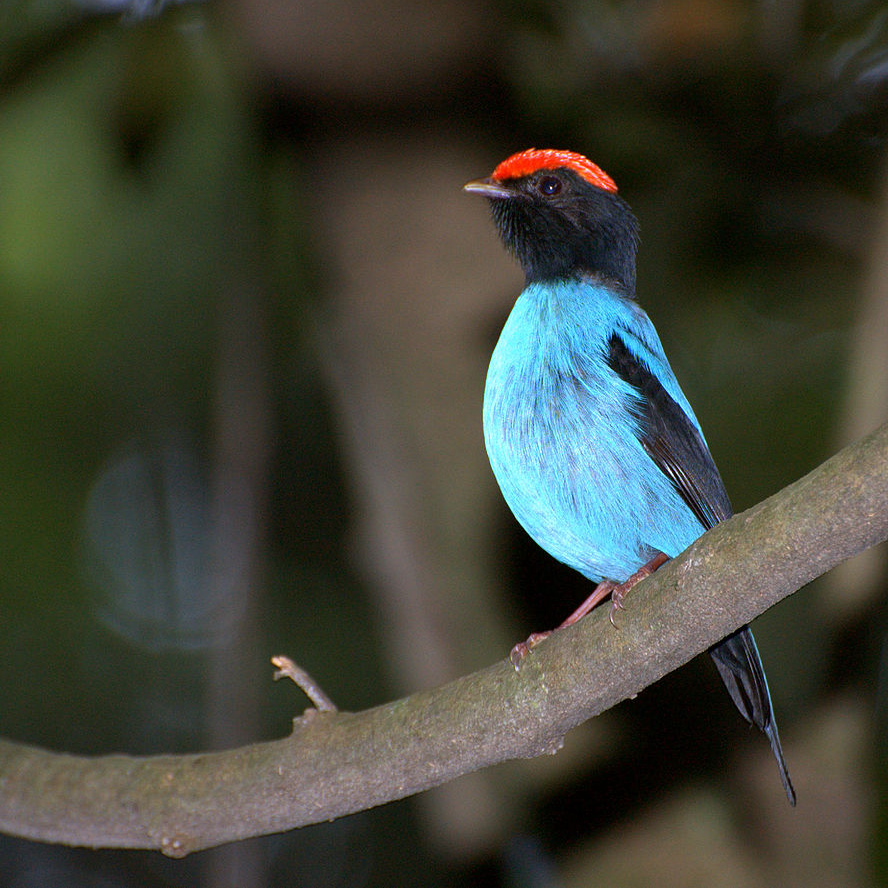
Flame-crowned Manakin
Heterocercus linteatus
Order: Passeriformes / Family: Pipridae

Wikimedia Commons
About the Flame-crowned Manakin
The Flame-crowned Manakin (Heterocercus linteatus) is a small passerine bird belonging to the family Pipridae. This visually striking species is most noted for its vivid flame-colored crown, which stands out against its otherwise olive-green body. Found primarily in the lowland tropical forests of the western Amazon Basin, this bird plays a significant ecological role as both a seed disperser and an insect predator. The Flame-crowned Manakin inhabits regions like the Loreto and Ucayali departments in Peru, extending into parts of western Brazil and eastern Ecuador. Its environment consists of dense understories and forest edges, where it contributes to the ecological balance by participating in seed germination processes and controlling insect populations. Throughout the year, the Flame-crowned Manakin engages in notable seasonal behaviors, including a prominent courtship display during the breeding season. Males gather in leks, where they perform a series of acrobatic maneuvers and produce distinctive calls to attract females. Outside of the breeding season, these birds are often solitary or found in small groups, displaying a more subdued social structure. These seasonal behaviors underline the species' adaptability and its ability to thrive in various microhabitats within its range.
The Flame-crowned Manakin belongs to the family Pipridae, within the order Passeriformes. These birds typically live 4 years on average, with a maximum recorded of 7 years..
How to Identify a Flame-crowned Manakin
Recognizing the Flame-crowned Manakin in its natural habitat involves noting several distinct field marks. Adult males possess the characteristic bright red crown, which contrasts sharply with their olive-green back and wings. Their underparts are a lighter yellowish color, providing a soft but noticeable separation from the darker back. Females and juvenile manakins are less vividly colored, with more subdued olive-green plumage and a less pronounced crown, making them harder to distinguish from other forest-dwelling birds. These differences in plumage between the sexes and age groups provide an insight into their roles within their species' social structure. Similar species, such as the Orange-crowned Manakin, can cause confusion, but the Flame-crowned Manakin's distinct red crown is a reliable distinguishing feature. In flight, its silhouette is compact, with short, rounded wings and a somewhat stubby tail. When perched, the Flame-crowned Manakin often adopts an upright posture, enhancing the visibility of its vibrant crown in the dense foliage of its forest habitat.
Having trouble telling birds apart? Upload a photo to our bird identification tool for an instant species match.
Flame-crowned Manakin Habitat and Range
Preferred Habitat
The preferred habitat of the Flame-crowned Manakin consists predominantly of lowland tropical forests, thriving particularly in areas with dense understory vegetation. These birds are most commonly found in the Amazon Basin, favoring primary forests with abundant insect diversity and fruit availability. They occupy elevations ranging from near sea level up to about 600 meters. Seasonal habitat shifts are minimal, as they are non-migratory, but they may move to slightly different forest areas in response to food availability changes. The Flame-crowned Manakin is usually absent from urban environments, preferring the undisturbed tranquility of rural and forested regions where human impact is minimal.
Geographic Range
The geographic range of the Flame-crowned Manakin extends across several South American countries, primarily within the Amazon Basin. Its distribution includes northeastern Peru, eastern Ecuador, and western Brazil. The bird is non-migratory, residing year-round in its range, although it may show some local movements in search of food. Population density is highest in the pristine forests of the Loreto and Ucayali regions in Peru, where environmental conditions are optimal for maintaining stable breeding populations. The Flame-crowned Manakin is less frequently observed in fragmented or heavily disturbed areas, underscoring the importance of contiguous forest habitats for its survival.
Want to know which birds visit your area? Browse our backyard birds by location guides for region-specific species lists.
What Does the Flame-crowned Manakin Eat?
The Flame-crowned Manakin's diet primarily consists of small fruits and insects, reflecting its role as both a frugivore and insectivore. Fruits from a variety of forest plants provide essential nutrients and energy, while insects offer protein-rich sustenance. Seasonal changes in diet may occur as different fruits become available, but they are adept at switching between food sources to meet their nutritional needs. Foraging typically occurs in the mid to lower canopy levels, where they skillfully pluck fruits and capture insects with swift, precise movements. This versatile foraging strategy allows the Flame-crowned Manakin to sustain itself throughout the year, regardless of seasonal fluctuations in food availability.
Flame-crowned Manakin Behavior and Social Structure
Socially, the Flame-crowned Manakin exhibits a fascinating array of behaviors, particularly during the breeding season when males engage in lekking. In these displays, males congregate in small groups and perform elaborate courtship dances, characterized by rapid wing movements and vocalizations to attract mates. Outside of the breeding season, the Flame-crowned Manakin is less gregarious, typically observed alone or in small mixed-species flocks. Territorial behavior is prominent in males, who vigorously defend their display sites against rivals. These birds are diurnal, with most activity occurring during the early morning and late afternoon, coinciding with peak feeding times. In response to potential threats, the Flame-crowned Manakin may emit alarm calls and retreat into dense foliage to avoid detection by predators.
Flame-crowned Manakin Nesting and Reproduction
Nesting for the Flame-crowned Manakin involves constructing a small, cup-shaped nest using fine plant fibers, leaves, and moss. These nests are typically situated in the lower to mid-level canopy, often well-concealed among dense foliage to protect them from predators. The clutch size usually consists of two eggs, with an incubation period of approximately 18-20 days. Female manakins primarily undertake incubation duties, while males focus on courtship and territorial defense. Once the eggs hatch, both parents contribute to feeding the chicks, which fledge after about 15-18 days. The species generally raises one brood per year, although favorable conditions may allow for a second brood.
Flame-crowned Manakin Sounds and Vocalizations
The Flame-crowned Manakin's vocalizations include a soft, melodic song characterized by a series of high-pitched notes that rise and fall in a rhythmic pattern. These songs serve as both territorial and courtship signals, often heard during the peak of the breeding season in the early morning. In addition to their primary song, these birds produce sharp call notes and alarm calls when disturbed or threatened. Their dawn chorus, while not as loud as some other bird species, is a distinctive aspect of their daily routine, contributing to the acoustic tapestry of the tropical forest.
Interesting Facts About the Flame-crowned Manakin
- 1The Flame-crowned Manakin is one of the most brightly colored manakins, with its vivid red crown being a key feature.
- 2During courtship, the male Flame-crowned Manakin performs a unique dance that involves acrobatic leaps and intricate wing displays.
- 3Manakins, including the Flame-crowned Manakin, have specially adapted wing feathers that produce mechanical sounds during flight displays.
- 4The Flame-crowned Manakin plays a crucial role in seed dispersal, aiding the regeneration of its tropical forest habitat.
- 5This species is part of a genus known for its elaborate lekking behavior, where males compete in group displays to attract females.
- 6The Flame-crowned Manakin is predominantly non-migratory, residing year-round in the Amazon Basin, unlike some other manakin species.
- 7Despite its small size, the Flame-crowned Manakin contributes significantly to its ecosystem through both insect predation and seed dispersal.
Flame-crowned Manakin Conservation Status
According to the IUCN, the Flame-crowned Manakin is currently listed as a species of Least Concern. However, its population trend shows signs of decline, primarily due to habitat loss from deforestation and forest fragmentation within its range. Conservation efforts focus on preserving large tracts of continuous forest, vital for maintaining stable populations. Despite these challenges, the historical population of the Flame-crowned Manakin has remained relatively stable, thanks to its adaptability and the protection of key habitats in national parks and reserves.