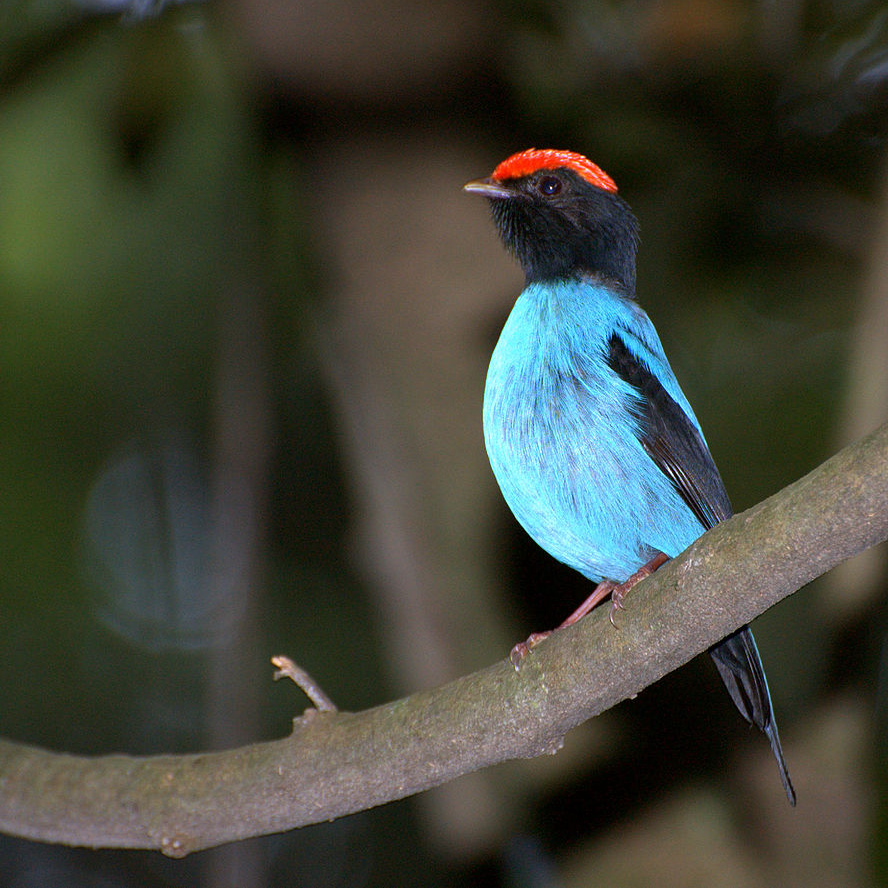
Golden-collared Manakin
Manacus vitellinus
Order: Passeriformes / Family: Pipridae

Wikimedia Commons
About the Golden-collared Manakin
The Golden-collared Manakin (Manacus vitellinus), a small, vividly colored bird in the Pipridae family, inhabits the tropical forests of Central America. Found primarily in Panama and western Colombia, this species thrives in humid lowland forests, especially in areas rich with dense understory vegetation. The manakin's striking appearance and behavior have made it a subject of interest for ornithologists and birdwatchers alike. This species plays an important role in its ecosystem as a seed disperser, aiding forest regeneration.
Golden-collared Manakins exhibit a fascinating lekking behavior during the breeding season, where males perform complex displays to attract females. These displays, characterized by unique acrobatics and mechanical snapping sounds, occur in small cleared areas on the forest floor. This courtship ritual not only highlights the bird's agility but also its evolutionary adaptation for attracting mates. As a frugivore, the Golden-collared Manakin primarily consumes fruit, which influences its habitat preferences and seasonal movements.
Ecologically, the presence of the Golden-collared Manakin indicates a healthy forest ecosystem. Its reliance on fruit means it contributes to seed dispersal, promoting plant diversity. The bird's seasonal behavior aligns with fruiting patterns, often leading it to explore different forest sections throughout the year. Its vocalizations, although not as melodious as other songbirds, play a vital role in communication and territory establishment within the dense forest habitat.
The Golden-collared Manakin belongs to the family Pipridae, within the order Passeriformes. These birds typically live average 5-7 years with a maximum of 10 years recorded..
How to Identify a Golden-collared Manakin
The Golden-collared Manakin is instantly recognizable by its brilliant yellow collar, contrasting with its otherwise olive-green body. Adult males are particularly distinctive, featuring a bright yellow throat and belly, with a black crown and face. The wings and back display a darker green hue, enhancing the contrast with its yellow markings. Females and juveniles differ significantly, exhibiting a more subdued olive-green overall plumage, lacking the bold yellow and black contrasts found in males.
In flight, the Golden-collared Manakin's short, rounded wings and rapid wing beats make it appear as a swift, darting presence among the forest understory. When perched, this species adopts an upright posture, often remaining motionless, which can make it challenging to spot among the dense foliage. The male's plumage and distinctive collar are key identifiers, especially during the breeding season when they perform conspicuous mating displays.
While it may be confused with other manakins, such as the White-collared Manakin (Manacus candei), the Golden-collared Manakin's unique combination of black, yellow, and olive-green makes it distinguishable. Observers can differentiate between these species by noting the absence of white in the Golden-collared Manakin's plumage.
Having trouble telling birds apart? Upload a photo to our bird identification tool for an instant species match.
Golden-collared Manakin Habitat and Range
Preferred Habitat
The Golden-collared Manakin predominantly inhabits humid lowland tropical forests, favoring areas with dense understory and abundant fruit resources. These forests, typically below 1,200 meters in elevation, provide the necessary cover and food abundance for the species. The bird shows a preference for primary forests but can also be found in secondary growth and forest edges where fruiting trees are plentiful.
During the breeding season, males select specific areas within the forest for their lekking grounds, often in small clearings surrounded by dense vegetation. This habitat choice facilitates their elaborate courtship displays, ensuring visibility while providing escape routes from predators. Unlike some tropical bird species, the Golden-collared Manakin does not occur in urban areas, maintaining its presence strictly in forested environments.
Seasonal habitat shifts are minimal, primarily influenced by the availability of fruit rather than climate changes. The bird's reliance on forest habitats underscores the importance of conserving these environments in regions like Panama and Colombia.
Geographic Range
The Golden-collared Manakin is a resident bird of Central America, with its range primarily encompassing the rainforests of Panama and extending into western Colombia. This non-migratory species occupies a relatively narrow geographical range compared to other passerines, favoring specific tropical and subtropical forest types.
In Panama, the bird is common in lowland and foothill forests, including the renowned Darién region, known for its rich biodiversity. Its presence in Colombia is more restricted, found in forested areas near the Panama border. Unlike migratory birds, the Golden-collared Manakin remains within these regions year-round, though its local movements might be influenced by fruit availability.
Population density can vary significantly within its range, often concentrated in areas with abundant fruiting trees and minimal disturbance. These hotspots are crucial for observing the bird's lekking behavior during the breeding season. Conservation efforts in these regions are paramount to maintaining the bird's habitat and ensuring its survival.
Want to know which birds visit your area? Browse our backyard birds by location guides for region-specific species lists.
What Does the Golden-collared Manakin Eat?
The Golden-collared Manakin primarily feeds on fruit, making it a crucial frugivore within its habitat. Its diet consists largely of small berries and drupes, which it plucks while hovering or perching near fruit-bearing trees. This dietary preference not only influences its habitat selection but also its role in seed dispersal.
During different seasons, the bird may shift its diet slightly based on fruit availability. While fruit remains the primary food source, the Golden-collared Manakin occasionally supplements its diet with small insects, especially when raising young. This opportunistic feeding ensures a consistent energy source throughout the year.
The bird typically forages alone or in small groups, often seen acrobatically maneuvering through the understory in search of ripe fruit. Its feeding schedule is diurnal, with peak activity observed during the early morning and late afternoon, coinciding with increased insect activity and optimal light conditions for fruit visibility.
Golden-collared Manakin Behavior and Social Structure
The Golden-collared Manakin is renowned for its elaborate courtship displays, a defining behavior that distinguishes it from many other bird species. Males gather in leks, small arenas where they perform synchronized displays that include rapid dashes, wing snapping, and distinctive mechanical sounds. These displays are designed to attract females and are most intense during the breeding season, typically from February to June.
The species exhibits a solitary or loosely social structure outside the breeding season. While not territorial in a traditional sense, males fiercely defend their display territories within the lek. Females, on the other hand, visit these leks briefly, choosing mates based on the quality of the displays.
In response to predators, such as snakes and birds of prey, the Golden-collared Manakin relies on its agility and dense vegetation for protection. It remains active during daylight hours, with peak activity in the cooler parts of the day. Its behavior reflects a highly adapted lifestyle to the dynamic rainforest environment.
Golden-collared Manakin Nesting and Reproduction
Golden-collared Manakins construct simple, cup-shaped nests typically located in low shrubs or small trees in the dense understory. The nest is made from leaves, fine plant fibers, and spider silk, providing a secure structure for eggs and chicks. Females alone build the nest and are responsible for all parental duties.
The typical clutch size ranges from one to two eggs, which the female incubates for about 18 to 21 days. Following hatching, the chicks remain in the nest for approximately 13 to 15 days before fledging. During this period, the female provides all the food, primarily small fruits and insects, to the growing chicks.
The Golden-collared Manakin may produce one to two broods per year, depending on food availability and environmental conditions. The nesting period aligns with peak fruiting seasons, facilitating easier access to food resources for the demanding task of rearing young.
Golden-collared Manakin Sounds and Vocalizations
The Golden-collared Manakin's sounds are as unique as its appearance. Its primary vocalization consists of a series of mechanical snaps and clicks produced during its courtship displays, rather than a melodious song. These snapping sounds, generated through rapid wing movements, resonate through the forest and serve as a key element in attracting females.
In addition to these display sounds, the bird emits a series of short, sharp calls used for communication and territory defense. Alarm calls are harsher and more abrupt, alerting nearby birds to potential threats. During dawn and dusk, the manakin's sounds contribute to the forest's ambient noise, though they are less pronounced compared to the typical dawn chorus of more vocal songbirds.
Interesting Facts About the Golden-collared Manakin
- 1The Golden-collared Manakin's courtship display includes over 100 rapid wing snaps per minute, creating a unique soundscape in the forest.
- 2Despite its small size, the Golden-collared Manakin can perform acrobatic displays that involve rapid movements and sudden stops.
- 3Males spend up to six hours a day performing courtship displays during the peak breeding season.
- 4The mechanical sounds made by the Golden-collared Manakin during courtship displays are rare among songbirds, as they don't rely on vocal cords.
- 5The species' lekking behavior is a fascinating example of sexual selection, where females choose mates based on display performance.
Golden-collared Manakin Conservation Status
The Golden-collared Manakin currently holds a status of 'Least Concern' on the IUCN Red List, indicating a stable global population trend. However, localized threats persist, primarily habitat loss due to deforestation for agriculture and urban development. Conservation efforts focus on preserving its rainforest habitat, particularly in biodiversity-rich regions like Panama's Darién. Efforts include establishing protected areas and promoting sustainable land-use practices to mitigate habitat destruction. Historical population changes have been minimal, but ongoing monitoring is essential to ensure that the species remains unthreatened, especially given the rapid environmental changes in its range.