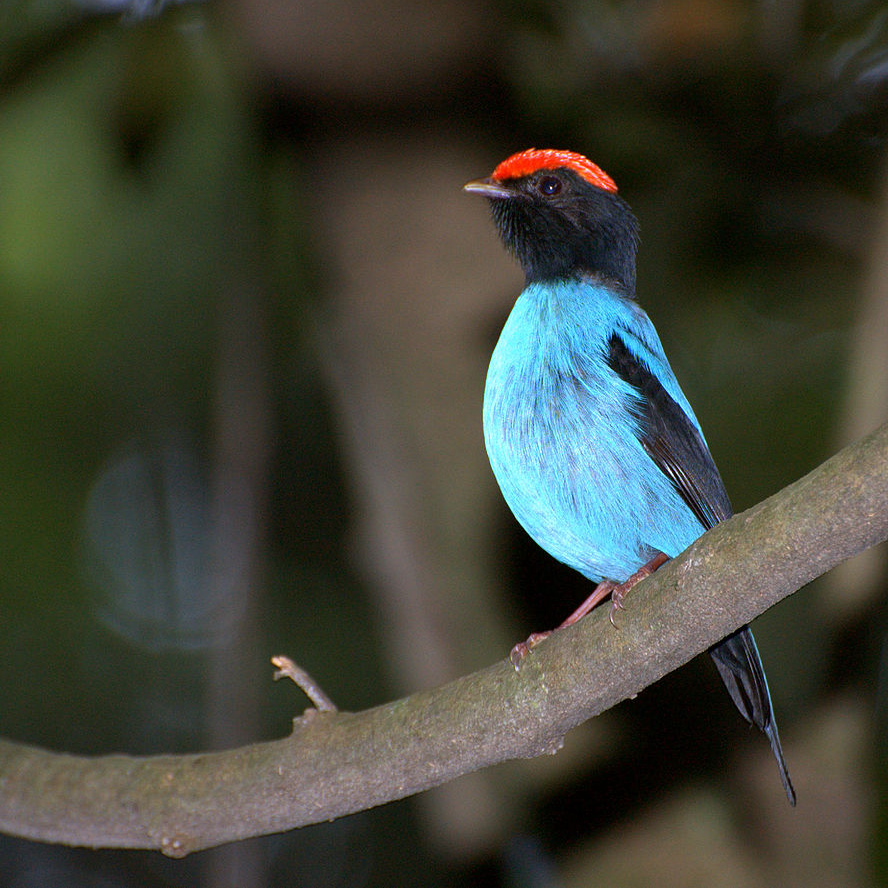
Golden-winged Manakin
Masius chrysopterus
Order: Passeriformes / Family: Pipridae

Wikimedia Commons
About the Golden-winged Manakin
The Golden-winged Manakin, scientifically known as Masius chrysopterus, is a captivating avian species found primarily in the subtropical and tropical moist montane forests of the Andes. This small passerine bird belongs to the Pipridae family, renowned for its striking appearance and intriguing behaviors. The manakin's habitat spans from Venezuela and Colombia to Ecuador and Peru, inhabiting elevations typically ranging from 1,000 to 2,200 meters. These regions provide a lush environment with rich biodiversity, essential to the manakin's survival and reproductive success.
The Golden-winged Manakin plays a significant role in its ecosystem, acting as both a pollinator and seed disperser. By consuming various fruits, this manakin aids in the regeneration of forest plant species, ensuring the health and sustainability of its habitat. Moreover, its presence serves as an indicator of forest health, as it requires dense, undisturbed forest canopies for breeding and feeding.
During the breeding season, which generally coincides with the rainy months, the Golden-winged Manakin engages in elaborate courtship displays. Males gather in leks, communal display grounds, where they perform intricate dances and vocalizations to attract females. These displays not only facilitate mating but also contribute to the genetic diversity of the population. Outside the breeding season, the species is less conspicuous, often seen foraging quietly in the dense understory. Seasonal movements are typically altitudinal rather than long-distance migrations, as the manakin shifts to slightly lower elevations during cooler months. Overall, the Golden-winged Manakin is a vital part of its ecosystem, contributing to its dynamic complexity and sustainability.
The Golden-winged Manakin belongs to the family Pipridae, within the order Passeriformes. These birds typically live typically around 6 years, with some individuals reaching up to 8 years..
How to Identify a Golden-winged Manakin
The Golden-winged Manakin exhibits remarkable plumage that makes it relatively easy to identify in its natural habitat. Adult males are particularly striking, with glossy black plumage contrasting sharply against their bright golden wing patches. These golden patches are not only a key identification feature but also a visual cue used during their lekking displays. Females and juveniles, on the other hand, are less conspicuous, displaying a more muted olive-green coloration that provides excellent camouflage in the forest understory. Unlike males, they lack the prominent golden wing patches.
Differences between males and females are pronounced, particularly during the breeding season. Males exhibit a more robust and vivid coloration, while females are more subdued, aiding in nest concealment. When in flight, the manakin's silhouette is compact, with a short tail and rounded wings, which aids in agile maneuvering through dense foliage. While perching, they often adopt an upright posture, which, coupled with their distinctive coloration, makes them relatively easy to spot.
The Golden-winged Manakin can be confused with the Club-winged Manakin due to similar size and habitat, but the latter lacks the golden wing patches and has a distinctive courtship display involving wing-snapping sounds. Observers should also note the habitat preferences, as the Golden-winged Manakin typically resides at slightly higher elevations.
Having trouble telling birds apart? Upload a photo to our bird identification tool for an instant species match.
Golden-winged Manakin Habitat and Range
Preferred Habitat
The Golden-winged Manakin thrives in subtropical and tropical moist montane forests, particularly those located along the eastern slopes of the Andes. These forests offer a diverse canopy and dense understory, providing both food sources and protection from predators. The preferred elevation range for this species is between 1,000 and 2,200 meters, where the climate remains relatively stable and humid throughout the year.
Seasonal habitat shifts occur, with the manakin often moving to slightly lower elevations during cooler months. This altitudinal migration helps them access different fruiting trees and maintain a steady food supply. The species tends to avoid heavily urbanized or agricultural areas, relying instead on the integrity of the forest ecosystem for survival. In rural settings, they are more likely to be found in forested reserves or protected areas where human disturbance is minimal.
Geographic Range
The Golden-winged Manakin's range is confined to the northern Andes, extending from Venezuela through Colombia and into Ecuador and Peru. Within this range, they occupy montane forests that provide suitable breeding and feeding conditions. The species is not known for long-distance migrations; instead, it engages in altitudinal movements between breeding and non-breeding seasons.
In Venezuela, it primarily inhabits the Sierra de Perijá and the Cordillera de Mérida. In Colombia, it can be found in the Eastern and Central Andes. Ecuador hosts populations in the eastern Andean slopes, while in Peru, the bird is located in the northern regions. Population densities are generally higher in areas with well-preserved forest habitats, such as national parks and nature reserves, where human impact is limited.
Want to know which birds visit your area? Browse our backyard birds by location guides for region-specific species lists.
What Does the Golden-winged Manakin Eat?
The diet of the Golden-winged Manakin is predominantly frugivorous, relying heavily on a variety of small fruits and berries available in its montane forest habitat. This diet shifts slightly with the seasons, as the manakin takes advantage of fruiting cycles of different plant species throughout the year. The bird's primary food sources include fruits from trees such as those in the Lauraceae and Melastomataceae families.
During the breeding season, the manakin's diet may be supplemented with small insects and arthropods, providing additional protein necessary for energy-intensive activities like courtship displays. Foraging typically occurs in the forest understory, where the bird uses quick, agile movements to pluck fruits from branches. The Golden-winged Manakin usually feeds alone or in small groups, and its feeding schedule is diurnal, with peak activity occurring in the early morning and late afternoon.
Golden-winged Manakin Behavior and Social Structure
The Golden-winged Manakin exhibits a range of fascinating behaviors, particularly during the breeding season. Males are known for their lekking behavior, where they congregate in small groups to perform elaborate courtship displays. These displays involve a combination of visual cues, such as wing-flashing to highlight their golden patches, and vocalizations designed to attract females. Each male stakes out a small territory within the lek, and competition for the best display location can be fierce.
Outside the breeding season, the species is more solitary or found in small family groups. They maintain small territories within the forest, which they defend from intruders, particularly during the fruiting season when food sources are abundant. The Golden-winged Manakin is diurnal, with most activities concentrated around feeding and territory maintenance during daylight hours.
In response to predators, the manakin relies on its cryptic coloration and the dense forest canopy for protection. When threatened, they often remain motionless, blending into the foliage. Flocking behavior is rare, although temporary associations may occur when individuals congregate around abundant food sources.
Golden-winged Manakin Nesting and Reproduction
The nesting habits of the Golden-winged Manakin are modest yet effective. Females are primarily responsible for nest construction, typically selecting a hidden location in the dense understory to protect against predators. The nest itself is a shallow cup made of fine plant fibers, moss, and spider webs, providing a secure yet camouflaged environment for eggs.
Clutch size is generally two eggs, which the female incubates alone for approximately 18 to 20 days. During this period, the male continues his courtship displays at the lek, offering no direct assistance in nesting duties. After hatching, the chicks remain in the nest for about 15 to 20 days before fledging. Parental care is predominantly the female's responsibility, and she may raise one to two broods per year, depending on food availability and environmental conditions.
Golden-winged Manakin Sounds and Vocalizations
The vocalizations of the Golden-winged Manakin are distinctive, playing a crucial role in their courtship rituals. The primary song consists of a series of high-pitched, rapid notes, often described as a 'tseet tseet tseet' sequence, which can carry over considerable distances in the dense forest. These calls are primarily used by males during lekking to attract females and assert dominance over display territories.
Apart from the primary song, the manakin also produces a variety of call notes, including short, sharp 'chip' sounds used for communication between individuals. Alarm calls are less frequent but are characterized by a more urgent tone, alerting nearby birds to the presence of potential threats. The dawn chorus, a common phenomenon in many bird species, is less pronounced in the Golden-winged Manakin, as their vocal activity peaks during the late morning and early afternoon.
Interesting Facts About the Golden-winged Manakin
- 1The Golden-winged Manakin's lekking displays can involve up to ten males vying for female attention.
- 2Despite their vibrant appearance, female Golden-winged Manakins are adept at remaining hidden due to their olive-green plumage.
- 3The Golden-winged Manakin is one of the few bird species whose lekking behavior involves both visual and acoustic displays.
- 4Masius chrysopterus has a relatively small range compared to other manakins, focusing primarily on the Andean slopes.
- 5The manakin's diet consists mostly of fruits, making it an important seed disperser in its ecosystem.
Golden-winged Manakin Conservation Status
According to the International Union for Conservation of Nature (IUCN), the Golden-winged Manakin is currently classified as Least Concern. While its population is relatively stable, continuous deforestation poses a significant threat to its habitat, particularly in the Andean regions where agriculture and logging activities are prevalent. Conservation efforts focus on preserving montane forest habitats through the establishment of protected areas and reserves. Historically, the manakin's population has shown resilience, adapting to habitat fragments and secondary growth forests, provided these areas remain relatively undisturbed. However, ongoing habitat loss and fragmentation could potentially impact genetic diversity and population numbers if not mitigated. Conservationists emphasize the importance of sustainable land management practices to ensure the long-term viability of this species.