
Goldie's Bird-of-Paradise
Paradisaea decora
Order: Passeriformes / Family: Paradisaeidae
Wikimedia Commons
About the Goldie's Bird-of-Paradise
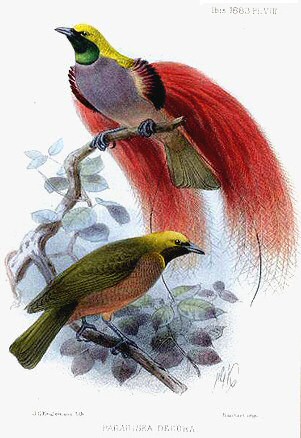
Goldie's Bird-of-Paradise, Paradisaea decora, is a mesmerizing avian species endemic to Papua New Guinea, specifically found on the islands of Fergusson and Normanby in the D'Entrecasteaux Archipelago. This bird, a member of the Paradisaeidae family, is renowned for its vibrant plumage and intricate courtship displays. The species plays a critical role in its ecosystem as both a pollinator and seed disperser, contributing significantly to the health of the local forest habitats. Males exhibit an elaborate set of bright, orange ornamental feathers and a stunning emerald-green breast shield. These features are not merely for aesthetic appeal; they serve a vital function in mating rituals. During these displays, the males perform an enchanting dance to attract females, fanning out their feathers and showcasing their colors in a dynamic presentation. The ecological significance of Goldie's Bird-of-Paradise extends beyond its role in reproduction. It aids in the propagation of various plant species by dispersing seeds and aiding in pollination. These processes are crucial in maintaining the biodiversity of the forest ecosystems in which they reside. The bird's presence indicates a healthy environment, as it thrives in undisturbed, primary forests. The conservation of such habitats is essential not only for the survival of this species but also for the myriad other organisms that share its home. Observations indicate that Goldie's Bird-of-Paradise may experience some seasonal movements within its range, although these are not fully understood. It largely remains in the montane and lowland rainforests throughout the year. The continued study of its behavior and habitat preferences is essential to ensure its preservation, given its restricted geographic range and the pressures faced from habitat loss and fragmentation.
The Goldie's Bird-of-Paradise belongs to the family Paradisaeidae, within the order Passeriformes. These birds typically live average 6-9 years, with some individuals living up to 11 years..
How to Identify a Goldie's Bird-of-Paradise
Goldie's Bird-of-Paradise is easily recognized by its striking coloration and distinctive morphology. Adult males boast a vibrant mix of orange and yellow plumes with a glossy green breast shield. Their upperparts are primarily a rich, maroon-brown, which contrasts with the iridescence of their display feathers. In comparison, females and juveniles have more subdued coloration, with a primarily brown plumage that offers better camouflage in dense foliage. The sexual dimorphism in this species is quite pronounced, aiding in the identification of gender in the field. Males have elongated flank plumes that are absent in females. These plumes are essential during courtship displays, as they are fanned out in a semicircle around the bird's body. Juveniles resemble females but can be distinguished by their shorter tail feathers and less defined plumage patterns. In flight, Goldie's Bird-of-Paradise presents a compact silhouette, with its wings slightly rounded and tail feathers that are not overly elongated. When perching, the bird adopts a posture that highlights its elongated flank plumes, often seen in display arenas known as leks. These natural stages are typically branches or clearings where the males perform their dances.
Having trouble telling birds apart? Upload a photo to our bird identification tool for an instant species match.
Goldie's Bird-of-Paradise Habitat and Range
Preferred Habitat
Goldie's Bird-of-Paradise inhabits the lush rainforests of Fergusson and Normanby islands in Papua New Guinea. These forests, characterized by high humidity and dense canopy cover, provide the ideal environment for the bird's survival. It primarily occupies lowland to montane rainforests, typically found at elevations ranging from 300 to 1,000 meters. The bird shows a preference for primary forests with minimal human disturbance, although it can sometimes be found in secondary growth areas if the forest structure remains largely intact. Seasonal shifts in habitat use are minimal, as the species tends to remain within the forested regions year-round. Unlike some bird species that have adapted to urban environments, Goldie's Bird-of-Paradise is not commonly found near human settlements. Its reliance on undisturbed forest ecosystems limits its presence in areas where deforestation or urban development occurs.
Geographic Range
The range of Goldie's Bird-of-Paradise is restricted to the D'Entrecasteaux Archipelago, with its populations confined mainly to the islands of Fergusson and Normanby. These islands are part of Papua New Guinea, located in the southwestern Pacific Ocean. The species does not undertake long-distance migrations, and its movements are generally limited to local shifts within its forested habitat. Population density is highest in areas with extensive primary forest cover, where the availability of food resources and suitable display sites is optimal. As a result of its limited range and specialized habitat requirements, the bird is vulnerable to changes in forest cover and quality. Despite these constraints, the bird's population remains stable in regions where conservation efforts have been implemented to protect its natural environment.
Want to know which birds visit your area? Browse our backyard birds by location guides for region-specific species lists.
What Does the Goldie's Bird-of-Paradise Eat?
Goldie's Bird-of-Paradise primarily feeds on a diet of fruits and arthropods, which it forages in the mid to upper levels of the forest canopy. This diet is rich in energy, supporting the bird's active lifestyle and elaborate courtship displays. The bird's fruit consumption includes a variety of berries and drupes, with a preference for those from the Lauraceae and Myrtaceae families. Insects form the secondary component of its diet, providing essential proteins. The bird employs a gleaning technique, delicately picking off fruits and insects from leaves and branches. Seasonal changes in diet are minimal, as the rainforest environment provides a consistent supply of food year-round. However, during certain times of the year, when specific fruits are in abundance, the bird may focus more heavily on these resources. Its feeding schedule is largely diurnal, with peak activity occurring in the early morning and late afternoon when temperatures are cooler and predation risk is reduced.
Goldie's Bird-of-Paradise Behavior and Social Structure
Goldie's Bird-of-Paradise exhibits fascinating behaviors, particularly during the breeding season. Males are territorial and establish display sites known as leks, where they perform their courtship dances. These displays involve a complex series of movements, including fanning their vibrant flank plumes and engaging in intricate dance steps to attract females. The species is generally solitary outside of the breeding season, with individuals maintaining defined territories. During the day, the bird is most active at dawn and dusk, engaging in foraging and display activities. Flocking behavior is uncommon, as the bird's social structure revolves around individual territories and mating displays. When faced with predators, such as raptors or larger mammals, the bird exhibits evasive flight patterns and seeks refuge in dense canopy cover. Its agility and speed in flight serve as effective deterrents. Goldie's Bird-of-Paradise communicates through a series of vocalizations, which play an essential role in maintaining territory and facilitating mating interactions.
Goldie's Bird-of-Paradise Nesting and Reproduction
The nesting habits of Goldie's Bird-of-Paradise involve building a cup-shaped nest using twigs, leaves, and other plant materials. Nests are typically situated in the fork of a tree branch, providing stability and protection from ground-based predators. The female alone takes on the responsibility of constructing the nest and incubating the eggs. A typical clutch consists of one to two eggs, which the female incubates for approximately 20 days. During this period, the male's role is limited to defending the territory and occasionally providing food. After hatching, the chicks remain in the nest for about 18 to 22 days, during which time the female provides all necessary care. She feeds the young a diet rich in fruits and insects, regurgitated directly into their mouths. The species typically raises one brood per year, although environmental conditions may allow for a second in particularly favorable years. Successful fledging depends heavily on the availability of food resources and the absence of significant disturbances in the surrounding habitat.
Goldie's Bird-of-Paradise Sounds and Vocalizations
The vocalizations of Goldie's Bird-of-Paradise are as captivating as their visual displays. The primary song consists of a series of melodic whistles and chirps, often described as both sweet and haunting. Each male individual may have its own variation of the song, which it uses to establish territory and attract potential mates. Call notes are generally shorter and used for communication with nearby individuals. Alarm calls are harsher and more abrupt, designed to warn of impending danger. During the dawn chorus, males are particularly vocal, using their songs to assert dominance and secure mating opportunities. The bird's vocal repertoire, while not as extensive as some songbirds, is distinctive and plays a crucial role in its overall behavior and reproductive success.
Interesting Facts About the Goldie's Bird-of-Paradise
- 1Goldie's Bird-of-Paradise was discovered in 1882, named after the Scottish naturalist Andrew Goldie.
- 2Males can spend up to six hours a day performing courtship displays during the breeding season.
- 3The bird's vibrant flank plumes can extend up to 33 centimeters, aiding in their elaborate dances.
- 4Goldie's Bird-of-Paradise is one of the least studied birds-of-paradise due to its secluded habitat.
- 5Its diet includes over 30 different fruit species, highlighting its role as a key seed disperser.
- 6The species was first described scientifically by Italian ornithologist Tommaso Salvadori in 1883.
- 7Goldie's Bird-of-Paradise is one of the few birds where the female is solely responsible for nesting duties.
Goldie's Bird-of-Paradise Conservation Status
Goldie's Bird-of-Paradise is currently classified as Vulnerable on the IUCN Red List, primarily due to habitat loss and fragmentation. The most significant threats include deforestation for agriculture and logging, which reduce the extent of suitable forest habitat. Conservation efforts focus on habitat protection and sustainable forestry practices to mitigate these impacts. In recent years, local and international conservation organizations have worked to establish protected areas within the bird's range, ensuring the preservation of critical habitats. Despite these efforts, the species remains vulnerable due to its restricted range and specialized habitat requirements. Continued monitoring and adaptive management strategies are essential to ensure the long-term survival of Goldie's Bird-of-Paradise.


