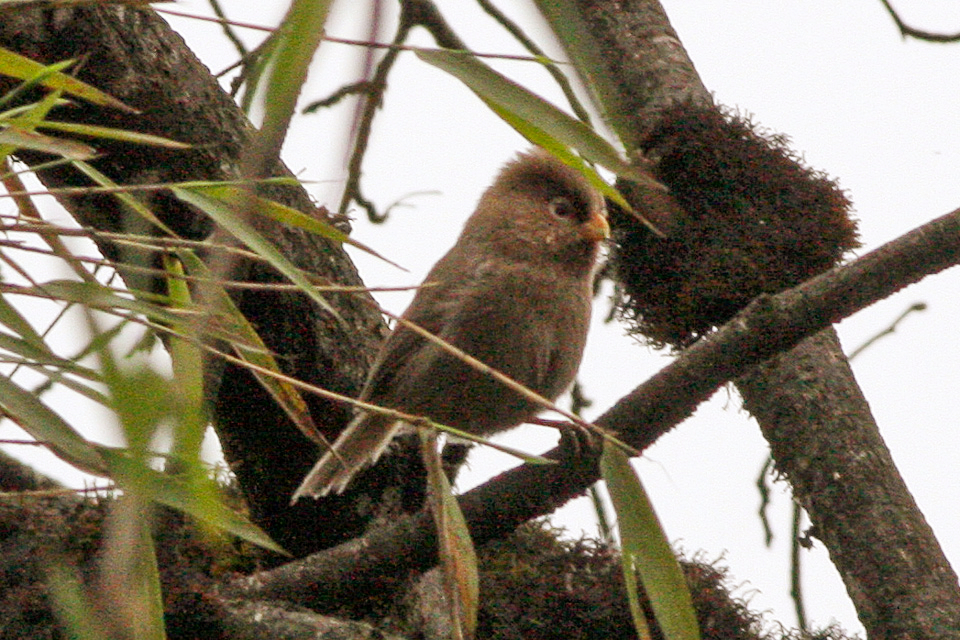
Gray-headed Parrotbill
Psittiparus gularis
Order: Passeriformes / Family: Sylviidae

Wikimedia Commons
About the Gray-headed Parrotbill
The Gray-headed Parrotbill, scientifically known as Psittiparus gularis, is an intriguing member of the Sylviidae family. Predominantly found in the lush, subtropical forests of Southeast Asia, this bird is a hallmark species within its range. Its distinctive gray head sets it apart from other parrotbills, making it instantly recognizable to birders and researchers alike. The Gray-headed Parrotbill thrives in dense vegetation, where it contributes significantly to the ecosystem by controlling insect populations and dispersing seeds. This species exhibits a fascinating array of seasonal behaviors. During the breeding season, which typically extends from March to July, the birds become highly territorial. Outside of this period, they display a more communal lifestyle, forming small flocks that forage together. The Gray-headed Parrotbill plays a crucial role in its ecosystem, serving as both a predator to insects and a prey item for larger birds and mammals. Its presence indicates a healthy, balanced habitat, and its absence often signals ecological distress. Throughout its range in countries such as China, Myanmar, and Thailand, local populations of the Gray-headed Parrotbill adapt to a variety of forest habitats, including temperate and evergreen forests. Conservationists consider the Gray-headed Parrotbill an indicator species for environmental health, given its sensitivity to habitat changes. Efforts to preserve its habitats are not only about protecting the bird itself but also about maintaining the ecological integrity of the regions it inhabits. Understanding the Gray-headed Parrotbill's ecology and behavior is vital, as it offers insights into the broader health of subtropical forest ecosystems. As human activities continue to encroach upon its natural habitats, the conservation of this species becomes increasingly important.
The Gray-headed Parrotbill belongs to the family Sylviidae, within the order Passeriformes. These birds typically live 5-7 years with a maximum recorded of 9 years.
How to Identify a Gray-headed Parrotbill
The adult Gray-headed Parrotbill features a slate-gray head, which is its most distinguishing characteristic. The crown and nape contrast sharply with its olive-brown upperparts and buffy underparts. The wings and tail exhibit a darker shade of brown, while the bill is stout and hooked, typical of parrotbills. In terms of size, the Gray-headed Parrotbill measures approximately 16 centimeters in length, making it a medium-sized member of its genus. Juveniles resemble adults but tend to have a slightly duller plumage. The sexes appear similar, with no significant differences in coloration or size. However, during the breeding season, males may exhibit more vibrant plumage due to hormonal changes. Birders may confuse the Gray-headed Parrotbill with the Fulvetta species, which share similar habitats and plumage tones. However, the parrotbill's distinctive gray head and thicker bill help differentiate it. In flight, the Gray-headed Parrotbill shows a compact silhouette with rounded wings and a relatively short tail. When perched, it often adopts a slightly hunched posture, typical of many parrotbills.
Having trouble telling birds apart? Upload a photo to our bird identification tool for an instant species match.
Gray-headed Parrotbill Habitat and Range
Preferred Habitat
The Gray-headed Parrotbill primarily inhabits subtropical and tropical moist lowland forests. These environments offer dense undergrowth, which the parrotbill uses for foraging and nesting. It can be found at elevations ranging from 200 to 1,800 meters, favoring areas with abundant vegetation. In countries like China and Myanmar, the Gray-headed Parrotbill occupies temperate forests and montane regions. During the non-breeding season, it may venture into secondary growth and scrublands. While it generally avoids urban areas, the parrotbill occasionally appears in rural settings adjacent to forests. Seasonal shifts in habitat use are minimal, as the bird remains largely sedentary throughout the year.
Geographic Range
The Gray-headed Parrotbill's range extends across Southeast Asia, with key populations in southern China, Myanmar, and northern Thailand. It is a resident breeder in these regions, showing limited migratory behavior. In China, the bird is particularly prevalent in the provinces of Yunnan and Sichuan. Though generally not migratory, some local movements occur in response to food availability and weather conditions. Population densities are highest in undisturbed forest habitats, where food resources are plentiful. Despite its widespread range, the Gray-headed Parrotbill's presence can be patchy, with certain areas hosting dense populations while others remain unoccupied.
Want to know which birds visit your area? Browse our backyard birds by location guides for region-specific species lists.
What Does the Gray-headed Parrotbill Eat?
The Gray-headed Parrotbill primarily feeds on insects and small invertebrates, which it skillfully extracts from foliage and bark. Its diet includes caterpillars, beetles, and spiders, with seasonal variations based on prey availability. During the breeding season, the demand for protein-rich food increases, prompting the birds to focus more on insects. Outside of this period, the parrotbill supplements its diet with seeds and berries, playing a role in seed dispersal. Foraging occurs mainly in the early morning and late afternoon, with birds often seen hopping through vegetation in search of food.
Gray-headed Parrotbill Behavior and Social Structure
Social by nature, the Gray-headed Parrotbill typically forms small flocks, especially outside the breeding season. These groups, usually consisting of 5 to 15 individuals, move through the forest in search of food. The species exhibits minimal territorial aggression, except during breeding when pairs defend their nesting area vigorously. Courtship displays are subtle, involving mutual preening and soft calls. Flocking provides safety in numbers, allowing for efficient predator detection. The parrotbill remains active throughout daylight hours, with peak activity during cooler morning and late afternoon periods.
Gray-headed Parrotbill Nesting and Reproduction
The Gray-headed Parrotbill constructs cup-shaped nests using a variety of plant materials, such as grasses, leaves, and twigs. These nests are usually positioned low in dense shrubs or small trees, providing concealment from predators. A typical clutch contains 3 to 4 eggs, with an incubation period of about 14 days. Both parents share in incubation duties and in feeding the hatchlings. Fledging occurs approximately 12 to 15 days post-hatching, with the young remaining dependent on the parents for several weeks. The species typically raises one or two broods per year, depending on food availability and environmental conditions.
Gray-headed Parrotbill Sounds and Vocalizations
The primary song of the Gray-headed Parrotbill is a series of clear, melodious whistles that vary in pitch and rhythm. These vocalizations serve to communicate with flock members and establish territory during the breeding season. Calls include sharp 'chit-chit' notes used as alarms or contact calls within the flock. During the dawn chorus, the parrotbill's song contributes to the vibrant symphony of the forest. Its vocal repertoire, while not as varied as that of some songbirds, is distinctive enough to aid in field identification.
Interesting Facts About the Gray-headed Parrotbill
- 1The Gray-headed Parrotbill can live up to 10 years in the wild, showcasing its adaptability to forest environments.
- 2Despite its name, the Gray-headed Parrotbill is not closely related to parrots but is a member of the Sylviidae family.
- 3This species often forages in mixed-species flocks, benefiting from the presence of other insectivorous birds.
- 4The Gray-headed Parrotbill's song includes over 10 distinct notes, each serving a specific communication purpose.
- 5During the breeding season, both male and female Gray-headed Parrotbills exhibit increased vocal activity.
- 6Gray-headed Parrotbills have a unique grooming behavior, often seen preening one another within flocks.
- 7Their nests are so well-camouflaged that finding one in the wild is a remarkable feat for birdwatchers.
Gray-headed Parrotbill Conservation Status
The IUCN classifies the Gray-headed Parrotbill as Least Concern, with populations currently stable. However, habitat loss due to deforestation poses a significant threat. Conservation efforts focus on preserving forest habitats and promoting sustainable land use practices. Historical data suggest fluctuations in population density correlated with habitat availability. Continued monitoring is necessary to ensure long-term stability, as ongoing deforestation in Southeast Asia could impact future populations.