
Gray Partridge
Perdix perdix
Order: Galliformes / Family: Phasianidae
Wikimedia Commons
About the Gray Partridge
The Gray Partridge, Perdix perdix, is a medium-sized gamebird that holds significance both ecologically and culturally across its range. Known for its mottled grayish-brown plumage, this bird inhabits the open countryside of Europe and parts of Asia. It thrives in grasslands, agricultural fields, and hedgerows, providing essential ecosystem services such as seed dispersal and insect population control.
The species plays a crucial role in the agricultural landscapes it inhabits, where it helps maintain a balanced ecosystem. By consuming weed seeds and insects, the Gray Partridge aids in pest control, benefiting crops and reducing the need for chemical interventions. This bird also acts as a prey species for a variety of raptors, contributing to the food web dynamics within its habitat.
Gray Partridges are non-migratory, but they do exhibit some seasonal movements within their range, primarily related to food availability and weather conditions. During the breeding season in spring and early summer, they form monogamous pairs and establish territories. In winter, they gather in coveys, which are social groups that can include up to 15 birds. This behavior not only facilitates foraging but also offers protection against predators.
The cultural significance of the Gray Partridge extends to hunting traditions in Europe, where it is considered a prized gamebird. Despite this, modern agricultural practices have imposed challenges, affecting their populations in certain areas. Conservation efforts focus on habitat management and restoration, emphasizing the importance of maintaining diverse and sustainable agricultural landscapes.
The Gray Partridge belongs to the family Phasianidae, within the order Galliformes. These birds typically live average lifespan is 3-4 years with a maximum recorded of 10 years..
How to Identify a Gray Partridge
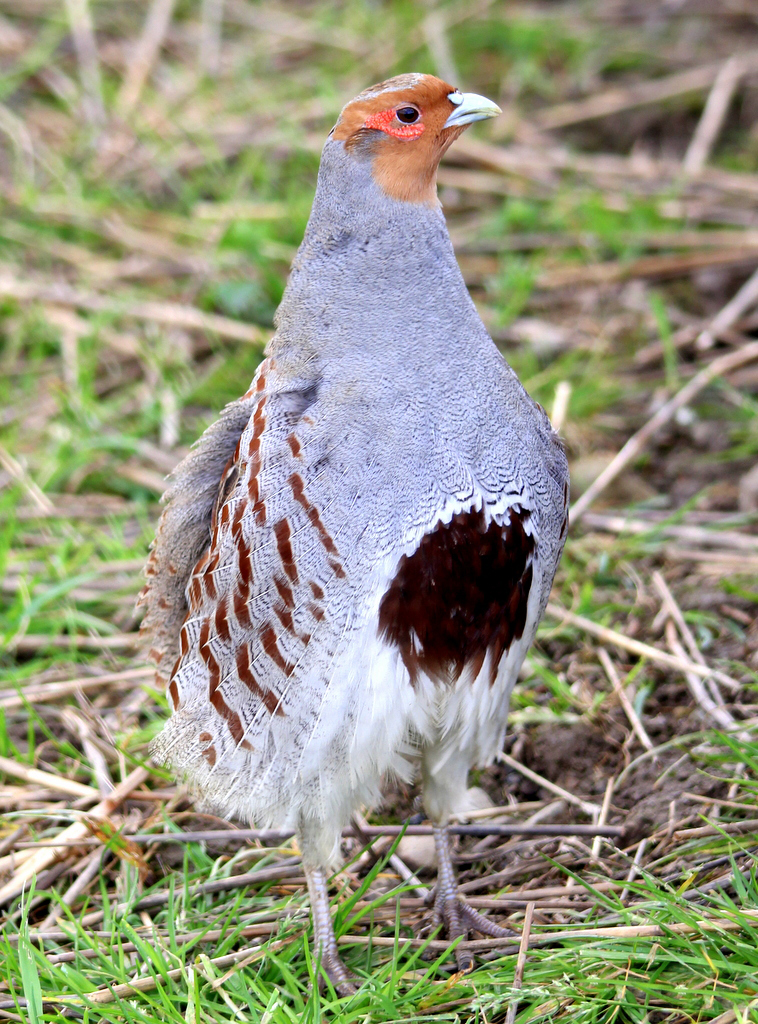
The Gray Partridge features a compact, rounded body with a short tail and a distinctive orange face. Adults possess mottled gray-brown plumage with subtle barring and a chestnut patch on the belly. The sexes are similar, although females tend to be slightly duller with less pronounced chestnut markings. Juveniles are more uniformly brown and lack the orange face of adults, making them somewhat harder to identify until they mature.
In flight, the Gray Partridge displays a distinctive rapid wingbeat, often accompanied by short glides. Its flight silhouette is characterized by a stocky body and short, rounded wings. When perched, the partridge typically exhibits a crouched posture, blending seamlessly into its surroundings due to its camouflaged plumage.
Potential confusion can arise with similar species such as the Chukar and the Red-legged Partridge, especially in overlapping ranges. However, the Gray Partridge can be distinguished by its more subdued coloration and the lack of a bold black and white face pattern seen in the Chukar.
Having trouble telling birds apart? Upload a photo to our bird identification tool for an instant species match.
Gray Partridge Habitat and Range
Preferred Habitat
The Gray Partridge favors open grasslands, farmlands, and hedgerows, thriving in landscapes that provide both cover and food. It often inhabits lowland areas but can occasionally be found at elevations up to 1,500 meters. The bird shows adaptability to various agricultural environments, including cereal crops and pasturelands.
Seasonal habitat shifts occur mainly in search of food and shelter. During the breeding season, they prefer areas with dense vegetation to conceal nests. In winter, they require fields with ample stubble or cover to protect them from harsh weather and predators. Urban presence is minimal, as they predominantly occupy rural areas where agriculture is present.
Geographic Range
The breeding range of the Gray Partridge spans across much of Europe and into western Asia. It is found from the British Isles and Scandinavia south to the Iberian Peninsula and eastward into Russia and western China. In North America, introduced populations exist primarily in the northern United States and southern Canada, though they are less widespread than in their native range.
Wintering range largely overlaps with breeding areas, as the Gray Partridge is generally non-migratory. However, local movements occur to find optimal winter foraging grounds. Population density hotspots include the agricultural heartlands of France, Germany, and eastern Europe, where traditional farming practices support healthy partridge populations.
Want to know which birds visit your area? Browse our backyard birds by location guides for region-specific species lists.
What Does the Gray Partridge Eat?
The diet of the Gray Partridge primarily consists of seeds and grains, with a strong preference for cereal crops such as wheat and barley. During the breeding season, their diet expands to include a significant proportion of insects, providing essential protein for growing chicks. Grasshoppers, beetles, and caterpillars form an important part of their summer diet.
Seasonal diet changes reflect availability; in winter, they rely more heavily on grains and seeds left in stubble fields. Foraging techniques include pecking and scratching at the ground, often in groups, which improves their efficiency in locating food. Feeding typically occurs during dawn and dusk, when they are less vulnerable to predators.
Gray Partridge Behavior and Social Structure
The Gray Partridge is a social bird, often found in coveys outside of the breeding season. These groups, comprising family members and other individuals, enhance foraging efficiency and predator detection. During the breeding season, pairs form monogamous bonds, with males displaying courtship behaviors such as calling and fanning their tails to attract females.
Territorial behavior is prominent during nesting, with pairs defending their sites against intruders. In response to threats, Gray Partridges rely on their cryptic plumage to remain unseen, but they can burst into rapid flight if necessary. Daily activity patterns are influenced by light and temperature, with peak activity during cooler parts of the day.
Gray Partridge Nesting and Reproduction
Gray Partridges build their nests on the ground, often concealed in tall grass or under bushes to protect from predators. The nest consists of a shallow scrape lined with grass and feathers. Preferred nest sites are in open fields, meadows, or along hedgerows where vegetation provides cover.
Clutch size ranges from 10 to 20 eggs, with incubation lasting about 23 to 25 days. Both parents play a role in raising the chicks, which are precocial and leave the nest shortly after hatching to follow and forage with their parents. Fledging occurs around 14 to 16 days after hatching, although chicks remain with the parents for several weeks. Typically, only one brood is raised per year.
Gray Partridge Sounds and Vocalizations
The primary call of the Gray Partridge is a harsh, staccato 'keerr-ik' or 'kurr-ik', often repeated in sequences. This call serves both as an alarm and a contact call within coveys. Males also produce a distinctive churring sound during courtship displays.
Alarm calls are sharp and more repetitive, alerting the group to potential threats. During the breeding season, their vocalizations are more frequent, especially at dawn and dusk. While not melodious, their calls are essential for communication and maintaining group cohesion.
Interesting Facts About the Gray Partridge
- 1Gray Partridge chicks are precocial, meaning they can feed themselves shortly after hatching.
- 2A covey of Gray Partridges can include up to 15 birds, providing safety in numbers.
- 3Introduced to North America in the early 1900s, they are now found in parts of Canada and the U.S.
- 4The Gray Partridge is a favorite gamebird in Europe, valued for its challenging hunt.
- 5Their cryptic plumage helps them blend into fields, making them hard to spot by predators.
- 6They have a strong preference for agricultural landscapes, favoring wheat and barley fields.
- 7Gray Partridges can produce up to 20 eggs per clutch, one of the largest among gamebirds.
Gray Partridge Conservation Status
The Gray Partridge is classified as 'Least Concern' by the IUCN, yet populations in some areas have been declining. Primary threats include habitat loss due to modern agricultural practices and pesticide use, which reduce food availability and nesting sites. Conservation efforts focus on habitat management, such as maintaining hedgerows and leaving stubble fields post-harvest to provide cover and food. Historical population changes have seen declines in western Europe, while stable or increasing numbers exist in eastern regions where traditional farming persists.
Other Phasianidae Species


Birds Similar to the Gray Partridge
These species are often confused with the Gray Partridge due to similar appearance or overlapping range.


