Chukar
Alectoris chukar
Order: Galliformes / Family: Phasianidae

Wikimedia Commons
About the Chukar
The Chukar (Alectoris chukar) is a striking member of the Phasianidae family, known for its bold plumage and robust build. Native to arid and rocky regions of Eurasia, the Chukar has been successfully introduced to North America, particularly in the western United States. This partridge thrives in open, dry habitats such as deserts, scrublands, and mountainous areas, often favoring slopes and rugged terrains where it can find adequate cover and food. The Chukar is integral to its ecosystem, serving as both a prey species for larger predators and a consumer of seeds and insects. Its presence also supports hunting activities in some regions, providing economic benefits and recreational opportunities. In spring and summer, the Chukar engages in courtship and nesting, while in autumn and winter it forms larger coveys, sometimes exceeding 40 birds. This seasonal behavior reflects its adaptability to varying environmental conditions. The Chukar plays a significant ecological role by influencing seed dispersal and contributing to predator-prey dynamics. Its interaction with native species and introduced populations underscores the bird's ecological significance. In North America, the Chukar's range encompasses states like Nevada, Idaho, and Utah, where it is often found in open landscapes with scattered vegetation. Across its range, the Chukar adapts to different elevations, from sea level to 4,000 meters. This adaptability is a testament to its resilience and versatility. The Chukar’s ecological presence is characterized by its unique behaviors, dietary habits, and its impact on both its native and introduced environments.
The Chukar belongs to the family Phasianidae, within the order Galliformes. These birds typically live average lifespan is 3-5 years with a maximum recorded of 10 years..
How to Identify a Chukar
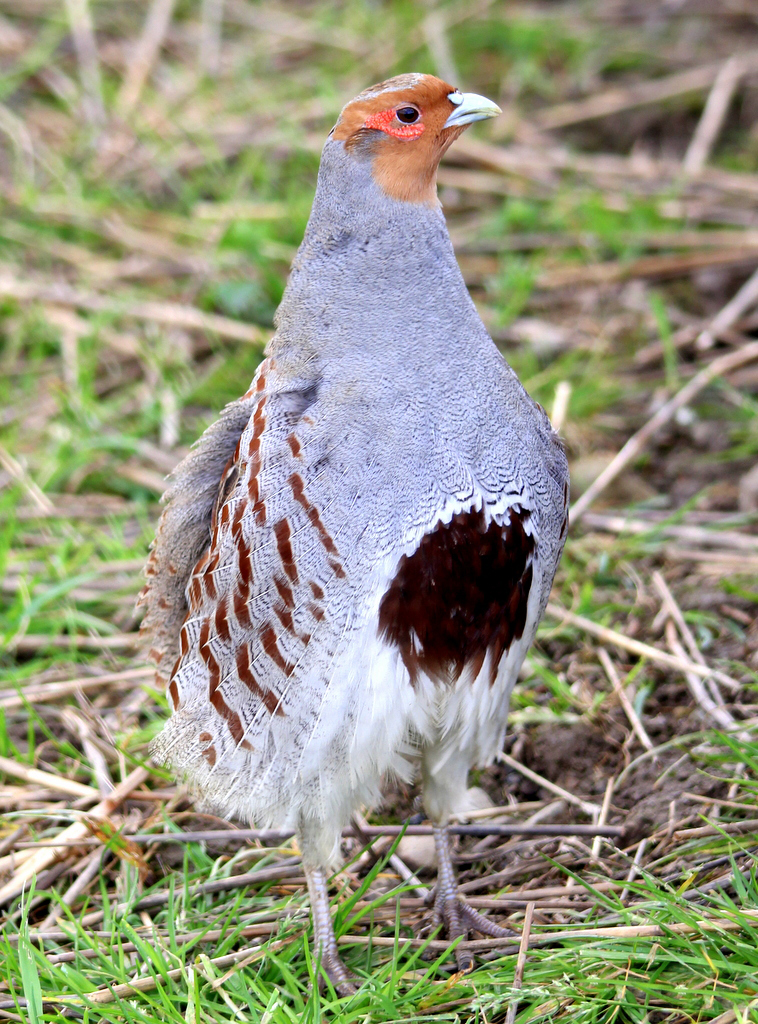
The adult Chukar is medium-sized, measuring about 32-35 cm in length, with a wingspan of 47-52 cm. Its plumage is predominantly buff, contrasted by bold black and white barring on the flanks, which is one of its most distinguishing features. The bird's face is adorned with a black band running from the forehead, through the eye, and down to the neck, forming a distinctive mask. Its bill and legs are bright red, adding to its striking appearance. Male and female Chukars are similar in appearance, though males are generally slightly larger. Juveniles resemble adults but with duller coloration and less pronounced barring. In flight, the Chukar displays a rounded wing silhouette, characterized by rapid wingbeats followed by glides. When perching, the Chukar stands upright, often on rocky outcrops or low vegetation, providing an excellent vantage point. Observers might confuse the Chukar with other partridge species, but its combination of facial markings and flank barring is distinctive. In comparison to similar species like the Rock Partridge, the Chukar's facial mask is more pronounced, and its habitat preference is usually at lower elevations.
Having trouble telling birds apart? Upload a photo to our bird identification tool for an instant species match.
Chukar Habitat and Range
Preferred Habitat
Chukars favor arid, rocky habitats, often inhabiting elevations from sea level up to 4,000 meters. These birds are commonly found in open landscapes such as deserts, grasslands, and mountainous terrains with sparse vegetation. In North America, they occupy regions like the Great Basin and Columbia Basin, where semi-arid conditions prevail. Unlike many birds, Chukars are well adapted to dry environments and can thrive with limited water sources. Seasonal shifts in habitat use occur, with lower elevations preferred during winter to avoid harsh conditions. In urban areas, Chukars are less common but may occasionally be observed near agricultural fields or rural outskirts where their preferred habitats persist. Their presence in urban settings is primarily opportunistic, relying on suitable patches of natural habitat that provide cover and food resources. The varied elevation range and adaptable nature of the Chukar make it a resilient species capable of inhabiting diverse environments.
Geographic Range
The Chukar's native breeding range extends across southeastern Europe and central Asia, including countries like Greece, Turkey, Iran, and India. In these regions, they inhabit mountainous and rocky terrains. In North America, the Chukar was introduced in the 20th century and now thrives in the western United States, particularly in states such as Nevada, Idaho, and Utah. These populations are primarily found in the Great Basin and Columbia Basin, where suitable habitat conditions mimic those of their native range. Chukars do not typically migrate long distances, but they may move altitudinally in response to seasonal changes in weather and food availability. During winter, populations may descend to lower elevations to escape snow-covered areas. Within their range, Chukars are generally widespread and can be locally abundant in suitable habitats. Population density hotspots occur in regions where open, arid landscapes provide ideal conditions for breeding and survival. The combination of native and introduced ranges highlights the Chukar's adaptability to various environmental conditions and its ability to establish stable populations outside its original range.
Want to know which birds visit your area? Browse our backyard birds by location guides for region-specific species lists.
What Does the Chukar Eat?
The Chukar's diet primarily consists of seeds and plant material, making it an herbivore with a preference for grains and grasses. In its native and introduced ranges, it forages on the ground, often scratching at the soil to uncover seeds. During the spring and summer, its diet expands to include insects and other invertebrates, which provide essential protein during the breeding season. Chukars exhibit opportunistic feeding behavior, adjusting their diet based on seasonal availability. In arid habitats, they consume seeds from plants like cheatgrass, which is abundant in western North America. This reliance on seeds makes the Chukar an important seed disperser in its ecosystem. Foraging often occurs in groups, with Chukars moving slowly across the landscape, pausing to peck and scratch at the ground. They are most active during the early morning and late afternoon, avoiding the midday heat. The Chukar's feeding schedule aligns with its activity patterns, optimizing its energy intake and water conservation in dry environments. Despite being primarily herbivorous, the flexibility in diet helps the Chukar adapt to varying food resources across its range.
Chukar Behavior and Social Structure
Chukars are social birds, often forming coveys of up to 40 individuals, particularly outside the breeding season. These coveys provide safety in numbers, aiding in predator detection and foraging efficiency. The Chukar's behavior shifts during the breeding season, when males become territorial and engage in courtship displays to attract mates. These displays include calls, strutting, and wing-flashing. Chukars are generally ground-dwelling, preferring to run rather than fly when disturbed, although they are capable of quick, strong flights if necessary. Their response to predators involves a combination of concealment and rapid escape, utilizing their excellent camouflage and agility. Daily activity patterns are crepuscular, with peak activity occurring during dawn and dusk. Chukars are most vocal in the early morning, with the male's characteristic "chuk-chuk-chuk" call echoing across the landscape. This call serves multiple functions, including territory establishment and communication within coveys. The social and territorial behaviors of Chukars are crucial for maintaining their population dynamics and ensuring successful reproduction in varying environmental conditions.
Chukar Nesting and Reproduction
The Chukar nests on the ground, typically choosing a well-concealed location among rocks or dense vegetation. The nest is a simple scrape in the ground, lined with grass, leaves, and feathers to provide insulation and comfort for the eggs. Clutch size ranges from 8 to 16 eggs, with incubation lasting about 22 to 24 days. Both parents participate in brood-rearing, although the female primarily incubates the eggs. After hatching, chicks are precocial, leaving the nest shortly after and following their parents to forage. This early independence is crucial for survival, as it reduces the time spent in vulnerable nest sites. Fledging occurs at about 10 to 12 weeks, by which time the juveniles are capable of sustained flight and increased self-sufficiency. Chukars typically produce one brood per year, although in favorable conditions, a second brood may occur. The choice of nesting site and materials reflects the Chukar's adaptation to its environment, ensuring that eggs and chicks are well-protected from predators and environmental stressors. The successful nesting strategies of Chukars contribute to their resilience and ability to thrive in diverse habitats.
Chukar Sounds and Vocalizations
The primary song of the Chukar is a series of loud, rhythmic calls that sound like "chuk-chuk-chuk," which increases in tempo and volume. This call is often heard at dawn and dusk, serving both territorial and communication purposes within coveys. The Chukar's calls are sharp and carry well over long distances, making them easily recognizable in their open habitats. In addition to the primary call, Chukars produce a variety of other vocalizations including softer chuckles and alarm calls. Alarm calls are higher-pitched and more rapid, serving as a warning to other covey members of potential predators. These vocalizations are an essential part of the Chukar's social interactions and territorial behaviors. The distinct acoustic characteristics of the Chukar's calls make them a notable feature in their habitat, contributing to their identification and study in the field.
Interesting Facts About the Chukar
- 1The Chukar is the national bird of Pakistan, symbolizing love and passion in local folklore.
- 2Chukars can survive without direct water sources, obtaining moisture from the food they consume.
- 3In North America, Chukars were first introduced to California in the 1930s for hunting purposes.
- 4The Chukar's ability to thrive in barren landscapes makes it a model species for studying adaptation to arid environments.
- 5Chukars have been observed traveling over 2 kilometers in a day while foraging for food.
- 6Their striking plumage serves as camouflage among the rocky terrains they inhabit, helping them avoid predators.
- 7Despite their ground-dwelling nature, Chukars are capable of strong, rapid flights when necessary to escape danger.
Chukar Conservation Status
The Chukar is currently listed as Least Concern by the IUCN, with stable population trends in most of its range. While some localized declines may occur due to habitat loss and hunting pressure, the overall population remains robust. Primary threats to the Chukar include habitat degradation, competition with livestock for resources, and predation by introduced species. Conservation efforts focus on habitat preservation and management to ensure sustainable populations, especially in areas where hunting is popular. Historical population changes reflect successful introductions in regions like North America, where the Chukar has adapted well to new environments. Conservation strategies emphasize the importance of maintaining healthy ecosystems to support both native and introduced populations. Public awareness and regulated hunting practices contribute to the ongoing success of Chukar populations, ensuring that this resilient species continues to thrive.
Other Phasianidae Species


Birds Similar to the Chukar
These species are often confused with the Chukar due to similar appearance or overlapping range.