
California Quail
Callipepla californica
Order: Galliformes / Family: Odontophoridae

Wikimedia Commons
About the California Quail
The California Quail (Callipepla californica) is a small, plump bird native to the west coast of the United States, renowned for its unique forward-curving head plume and sociable behavior. This bird is the state bird of California, reflecting its iconic status and widespread presence throughout the region. California Quail populations extend from the coastal regions of southern British Columbia down through California into Baja California. Their adaptability allows them to inhabit various environments, including coastal sagebrush, chaparral, foothills, and urban parks. These birds play an essential ecological role as seed dispersers and are an integral part of the food chain, serving as prey for numerous predators, including hawks and coyotes. Seasonal behaviors of the California Quail include forming large coveys during the fall and winter, where they exhibit strong social bonds. In the spring and summer, they disperse into breeding pairs, with males often seen engaging in elaborate courtship displays. The California Quail is particularly notable for its resilience in urban environments, making it a familiar sight in city parks and gardens across its range. Their presence in a variety of habitats from sea level up to 3,000 feet in altitude showcases their adaptability. Despite urban expansion and habitat alteration, the California Quail maintains stable populations due to its flexible diet and reproductive strategies. These birds serve as an important indicator for the health of ecosystems, and their varied calls add a rich auditory layer to their environment. In addition to their ecological significance, California Quails are a popular game bird, which has led to regulated hunting practices across their range. During the breeding season, males establish territories, and their characteristic 'chi-ca-go' call can often be heard echoing through open woodlands and scrublands. Their ability to thrive in disturbed environments makes them an excellent study species for understanding avian adaptation to human-modified landscapes.
The California Quail belongs to the family Odontophoridae, within the order Galliformes. These birds typically live on average, california quails live for 1-4 years in the wild, with the maximum recorded lifespan being 6 years..
How to Identify a California Quail
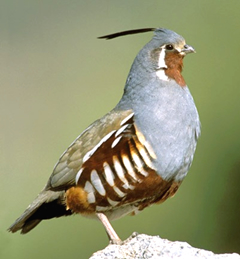
The California Quail is easily recognized by its striking head plume, a teardrop-shaped cluster of feathers that curves forward. Adult males boast a bold black face with a white border, a chestnut crown, and a scaled gray body with intricate patterning on the wings and back. Females are more subdued in color, with a brownish face and overall grayish-brown plumage, lacking the vivid black and white markings of the male. Juveniles resemble females but are more uniformly colored with a mottled appearance. While similar in size and shape to the Gambel's Quail, the California Quail can be distinguished by the darker, more pronounced facial markings and the lack of a distinct black patch on the breast. In flight, these birds are quick and low, with short bursts of rapid wing beats followed by brief glides. On the ground, California Quails exhibit a distinctive bobbing motion as they forage, often seen in small groups or 'coveys.'
Having trouble telling birds apart? Upload a photo to our bird identification tool for an instant species match.
California Quail Habitat and Range
Preferred Habitat
California Quails inhabit a wide range of environments, from coastal chaparral and oak woodlands to suburban gardens and desert washes. They are most commonly found at elevations from sea level to 3,000 feet but can occasionally be seen at higher altitudes in mountainous regions. These birds favor areas with dense shrub cover, which provides protection from predators and harsh weather. In urban settings, they thrive in parks and gardens, often using hedges and ornamental plantings for cover. During breeding season, they prefer open areas with scattered shrubs and trees, which offer both foraging opportunities and nesting sites. Seasonal habitat shifts are minimal, as these birds are largely non-migratory, maintaining local territories year-round.
Geographic Range
The California Quail's range spans from southern British Columbia down through the western United States to Baja California. They are year-round residents across most of this range, though populations in the northernmost areas may shift slightly southward during harsh winters. In the United States, their highest densities occur in California, Oregon, and Washington. The quail's distribution is closely tied to regions with a Mediterranean climate, characterized by wet winters and dry summers. Although primarily found along the Pacific Coast, isolated populations exist in the interior regions where suitable habitat conditions prevail. These birds are rare east of the Rocky Mountains, highlighting their preference for the specific ecological conditions found in their typical range.
Want to know which birds visit your area? Browse our backyard birds by location guides for region-specific species lists.
What Does the California Quail Eat?
The California Quail has a diverse diet consisting primarily of seeds, which make up the bulk of their intake. They also consume a variety of plant material, including leaves and flowers, particularly during the spring and summer when new growth is abundant. Insects and other invertebrates supplement their diet, providing a crucial protein source during the breeding season when energy demands are high. These quails forage on the ground, using their strong legs to scratch the soil and uncover hidden food items. Their foraging often occurs in the early morning and late afternoon, avoiding the midday heat. During the fall and winter, they rely more heavily on acorns and other nuts, utilizing their robust beaks to crack open hard shells.
Want to attract California Quails to your yard? See our recommended feeders and seed types for the best results.
California Quail Behavior and Social Structure
California Quails are highly social birds, often seen in coveys ranging from a few individuals to over a dozen during non-breeding seasons. These coveys provide social structure and protection from predators, with individuals taking turns watching for danger. Their territorial behavior becomes more pronounced during the breeding season, with males establishing and defending territories through vocalizations and displays. Courtship involves the male displaying his plumage and performing a series of calls to attract a mate. Once paired, quail engage in monogamous relationships for the breeding season. Their response to predators includes a series of alarm calls and a rapid retreat to dense cover. They are primarily crepuscular, being most active during dawn and dusk, which helps them avoid predation during the hot midday and nighttime.
California Quail Nesting and Reproduction
California Quails construct their nests on the ground, often hidden under bushes or in tall grass to provide concealment from predators. The nest is a shallow depression lined with grass, leaves, and feathers. Clutch sizes range from 12 to 16 eggs, which are pale with dark spots. Both parents participate in incubation, which lasts about 22 to 23 days. After hatching, the precocial chicks leave the nest within hours, following their parents in search of food. The family group remains together for several weeks, with adults teaching the young how to forage. Typically, California Quails raise one brood per year, though occasionally a second brood may occur if conditions are favorable.
California Quail Sounds and Vocalizations
The unmistakable primary call of the California Quail is a three-note 'chi-ca-go,' often heard throughout their habitat. This call serves as a contact call and a territorial announcement. Their repertoire also includes a variety of clucks and pips used for communication within coveys. When alarmed, they emit sharp, high-pitched notes to alert other quails of potential threats. During the dawn chorus, their calls can be heard echoing through open areas, providing a distinctive soundtrack to the early morning hours.
Interesting Facts About the California Quail
- 1The California Quail's head plume, or 'topknot,' is actually a cluster of six overlapping feathers.
- 2A single covey of California Quails can consist of up to 75 birds during the winter months.
- 3These quails can run at speeds of up to 12 miles per hour when startled, a useful trait for evading predators.
- 4California Quails have been introduced to New Zealand, where they have established small populations.
- 5The male California Quail participates in nest defense and chick-rearing, showcasing strong parental involvement.
- 6In the wild, California Quails have an average lifespan of 1.5 years, although some individuals live much longer.
- 7California Quails have zygodactyl feet, meaning two toes face forward and two backward, aiding in their ability to grasp surfaces.
California Quail Conservation Status
The California Quail is currently listed as a species of Least Concern by the IUCN, with population trends considered stable. Despite habitat fragmentation due to urban development and agriculture, these birds have shown a remarkable ability to adapt to modified landscapes. The primary threats include habitat loss and predation by domestic animals, but conservation efforts such as habitat restoration and regulated hunting have helped mitigate these impacts. Historically, California Quail populations have fluctuated with changes in land use, but their adaptability suggests a promising future.
Attracting California Quails to Your Feeder
The California Quail is a regular visitor to backyard bird feeders across its range. At the Eye On The Fly feeding station, we observe California Quails regularly and capture footage with our feeder cameras.
Other Odontophoridae Species


Birds Similar to the California Quail
These species are often confused with the California Quail due to similar appearance or overlapping range.