
Scaled Quail
Callipepla squamata
Order: Galliformes / Family: Odontophoridae

Wikimedia Commons
About the Scaled Quail
The Scaled Quail, scientifically known as Callipepla squamata, is a distinctive bird found primarily in the arid and semi-arid regions of the southwestern United States and northern Mexico. This species, often referred to as the Blue Quail, exhibits a unique scaled appearance due to the feather pattern on its body, which is particularly prominent on the breast and back. The Scaled Quail plays a significant ecological role as both a prey species and a seed disperser. Its presence contributes to the biodiversity of the scrublands and desert grasslands it inhabits, serving as a vital component in these fragile ecosystems.
Significantly, the Scaled Quail's range includes areas such as Texas, New Mexico, Arizona, and extends into Mexican states like Chihuahua and Sonora. This bird thrives in habitats characterized by low shrubs, open grasslands, and areas with scattered cacti. Seasonal behaviors of the Scaled Quail are closely tied to their environment. During the breeding season, these birds form monogamous pairs and become territorial, whereas in the non-breeding season, they often form coveys that can number up to 50 individuals.
The ecological role of the Scaled Quail extends beyond its immediate habitat. As a ground-dwelling bird, it forages for seeds and insects, contributing to the control of insect populations and aiding in seed dispersal. This quail's feeding habits are particularly important in maintaining the health and sustainability of their arid ecosystems. Furthermore, Scaled Quail serve as prey for various predators, including hawks, coyotes, and snakes, thereby occupying a crucial position in the food web.
The Scaled Quail is adapted to survive in harsh climates, relying on its cryptic coloration for camouflage and its social behavior for protection. The species has adapted well to its environment, showcasing a fascinating blend of behavioral and physiological traits that allow it to endure the challenges of desert living. With a keen ability to locate water sources and a diet that varies with seasonal availability, the Scaled Quail exemplifies the resilience of avian species inhabiting some of the most demanding landscapes on earth.
The Scaled Quail belongs to the family Odontophoridae, within the order Galliformes. These birds typically live average lifespan is 3-4 years with a maximum recorded of 6 years..
How to Identify a Scaled Quail
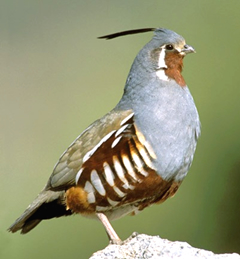
The Scaled Quail is a medium-sized bird, measuring approximately 25-30 centimeters in length. Its most distinguishing feature is the scaly pattern on its plumage, which gives it a distinctive appearance. The scales are most prominent on the breast, back, and sides, creating a pattern of dark edges on each feather. The overall coloration of the Scaled Quail is a soft blue-gray, which provides excellent camouflage against the arid landscapes it inhabits.
Adults of both sexes exhibit similar plumage, although females may appear slightly duller compared to males. Juveniles can be identified by their more muted coloration and the absence of well-defined scaly patterns, which develop as they mature. Unlike many other quail species, the Scaled Quail lacks a prominent crest, instead sporting a short, bushy topknot of feathers that can be difficult to discern at a distance.
In flight, the Scaled Quail displays a rapid, whirring wingbeat pattern typical of quail. Its flight silhouette is characterized by short, rounded wings and a compact body. When perched, the Scaled Quail often assumes a hunched posture, which further aids in its ability to blend into its surroundings. Confusion with other quail species is possible, particularly with the Gambel's Quail and the Northern Bobwhite, but the Scaled Quail's unique plumage and lack of a prominent crest make it distinguishable upon closer inspection.
Having trouble telling birds apart? Upload a photo to our bird identification tool for an instant species match.
Scaled Quail Habitat and Range
Preferred Habitat
Scaled Quail primarily inhabit arid and semi-arid regions, favoring environments such as desert grasslands, scrublands, and areas with scattered cacti and low shrubs. They are commonly found at elevations ranging from 300 to 1500 meters above sea level. This species is well-adapted to the hot, dry climates of the southwestern United States and northern Mexico.
In terms of habitat preferences, Scaled Quail thrive in areas where vegetation is sparse enough to provide visibility for detecting predators, yet dense enough to offer cover. They often frequent areas with mesquite, creosote bush, and yucca, and can also be found in agricultural lands where they benefit from the availability of food resources.
Although primarily associated with rural and undeveloped areas, Scaled Quail can occasionally be found in more urban settings, particularly where suitable habitat overlaps with suburban development. Seasonal habitat shifts are minimal, as the Scaled Quail is largely sedentary, remaining within its established range year-round.
Geographic Range
The Scaled Quail's range encompasses parts of the southwestern United States and northern Mexico. In the United States, its distribution includes states such as Texas, New Mexico, Arizona, and portions of Colorado, Oklahoma, and Kansas. In Mexico, the Scaled Quail can be found in the states of Chihuahua, Sonora, and Coahuila, among others.
This species does not engage in significant migratory behavior, instead maintaining a relatively stable range throughout the year. However, local movements may occur in response to environmental conditions, such as drought or food scarcity, prompting quail to seek more favorable areas within their range.
Population density varies within its range, with higher concentrations often found in regions that offer a combination of suitable habitat and ample food resources. Areas with a mix of open grasslands and scrub habitats, such as the Chihuahuan Desert and the Edwards Plateau, serve as population hotspots.
Want to know which birds visit your area? Browse our backyard birds by location guides for region-specific species lists.
What Does the Scaled Quail Eat?
The diet of the Scaled Quail is diverse and varies seasonally, reflecting the availability of food resources in its arid habitat. Primarily, the Scaled Quail feeds on seeds, which make up the bulk of its diet. Common seed sources include grasses, forbs, and shrubs. During the summer months, when insects are more abundant, Scaled Quail supplement their diet with various arthropods, such as beetles, ants, and grasshoppers.
Foraging typically occurs on the ground, where Scaled Quail use their strong legs and beaks to scratch and peck at the soil surface. This behavior not only aids in seed dispersal but also in the aeration of soil. The quail often feed in the early morning and late afternoon, taking advantage of cooler temperatures and reduced predator activity.
In periods of drought or food scarcity, Scaled Quail may expand their diet to include fruits and buds from desert plants, demonstrating their adaptability to changing environmental conditions. The size of prey items consumed by Scaled Quail is generally small, with a preference for insects and seeds that can be easily handled and ingested.
Scaled Quail Behavior and Social Structure
Scaled Quail exhibit a variety of behaviors that are well-suited to their arid environments. Socially, they are known for forming coveys, especially outside of the breeding season. These groups can include up to 50 individuals, providing safety in numbers against predators.
During the breeding season, which typically begins in late spring, Scaled Quail become more territorial. Males establish and defend territories, often engaging in vocal displays and posturing to deter rivals. Courtship involves displays that include calling and subtle feather movements.
Flocking patterns of Scaled Quail change with the seasons. In the winter, large coveys form, but as spring approaches, these groups disperse into breeding pairs. Despite their tendency to form groups, Scaled Quail maintain a strong association with specific home ranges, rarely venturing far from established territories.
In terms of predator response, Scaled Quail rely on their cryptic coloration and the cover of vegetation to avoid detection. When threatened, they often remain still, relying on their plumage to blend into the surroundings. If flushed, they explode into short, rapid flights, seeking immediate cover.
Scaled Quail Nesting and Reproduction
The nesting habits of the Scaled Quail reflect their adaptation to arid environments. Nests are typically shallow depressions scraped into the ground, often hidden under shrubs or within clumps of grass. These depressions are lined with grasses, leaves, and feathers to provide insulation and camouflage.
Scaled Quail prefer nesting sites that offer some overhead cover, such as mesquite bushes or yucca plants, which help shield the nest from predators and the harsh sun. Clutch sizes generally range from 9 to 16 eggs, with an average of about 12 per clutch.
The incubation period lasts approximately 21 to 23 days, during which the female primarily assumes the responsibility of incubating the eggs. Once hatched, the precocial chicks leave the nest quickly, usually within a day, following the parents as they forage for food. Both parents play a role in caring for the young, leading them to food sources and protecting them from threats.
Scaled Quail may raise one or two broods per year, depending on environmental conditions. In favorable years with abundant resources, a second brood is more likely.
Scaled Quail Sounds and Vocalizations
The vocalizations of the Scaled Quail are distinctive and serve various purposes. Their primary call, often described as a sharp, whistled "queet," is used for communication within coveys and between mates. This call is clear and carries well across the open landscapes they inhabit.
Alarm calls are more urgent in tone and are used to alert other quail to potential threats. These calls are typically short and sharp, designed to quickly grab attention without revealing too much information to predators.
During the breeding season, males may engage in more prolonged vocal displays to establish territory and attract mates. The dawn chorus, though not as elaborate as in some songbird species, is a time when males are particularly vocal. Their calls, often repeated in a rhythmic pattern, can be heard at a distance, serving as an auditory marker of territory.
Compared to other quail species, the Scaled Quail's vocalizations are relatively simple but effective in their arid environment where sound travels well.
Interesting Facts About the Scaled Quail
- 1Scaled Quail can form coveys of up to 50 individuals, providing safety in numbers.
- 2Despite their name, Scaled Quail are adept runners and often prefer running to flying when threatened.
- 3A Scaled Quail's diet includes a variety of seeds and insects, showcasing its adaptability to arid environments.
- 4Their distinctive scaly plumage provides excellent camouflage against the desert terrain.
- 5Scaled Quail are known for their rapid, whirring flight pattern, typical of ground-dwelling birds.
- 6The Scaled Quail's range extends across the southwestern United States, including states like Texas and Arizona.
- 7These quail have a unique bushy topknot of feathers on their heads, rather than a crest.
Scaled Quail Conservation Status
The Scaled Quail is currently listed as a species of Least Concern by the IUCN, indicating that it is not at immediate risk of widespread decline. However, populations are subject to fluctuations due to factors such as habitat loss, climate change, and predation pressure. Primary threats to Scaled Quail include agricultural expansion, which can lead to habitat fragmentation and degradation. Additionally, prolonged droughts, likely exacerbated by climate change, pose a significant threat to their survival by reducing food and water availability. Conservation efforts focus on habitat preservation and restoration, particularly in regions where agricultural practices have altered the landscape. Programs aimed at managing rangelands to support quail populations are crucial for maintaining their numbers. Historically, Scaled Quail populations have experienced periods of both increase and decline, largely in response to changing environmental conditions. Continued monitoring and adaptive management strategies are essential to ensure the long-term viability of Scaled Quail populations.
Other Odontophoridae Species


Birds Similar to the Scaled Quail
These species are often confused with the Scaled Quail due to similar appearance or overlapping range.