
Mountain Quail
Oreortyx pictus
Order: Galliformes / Family: Odontophoridae
Wikimedia Commons
About the Mountain Quail
The Mountain Quail (Oreortyx pictus) is a remarkable bird native to the western United States, specifically known for its adaptation to rugged, mountainous terrains. This bird plays a significant ecological role in its habitat, contributing to seed dispersion and acting as a prey species for various predators. It inhabits a range of locales from the coastal ranges of California to the Sierra Nevada and the Cascade Range, extending into parts of Oregon, Washington, Idaho, and Nevada. The Mountain Quail prefers dense, brush-covered areas, often found in chaparral, mixed coniferous forests, and oak woodlands. Mountain Quails exhibit seasonal behaviors, undergoing altitudinal migrations, moving to lower elevations in the winter months when snow covers their high-altitude summer habitats. In the spring and summer, they ascend to higher altitudes, usually between 3,000 and 10,000 feet, to breed and forage. This altitudinal migration is vital for their survival, as it allows them access to food resources and suitable breeding sites throughout the year. Mountain Quails are important for maintaining ecological balance in their habitats. By consuming a diet rich in seeds, berries, and insects, they aid in controlling insect populations and facilitate the spread of plant seeds. Their presence also supports avian and mammalian predators, making them a crucial component of the food web. With their striking plumage, characteristic head plumes, and secretive nature, the Mountain Quail has become a favorite among bird watchers, contributing to ecotourism in the regions they inhabit. Their natural habitat preferences and behaviors provide insights into the health of the ecosystems they occupy, making them an indicator species for environmental changes.
The Mountain Quail belongs to the family Odontophoridae, within the order Galliformes. These birds typically live average lifespan is 1-4 years, with a maximum recorded lifespan of 6 years in the wild..
How to Identify a Mountain Quail
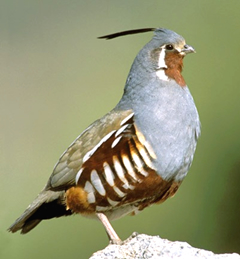
The Mountain Quail is easily identifiable by its striking plumage and distinctive features. Adult quails display a striking combination of bluish-gray on the chest and face, with bold white and chestnut barring on the flanks. The back and wings are predominantly brown, providing effective camouflage in their natural habitat. One of the most unique features of the Mountain Quail is its topknot, a long, straight plume that extends from the top of the head, offering a key identification marker. Males and females appear similar, although males may have slightly larger topknots. Juveniles resemble adults but have more subdued and less distinct coloration, lacking the pronounced topknot. When perched, Mountain Quails maintain an upright posture, and their large size, compared to other quail species, helps distinguish them. In flight, they exhibit short, rapid wingbeats followed by a glide, typical of quails. Despite their striking appearance, they can be confused with similar species like the California Quail, but the Mountain Quail's larger size and distinctive chestnut barring help to differentiate it.
Having trouble telling birds apart? Upload a photo to our bird identification tool for an instant species match.
Mountain Quail Habitat and Range
Preferred Habitat
Mountain Quails predominantly inhabit dense, brushy areas within mountainous regions. They thrive in chaparral, mixed coniferous forests, and oak woodlands, where they find ample cover and food resources. These birds are typically found at elevations ranging from 3,000 to 10,000 feet. They exhibit seasonal habitat shifts, moving to lower elevations during winter to avoid snow cover and ascending to higher altitudes in spring and summer for breeding. Mountain Quails are more commonly found in rural areas, although they occasionally venture into the edges of urban zones where suitable habitat exists. Their preference for dense vegetation makes them less likely to inhabit open or heavily urbanized areas.
Geographic Range
The Mountain Quail's range is primarily concentrated in the western United States. During the breeding season, they are found from the coastal ranges of California, extending northwards through the Sierra Nevada and the Cascade Range into Oregon and Washington. They also inhabit the mountainous regions of Idaho and Nevada. In winter, their range contracts as they move to lower elevations, primarily within the same states, to escape harsh weather conditions. While they do not undergo long-distance migrations, their altitudinal movements are significant. Population densities are highest in California's Sierra Nevada foothills, where suitable habitat is abundant. Despite their limited overall range, their adaptability to different elevations ensures a stable presence across their habitat.
Want to know which birds visit your area? Browse our backyard birds by location guides for region-specific species lists.
What Does the Mountain Quail Eat?
The Mountain Quail's diet consists primarily of seeds, fruits, and insects, varying with the seasons. In spring and summer, they consume a wide array of seeds and berries, such as manzanita, ceanothus, and elderberry, which provide essential nutrients for breeding and raising young. Insects, including beetles and grasshoppers, become a vital protein source during this time, especially for growing chicks. As autumn approaches, the Mountain Quail shifts its diet towards acorns and other available nuts, storing fat reserves for the winter. Their foraging technique involves scratching the ground with their feet to uncover hidden seeds and insects. They exhibit a diurnal feeding schedule, actively foraging during the morning and late afternoon, while seeking cover during the hottest parts of the day.
Mountain Quail Behavior and Social Structure
Mountain Quails exhibit a fascinating array of behaviors, particularly in their social and territorial interactions. They are generally monogamous, forming pairs during the breeding season. These birds display strong territorial behavior, with males often engaging in vocalizations and physical displays to defend their territory. Courtship involves a series of displays, including bowing and calling, which strengthen pair bonds. Outside the breeding season, Mountain Quails form small coveys, often consisting of family groups. These coveys can be seen foraging together, providing safety in numbers. When threatened by predators such as raptors or mammals, Mountain Quails rely on their impressive running ability to escape, preferring to run rather than fly. Their daily activity patterns include active foraging during cooler parts of the day and resting under cover when temperatures rise.
Mountain Quail Nesting and Reproduction
The Mountain Quail's nesting habits are adapted to its rugged environment. Nests are usually located on the ground, well-concealed under dense vegetation or among rocks, providing protection from predators. They construct their nests using a variety of materials, including grass, leaves, and twigs, creating a shallow depression. The typical clutch size ranges from 9 to 12 eggs, which are incubated primarily by the female for about 24 days. After hatching, chicks are precocial and leave the nest quickly, following the parents as they forage. Both parents participate in rearing the young, providing protection and guidance. Mountain Quails typically raise one brood per year, although in some favorable conditions, they may attempt a second.
Mountain Quail Sounds and Vocalizations
The Mountain Quail's vocalizations are distinctive and serve various purposes. Their primary song consists of a series of clear, high-pitched whistles, often described as 'quee-quee-quee,' which males use during the breeding season to establish territory and attract mates. Their call notes are sharp and abrupt, used for communication within coveys. Alarm calls are harsh and rapid, signaling the presence of predators. During the dawn chorus, Mountain Quails are particularly vocal, with males issuing repeated calls that reverberate through their dense habitats. These vocalizations are essential for maintaining social cohesion and ensuring the safety of the covey.
Interesting Facts About the Mountain Quail
- 1Mountain Quails are the largest quail species in the United States, measuring up to 11 inches in length.
- 2Unlike many other quail, Mountain Quails are capable of long, sustained flights, aiding their altitudinal migrations.
- 3The topknot of the Mountain Quail, which can reach two inches, is a key identifier and varies in size among individuals.
- 4Mountain Quails participate in altitudinal migrations, moving seasonally to different elevations rather than long-distance migrations.
- 5These birds have a unique feeding behavior, scratching the ground vigorously with both feet simultaneously to uncover food.
- 6Mountain Quails' cryptic coloration provides excellent camouflage, allowing them to blend seamlessly into their brushy habitats.
- 7Despite their size, Mountain Quails are adept at navigating dense underbrush, using their strong legs to maneuver quickly.
Mountain Quail Conservation Status
The Mountain Quail currently holds a status of Least Concern according to the IUCN, although certain populations face pressures from habitat loss and fragmentation. Their population trend is considered stable, though localized declines have occurred due to urbanization, agricultural expansion, and fire suppression practices that alter natural habitats. Conservation efforts focus on habitat restoration and management, particularly in maintaining suitable brushy areas through controlled burns and reforestation. Historically, the Mountain Quail's range has contracted in some areas, but conservation initiatives aim to prevent further declines by promoting sustainable land use practices and raising awareness about the species' ecological importance.
Other Odontophoridae Species


Birds Similar to the Mountain Quail
These species are often confused with the Mountain Quail due to similar appearance or overlapping range.