
Green Tinkerbird
Pogoniulus simplex
Order: Piciformes / Family: Lybiidae

Wikimedia Commons
About the Green Tinkerbird
The Green Tinkerbird (Pogoniulus simplex) is a fascinating avian species belonging to the family Lybiidae and order Piciformes. This small bird is predominantly found in the forests of Eastern Africa, particularly in countries such as Kenya, Tanzania, and Uganda. The Green Tinkerbird plays a significant ecological role in these regions, acting as both a pollinator and a seed disperser. Its presence is crucial for maintaining the biodiversity of its habitat, as it feeds on a variety of fruits and insects. The bird's green plumage provides excellent camouflage against the verdant backdrop of its forest home, allowing it to avoid predators and move stealthily through the canopy. During the breeding season, which typically aligns with the rainy periods in its habitat, the Green Tinkerbird becomes more vocal and active. Its distinctive calls can be heard echoing through the forest as males establish territories and attract mates. The Green Tinkerbird's role in the ecosystem extends beyond its feeding habits; it also participates in complex interactions with other species. For instance, its foraging activities can inadvertently benefit other animals by dislodging insects and seeds, which then become available to other forest dwellers. As a species that thrives in tropical forests, the Green Tinkerbird's presence indicates a healthy ecosystem, making it a valuable indicator species for conservationists monitoring forest health. The Green Tinkerbird is also of interest to ornithologists and bird watchers. Its vibrant coloration and distinctive vocalizations make it a sought-after species for those keen on observing the rich birdlife of Eastern Africa. Beyond its ecological significance, the Green Tinkerbird holds cultural value for local communities who often associate it with the vibrancy and vitality of the forest. Its persistence in surviving and thriving amid environmental changes exemplifies the resilience of forest ecosystems in the face of threats such as deforestation and climate change.
The Green Tinkerbird belongs to the family Lybiidae, within the order Piciformes. These birds typically live average 4-5 years, with a maximum recorded of 7 years..
How to Identify a Green Tinkerbird
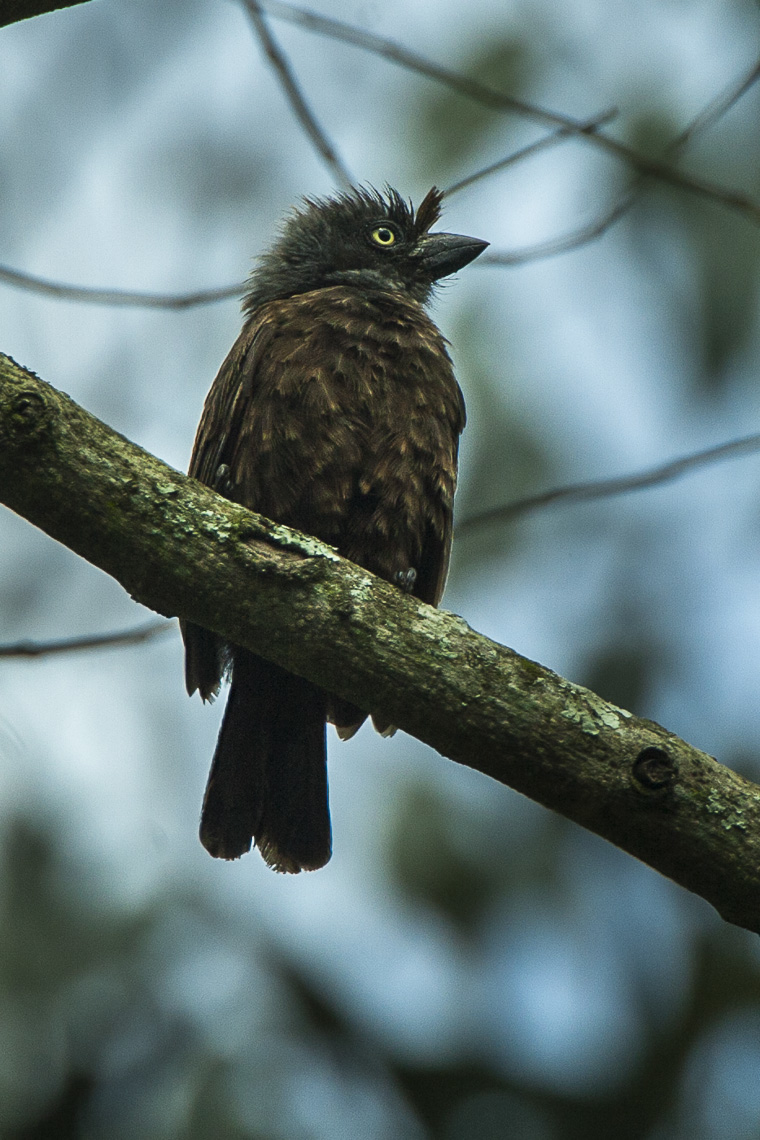
The Green Tinkerbird is a small bird, measuring about 10 cm in length. Its most distinguishing feature is its bright green plumage, which covers most of its body and provides excellent camouflage in its forest habitat. The bird exhibits a small, stout body typical of tinkerbirds, with a short tail and a strong, slightly curved bill that aids in foraging. Adult Green Tinkerbirds show little sexual dimorphism, with males and females appearing similar. However, males may exhibit slightly brighter plumage, especially during the breeding season. Juveniles are generally duller with more muted green tones and lack the sheen of the adults' feathers. In terms of similar species, the Green Tinkerbird can be confused with the Yellow-rumped Tinkerbird (Pogoniulus bilineatus), but the latter has distinctive yellow markings on its rump and a different vocalization pattern. In flight, the Green Tinkerbird has a quick and direct flight pattern, often moving in short bursts from one tree to another. When perched, it maintains an upright posture, often sitting still for long periods, making it easier to observe once located.
Having trouble telling birds apart? Upload a photo to our bird identification tool for an instant species match.
Green Tinkerbird Habitat and Range
Preferred Habitat
The Green Tinkerbird predominantly inhabits lowland tropical forests in Eastern Africa, ranging from dense primary forests to secondary growth areas. It is commonly found at elevations up to 2,500 meters, favoring areas with abundant fruiting trees and a dense canopy. The bird's preference for forested environments means it is less frequently seen in open areas or savannas. However, it adapts well to fragmented forests and can sometimes be spotted in wooded suburban areas or forest edges where suitable tree cover exists. Seasonally, there is little habitat shift for the Green Tinkerbird, as it is primarily a resident species. Its presence in both pristine and disturbed habitats highlights its adaptability, though it thrives best in intact forest ecosystems.
Geographic Range
The Green Tinkerbird's range is primarily confined to the Eastern African countries of Kenya, Tanzania, and Uganda. It is a year-round resident in these regions, showing little migratory behavior. Within its range, the bird is most commonly found in forested areas, including national parks and reserves where its habitat is protected. The population density of the Green Tinkerbird is highest in areas with rich fruiting vegetation, such as the coastal forests of Kenya and the highlands of Tanzania. Despite its relatively restricted range, the Green Tinkerbird is considered widespread within suitable habitats in these countries.
Want to know which birds visit your area? Browse our backyard birds by location guides for region-specific species lists.
What Does the Green Tinkerbird Eat?
The diet of the Green Tinkerbird primarily consists of fruits and insects. It shows a particular preference for figs and small berries, which it forages from tree canopies. During certain seasons, particularly when fruit is less abundant, it shifts its diet to include more insects, capturing caterpillars, beetles, and other small arthropods. The Green Tinkerbird employs a gleaning foraging technique, carefully picking food items from foliage and branches. It often feeds alone or in pairs, occasionally joining mixed-species flocks to exploit feeding opportunities. The bird's feeding activity peaks during the early morning and late afternoon when temperatures are cooler and insect activity increases.
Green Tinkerbird Behavior and Social Structure
The Green Tinkerbird exhibits a range of interesting behaviors that reflect its adaptability and social nature. It is generally a solitary bird but can also be seen foraging in pairs or small family groups during the breeding season. Territorial behavior is pronounced among males, who use their vocalizations to establish and defend their territories from rivals. During courtship, males perform elaborate displays, which include vocal duets with potential mates and physical displays such as wing flicking. Flocking behavior is most evident outside the breeding season when the Green Tinkerbird may join mixed-species foraging flocks to increase feeding efficiency and reduce predation risks. The bird remains active throughout the day, with peak activity during the cooler morning and late afternoon hours. In response to predators, the Green Tinkerbird employs a strategy of stillness, relying on its camouflaged plumage to avoid detection.
Green Tinkerbird Nesting and Reproduction
The Green Tinkerbird constructs its nest in tree cavities, often utilizing existing holes or abandoned nests of woodpeckers. The nest's interior is lined with soft plant material, feathers, and sometimes small pieces of bark. Nest sites are typically located several meters above the ground in well-concealed locations to deter predators. The female lays a clutch of 2-3 eggs, which she incubates for about 14 days. Both parents participate in feeding the chicks, which fledge approximately 20 days after hatching. The Green Tinkerbird typically raises one brood per year, though in optimal conditions, a second brood may be attempted.
Green Tinkerbird Sounds and Vocalizations
The Green Tinkerbird is known for its distinctive vocalizations, which include a series of rapid, high-pitched notes that resemble a tinkling bell. This rhythmic song serves as both a territorial call and a communication tool between mates. The call notes are short and repetitive, often lasting several seconds. Alarm calls are sharper and more insistent, used to warn of nearby predators. During the dawn chorus, the Green Tinkerbird's song is a prominent and familiar sound in its forest habitat, often heard before the first light.
Interesting Facts About the Green Tinkerbird
- 1The Green Tinkerbird's call resembles the sound of a tinkling bell, making it easy to identify even without seeing the bird.
- 2This bird plays a crucial role in seed dispersal, helping to maintain the health and diversity of its forest habitat.
- 3Unlike many birds, the Green Tinkerbird does not migrate, remaining in its forest home year-round.
- 4The Green Tinkerbird can adapt to both primary and secondary forests, demonstrating remarkable ecological flexibility.
- 5During the breeding season, male Green Tinkerbirds engage in vocal duets with their mates to strengthen pair bonds.
- 6In addition to fruits, the Green Tinkerbird's diet includes a variety of insects, providing it with essential proteins.
- 7The Green Tinkerbird's nesting success often depends on the availability of tree cavities, highlighting the importance of old-growth forests.
Green Tinkerbird Conservation Status
The Green Tinkerbird is currently classified as Least Concern by the IUCN, with a stable population trend. Despite this, habitat loss due to deforestation and land conversion poses a significant threat to its survival. Conservation efforts focus on preserving forest habitats, particularly in protected areas and reserves. Historically, the Green Tinkerbird has maintained stable populations, but ongoing monitoring is essential to ensure its continued presence in Eastern Africa's forests.
Other Lybiidae Species


Birds Similar to the Green Tinkerbird
These species are often confused with the Green Tinkerbird due to similar appearance or overlapping range.

