
Yellow-throated Tinkerbird
Pogoniulus subsulphureus
Order: Piciformes / Family: Lybiidae

Wikimedia Commons
About the Yellow-throated Tinkerbird
The Yellow-throated Tinkerbird, scientifically known as Pogoniulus subsulphureus, is a fascinating member of the Lybiidae family, renowned for its vibrant plumage and distinctive call. This bird is commonly found across the forests of sub-Saharan Africa, with a significant presence in countries like Ghana, Nigeria, Cameroon, and the Democratic Republic of the Congo. The bird favors dense tropical forests, often residing on the edges where it can find a mix of open spaces and dense foliage for feeding and nesting. These areas provide the essential resources needed for the Yellow-throated Tinkerbird to thrive.
This bird plays a crucial role in its ecosystem as both a seed disperser and a predator of insects. By consuming various fruits and berries, the Yellow-throated Tinkerbird helps in the propagation of several plant species, promoting forest regeneration. Additionally, its insectivorous diet aids in controlling pest populations, thus maintaining ecological balance. The bird's presence in a region often indicates a healthy, biodiverse habitat, making it a valuable species for birdwatchers and conservationists alike.
Seasonally, the Yellow-throated Tinkerbird remains a resident bird, showing little to no migratory behavior. Its year-round presence in the same habitat contributes to a stable population, assuming no drastic environmental changes occur. However, it may show some altitudinal movement depending on food availability and climatic conditions. During the breeding season, which varies slightly across its range, the bird becomes more vocal and active, as males sing to establish territories and attract mates. Through its persistent calling, the Yellow-throated Tinkerbird becomes an auditory symbol of the African forests, resonating through the canopy and adding to the rich tapestry of forest sounds.
The Yellow-throated Tinkerbird belongs to the family Lybiidae, within the order Piciformes. These birds typically live typically 5-6 years, with some individuals reaching up to 8 years..
How to Identify a Yellow-throated Tinkerbird
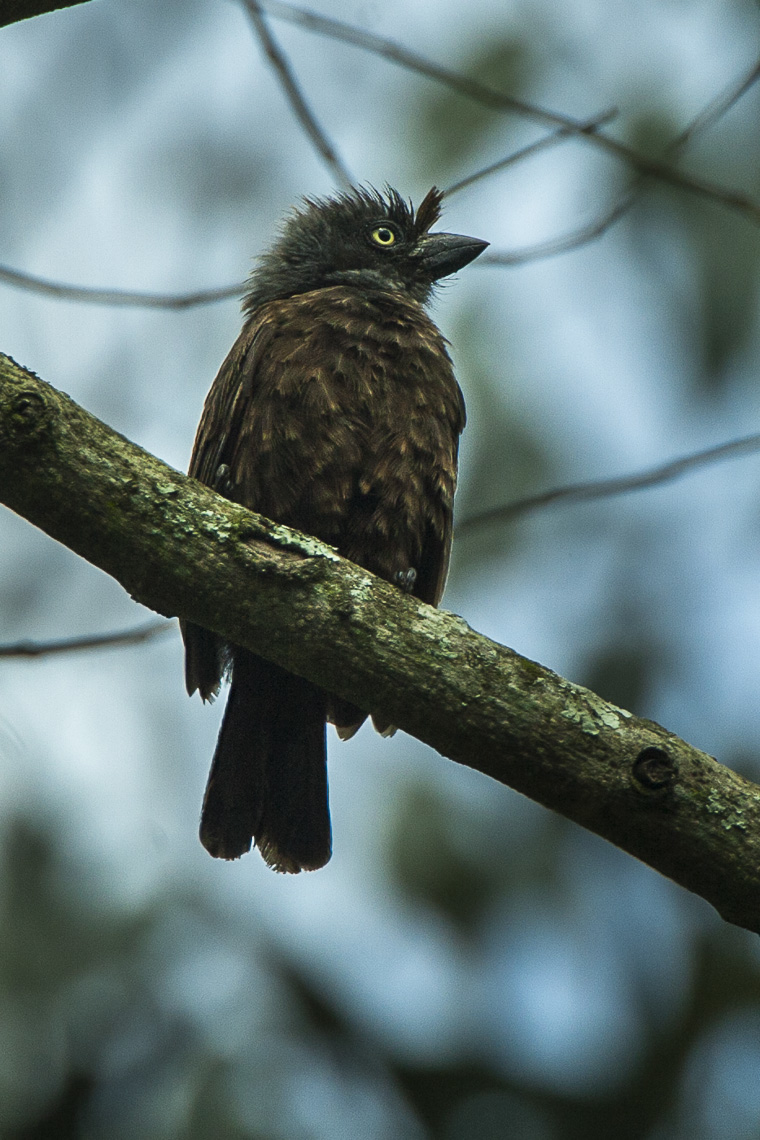
The Yellow-throated Tinkerbird is a small, striking bird characterized by its bright yellow throat and chest. Its head is adorned with a mix of black and white stripes, offering a stark contrast to its otherwise predominantly yellow and green plumage. Adult birds showcase a glossy black crown, while juveniles tend to have a slightly duller appearance, lacking the full vibrancy of the adults. Both males and females share similar plumage, making sex differentiation based on sight alone challenging.
In terms of size, the Yellow-throated Tinkerbird measures approximately 9-10 cm in length, making it one of the smaller members of its family. Its short tail and stout body are typical of tinkerbirds, aiding in its maneuverability among dense branches. When in flight, the Yellow-throated Tinkerbird exhibits a rapid, undulating flight pattern common to many small forest birds.
Confusion with similar species such as the Yellow-fronted Tinkerbird is possible due to overlapping ranges. However, the Yellow-throated Tinkerbird can be distinguished by its lack of a yellow forehead patch, a feature present in the Yellow-fronted. Observing the Yellow-throated Tinkerbird perched, one can note its upright posture and constant tail flicking, behaviors that are consistent with its foraging and territorial activities.
Having trouble telling birds apart? Upload a photo to our bird identification tool for an instant species match.
Yellow-throated Tinkerbird Habitat and Range
Preferred Habitat
The Yellow-throated Tinkerbird primarily inhabits lowland tropical forests, often found at elevations ranging from sea level to about 1800 meters. It thrives in humid environments, preferring dense forest edges and clearings where it can access both shelter and food resources. These birds are also common in secondary forests and sometimes venture into cultivated areas and gardens, especially when these spaces are adjacent to their preferred woodland habitats.
Despite its adaptability, the Yellow-throated Tinkerbird is less frequently observed in dry savannahs or open landscapes without sufficient tree cover. Seasonal shifts in habitat are not pronounced, as the bird tends to remain in regions where food supply and nesting sites are consistently available.
In urban settings, the Yellow-throated Tinkerbird may occasionally appear in well-vegetated parks and gardens, particularly in cities that incorporate natural forest elements within their landscapes. However, its presence in heavily urbanized areas remains limited due to the lack of suitable nesting and foraging grounds.
Geographic Range
The Yellow-throated Tinkerbird boasts a wide range across sub-Saharan Africa, with its presence noted from West Africa to Central Africa. In the west, it is commonly found in countries such as Sierra Leone, Liberia, and Ghana. Moving eastward, its range extends through Nigeria and into the lush forests of Cameroon and Gabon. The bird also occupies territories in the Democratic Republic of the Congo, where extensive forest habitats provide ideal living conditions.
Unlike many bird species, the Yellow-throated Tinkerbird does not undertake long-distance migrations, instead maintaining its range year-round. This stability in range correlates with its preference for consistent tropical climates and habitats.
Populations are denser in regions with intact forests, with hotspots of activity observed in national parks and protected forest reserves where human disturbance is minimized. Its distribution is largely continuous within suitable habitats, although fragmentation due to deforestation poses a potential threat to its habitats.
Want to know which birds visit your area? Browse our backyard birds by location guides for region-specific species lists.
What Does the Yellow-throated Tinkerbird Eat?
The diet of the Yellow-throated Tinkerbird is primarily frugivorous, with a strong preference for small fruits and berries. It often feeds on the fruits of figs, mistletoes, and other forest trees, playing a vital role in seed dispersal. This bird's diet also includes a variety of insects, which it gleans from foliage and bark, providing a crucial protein source.
Seasonal variations in diet are minimal, as the bird's habitat consistently offers fruit-bearing plants and a steady supply of insects. However, during certain times of the year, when specific fruits are more abundant, the Yellow-throated Tinkerbird may show a preference for these temporary food sources.
Typically, foraging occurs during daylight hours, with peak activity in the early morning and late afternoon. The bird uses its strong, slightly hooked bill to pluck fruits and capture insects, often performing acrobatic maneuvers to reach food hidden in the canopy. By maintaining a varied diet, the Yellow-throated Tinkerbird supports its energetic lifestyle and contributes to the ecological health of its environment.
Yellow-throated Tinkerbird Behavior and Social Structure
The Yellow-throated Tinkerbird exhibits a variety of fascinating behaviors that make it a notable member of its ecosystem. This species is primarily solitary or found in pairs, with social structures centered around breeding pairs and their territories. The bird is highly territorial, with males often singing persistently to assert dominance over their chosen area and to ward off potential intruders.
During the breeding season, courtship displays become more pronounced. Males engage in vocal duets with females, reinforcing pair bonds and synchronizing nesting activities. While not as gregarious as some other bird species, the Yellow-throated Tinkerbird occasionally joins mixed-species flocks, particularly in areas where food resources are abundant.
In response to predators, the Yellow-throated Tinkerbird relies on a combination of alarm calls and evasive flight. The bird's small size and agility allow it to quickly maneuver through dense foliage, making it a challenging target for predators. Its daily activity patterns are diurnal, with periods of rest interspersed with foraging and territorial defense activities. By maintaining a heightened presence within its territory, the Yellow-throated Tinkerbird ensures access to vital resources and enhances its chances of reproductive success.
Yellow-throated Tinkerbird Nesting and Reproduction
The Yellow-throated Tinkerbird constructs its nests in tree cavities, often using natural holes or those excavated by other species such as woodpeckers. The bird exhibits a preference for nesting sites that offer protection from predators and environmental elements, typically choosing locations high above the ground.
Nesting materials include fine grasses, feathers, and other soft plant fibers, which the birds use to line the cavity interior. The clutch size usually ranges from two to four eggs, with both parents sharing incubation duties over a period of approximately 13-15 days.
Upon hatching, the chicks remain in the nest for about 20-25 days, during which time they are fed and cared for by both parents. The cooperative efforts of the pair ensure that the chicks receive ample nourishment and protection during this critical period. The Yellow-throated Tinkerbird may raise one or two broods per year, depending on environmental conditions and resource availability. Successful breeding requires a stable habitat with sufficient food supply and minimal disturbance, underscoring the importance of conservation efforts in maintaining viable populations.
Yellow-throated Tinkerbird Sounds and Vocalizations
The Yellow-throated Tinkerbird is well-known for its distinctive vocalizations, which consist of a series of rapid, repetitive notes resembling the sound of a small hammer striking metal. This primary song is often described as a 'tink' sound, repeated at a consistent rhythm, which can carry over considerable distances in the forest.
In addition to its primary song, the bird emits a variety of call notes used in communication between mates and in territorial disputes. Alarm calls are sharper and more urgent, differing from the melodious quality of its regular song.
Dawn and dusk are the most active vocal periods for the Yellow-throated Tinkerbird, as the bird establishes its presence and territory during these cooler, quieter times of the day. The bird's song contributes to the vibrant soundscape of the African forests, providing a familiar auditory backdrop for those who frequent these tropical regions.
Interesting Facts About the Yellow-throated Tinkerbird
- 1The Yellow-throated Tinkerbird's song can be heard up to 200 meters away, making it a key identifier in the dense forest.
- 2A typical clutch of the Yellow-throated Tinkerbird consists of 2-4 eggs, with both parents involved in incubation.
- 3Despite being small, the Yellow-throated Tinkerbird can occupy territories as large as 1 hectare.
- 4This bird's diet includes over 50 different fruit species, highlighting its role in forest seed dispersal.
- 5The Yellow-throated Tinkerbird can complete a nesting cycle from egg-laying to fledging in just 6-7 weeks.
- 6These birds often use cavities created by woodpeckers, demonstrating a unique ecological interdependence.
- 7The Yellow-throated Tinkerbird's call is often mistaken for the sound of a distant woodpecker due to its rhythmic nature.
Yellow-throated Tinkerbird Conservation Status
The Yellow-throated Tinkerbird is classified as 'Least Concern' by the IUCN, indicating a stable population trend without immediate threats of decline. Nevertheless, habitat loss due to deforestation and agricultural expansion poses a significant long-term threat to its habitat. As forests are cleared for timber and converted into farmland, the availability of suitable nesting and feeding grounds diminishes, potentially impacting population stability. Conservation efforts focus on habitat preservation, particularly through the establishment and maintenance of protected areas that safeguard the rich biodiversity of tropical forests. Community-based conservation programs also play a role in raising awareness about the ecological value of species like the Yellow-throated Tinkerbird. Historical records suggest that the population of this species has remained relatively stable over recent decades, thanks to its wide range and adaptability to secondary habitats. Continued monitoring and proactive conservation measures will be essential to ensure the long-term viability of its populations in the face of ongoing environmental changes.
Other Lybiidae Species


Birds Similar to the Yellow-throated Tinkerbird
These species are often confused with the Yellow-throated Tinkerbird due to similar appearance or overlapping range.

