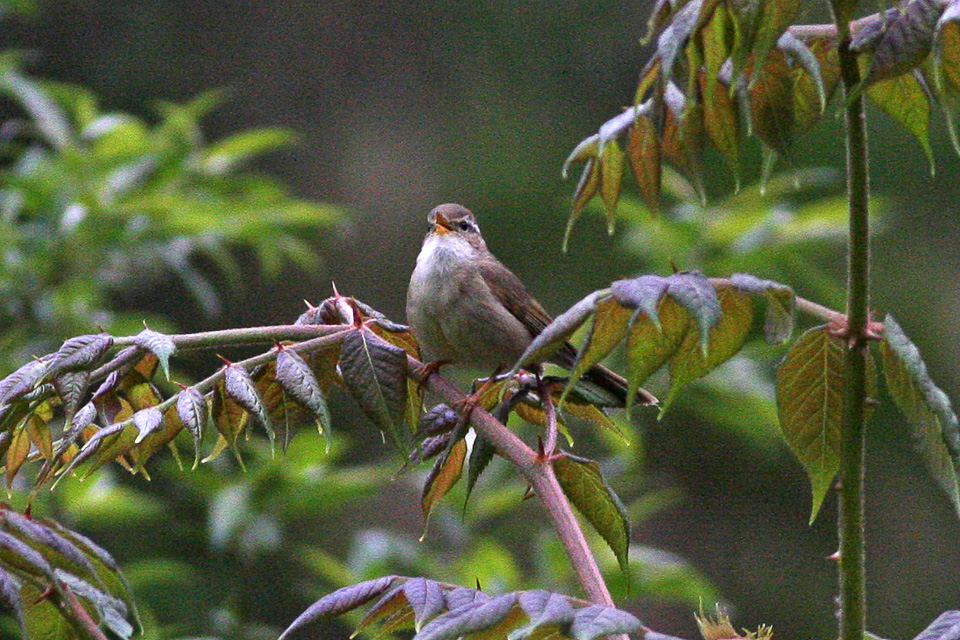
Hainan Leaf Warbler
Phylloscopus hainanus
Order: Passeriformes / Family: Phylloscopidae

Wikimedia Commons
About the Hainan Leaf Warbler
The Hainan Leaf Warbler (Phylloscopus hainanus) is a small passerine bird that belongs to the Phylloscopidae family. This warbler is primarily found in the subtropical and tropical montane forests of Hainan Island, China. It plays a vital ecological role as an insectivore, helping to control insect populations in its habitat. The Hainan Leaf Warbler is often associated with dense understory vegetation, where it actively forages for insects and other small invertebrates. Its presence indicates a healthy forest ecosystem, and it often serves as a bioindicator for environmental changes due to its sensitivity to habitat alteration. During the breeding season, which typically occurs between March and July, the Hainan Leaf Warbler becomes more conspicuous as males engage in complex vocal displays to attract mates and establish territories. This species exhibits altitudinal migration, moving to lower elevations during the winter months. The bird's adaptability to different forest types, including secondary growth and plantation areas, ensures its survival despite ongoing habitat fragmentation. Conservation efforts focus on preserving its native forest habitats and mitigating the impacts of deforestation. Given its restricted range and specialized habitat requirements, the Hainan Leaf Warbler is of particular interest to ornithologists and conservationists alike, who study its behavior, population dynamics, and the impacts of environmental changes on its survival.
The Hainan Leaf Warbler belongs to the family Phylloscopidae, within the order Passeriformes. These birds typically live average 4 years with a max recorded of 6 years..
How to Identify a Hainan Leaf Warbler
The Hainan Leaf Warbler is a small bird, measuring approximately 10-12 cm in length with a wingspan of about 18 cm. Its plumage is predominantly bright green, which provides excellent camouflage among the foliage. The underparts are off-white, and a distinct pale yellow stripe runs above the eye, contrasting with the grayish crown. Juveniles resemble adults but have duller plumage and less pronounced markings. There is little sexual dimorphism, with males and females appearing similar in size and coloration. The Hainan Leaf Warbler can be confused with other Phylloscopus species, but its unique vocalizations and specific habitat preferences help distinguish it in the field. In flight, the bird exhibits rapid wing beats and a characteristic flitting motion. When perched, it often holds its body horizontally, with its tail slightly cocked upward. Observers should note the bird's active foraging behavior and frequent tail flicking, which are indicative of its species.
Having trouble telling birds apart? Upload a photo to our bird identification tool for an instant species match.
Hainan Leaf Warbler Habitat and Range
Preferred Habitat
The Hainan Leaf Warbler inhabits subtropical and tropical montane forests, often found at elevations ranging from 600 to 1800 meters. It prefers dense understory and mixed forest types, including primary forests, secondary growth, and plantation areas on Hainan Island. Seasonal habitat shifts occur as the bird moves to lower elevations during the cooler months, where it occupies similar forest types. The warbler is less commonly found in urban areas, although it may occasionally venture into gardens and parks adjacent to forested regions. Its presence indicates healthy forest ecosystems, and it tends to avoid heavily disturbed habitats.
Geographic Range
The Hainan Leaf Warbler's range is limited to Hainan Island, located in southern China. It occupies the central and southern parts of the island, with population density hotspots in the island's montane forest regions. During the breeding season, the bird is found at higher elevations, but it descends to lower altitudes in the winter months. The species does not undertake long-distance migrations but exhibits altitudinal movements in response to seasonal temperature changes. Conservationists closely monitor its population due to its restricted range and potential vulnerability to habitat loss.
Want to know which birds visit your area? Browse our backyard birds by location guides for region-specific species lists.
What Does the Hainan Leaf Warbler Eat?
The Hainan Leaf Warbler primarily feeds on insects and other small invertebrates, including caterpillars, beetles, and spiders. Its diet may vary seasonally, with an increased intake of caterpillars during the breeding season when protein demands are higher. The bird employs a variety of foraging techniques, such as gleaning from leaves, branches, and bark, as well as hovering briefly to catch prey in flight. It typically forages alone or in small groups, moving rapidly through the forest understory in search of food. Feeding activity peaks during the early morning and late afternoon, though the bird may adjust its schedule based on prey availability.
Hainan Leaf Warbler Behavior and Social Structure
Hainan Leaf Warblers are primarily solitary or found in pairs during the breeding season. Males are territorial and engage in vocal displays and aggressive behaviors to defend their territories. Courtship involves males singing complex songs and performing flight displays. Outside the breeding season, the species may join mixed-species foraging flocks, benefiting from the added protection against predators. The warbler is diurnal, with peak activity during the cooler parts of the day. In response to predators, the bird uses alarm calls and seeks cover in dense vegetation. The Hainan Leaf Warbler's social structure and behavior reflect its adaptation to a densely forested environment.
Hainan Leaf Warbler Nesting and Reproduction
The Hainan Leaf Warbler typically builds a cup-shaped nest using fine grasses, leaves, and other plant materials. It prefers to locate nests in dense vegetation, often in shrubs or small trees, to provide concealment from predators. The female lays a clutch of 3-5 eggs, which she incubates for about 12-14 days. Both parents participate in feeding the chicks, which fledge approximately 10-12 days after hatching. The species may raise two broods per year, depending on environmental conditions. Parental care is well-coordinated, with both adults contributing to the protection and nourishment of the young.
Hainan Leaf Warbler Sounds and Vocalizations
The primary song of the Hainan Leaf Warbler consists of a series of high-pitched, melodious notes delivered in rapid succession. Its song is distinctive and serves as a key identification feature in the field. Call notes are sharp and metallic, often used to communicate with mates or as alarm signals. During the dawn chorus, males sing vigorously to establish territories and attract mates. The warbler's vocalizations are reminiscent of those of other Phylloscopus species but are distinguished by their unique rhythm and pitch.
Interesting Facts About the Hainan Leaf Warbler
- 1The Hainan Leaf Warbler is named after its primary habitat, Hainan Island, which is a biodiversity hotspot in China.
- 2Despite its small size, the Hainan Leaf Warbler can cover large areas in search of food, showcasing remarkable stamina.
- 3The species' bright green plumage provides excellent camouflage, making it challenging to spot in dense foliage.
- 4The Hainan Leaf Warbler's song is a key tool for territory defense, with males often engaging in singing duels.
- 5This warbler is an important study subject for understanding the impacts of climate change on montane bird species.
- 6Hainan Island's unique ecosystems host a number of endemic species, with the Hainan Leaf Warbler being one of them.
- 7The bird's adaptability to different forest types has helped it persist despite significant habitat alterations.
Hainan Leaf Warbler Conservation Status
The Hainan Leaf Warbler is currently classified as Least Concern on the IUCN Red List, but its population trend is decreasing. Major threats include habitat loss due to deforestation and land conversion for agriculture. Conservation efforts focus on preserving the remaining forest habitats on Hainan Island and promoting sustainable land-use practices. Historical data indicate that the bird's population has experienced fluctuations in response to habitat changes, underscoring the need for continued monitoring and protective measures to ensure its long-term survival.