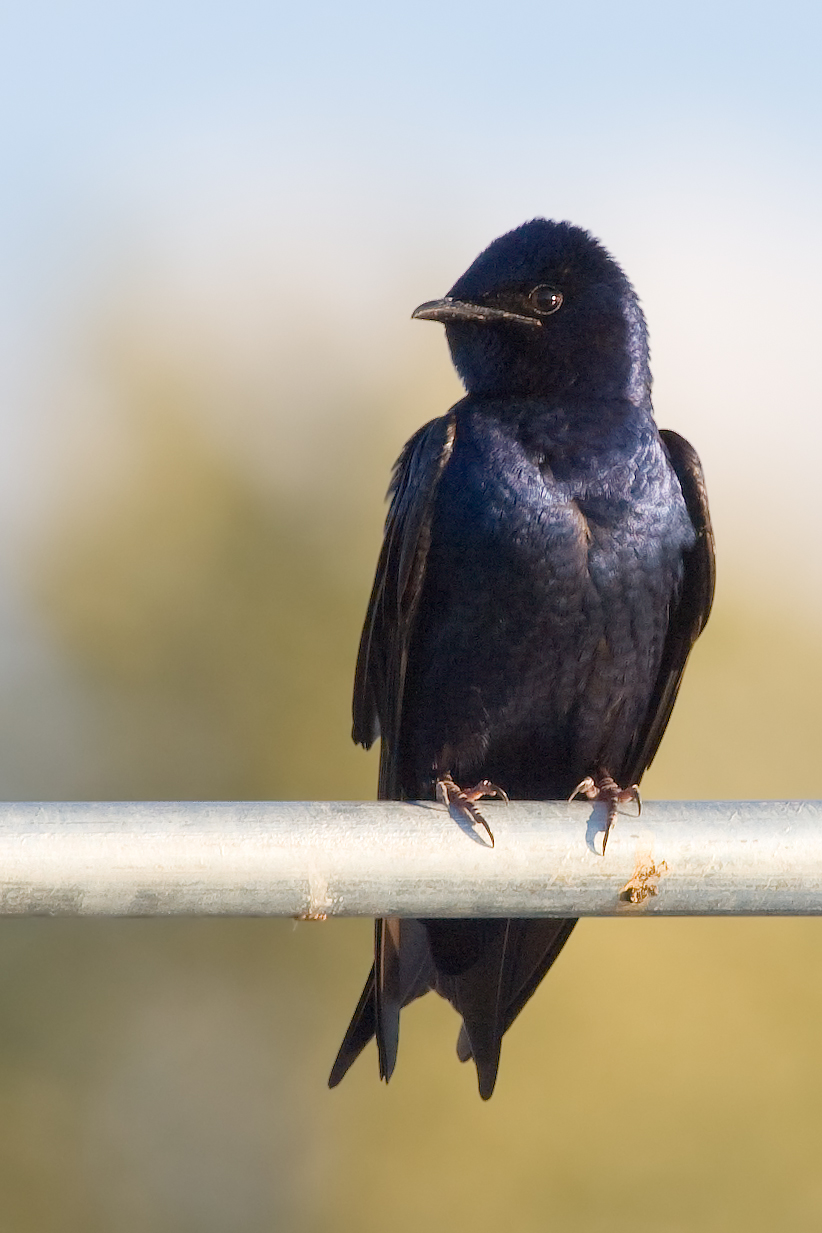
Hirundo purpurea
Hirundo purpurea
Order: Passeriformes / Family: Hirundinidae

Wikimedia Commons
About the Hirundo purpurea
The Purple Martin (Hirundo purpurea) is North America's largest swallow, showcasing its remarkable adaptation to aerial life with a streamlined body and long, pointed wings. This bird is celebrated for its glossy, iridescent plumage, which appears deep blue to black in sunlight, leading to its common name. While Purple Martins are predominantly found in North America, their ecological role extends beyond their regional boundaries. They feast primarily on flying insects, thereby maintaining a crucial balance within ecosystems by controlling pest populations. Historically, Native Americans provided gourds as nesting sites for these birds, which has evolved into a widespread human-assisted nesting program today. Purple Martins engage in long migratory journeys. They breed in the eastern United States and parts of southern Canada, then undertake an arduous migration to winter in the Amazon Basin in South America. This migration highlights their adaptability and resilience. During the breeding season, they are seen in open areas near water, often in proximity to human habitation. Their social nature leads them to form colonies, making them a familiar presence in urban and suburban settings. The Purple Martin's seasonal behaviors reflect their dependence on specific habitats. They are cavity nesters, relying heavily on human-provided housing due to the shortage of natural nesting sites. These birds often return to the same nesting locations each year, demonstrating site fidelity. Their migration timing is closely aligned with the availability of their insect prey, ensuring they arrive at breeding grounds when food is abundant. The decline in natural habitats and competition from non-native species like the European Starling and House Sparrow pose challenges to their population, emphasizing the importance of continued conservation efforts.
The Hirundo purpurea belongs to the family Hirundinidae, within the order Passeriformes. These birds typically live average 5 years, with a maximum recorded of 9 years..
How to Identify a Hirundo purpurea
Adult Purple Martins are striking birds with a glossy blue-black appearance, most vivid in males. Females and juveniles, however, display a duller coloration, with lighter underparts and a slightly grayish tone. This sexual dimorphism aids in distinguishing between the sexes in the field. Juvenile martins resemble females but can be identified by their less glossy plumage and more pronounced gray tones. When in flight, the Purple Martin's silhouette is distinctive, characterized by elongated wings and a slightly forked tail. They exhibit agile, soaring flight patterns, often seen gliding or diving acrobatically while catching insects. At rest, they maintain an upright posture, perching on wires or nesting structures, sometimes in large groups. While the Barn Swallow and Tree Swallow share similar habitats and behaviors, their plumage and size are different. The Barn Swallow has a deeply forked tail and orange underparts, and the Tree Swallow's smaller size and iridescent greenish-blue upperparts set it apart from the Purple Martin. The Purple Martin's larger size and unique coloration make it relatively easy to identify among swallows.
Having trouble telling birds apart? Upload a photo to our bird identification tool for an instant species match.
Hirundo purpurea Habitat and Range
Preferred Habitat
Purple Martins thrive in open areas near water, such as lakes, rivers, and wetlands, which support their insect-rich diet. They are notably adaptable, often found in urban and suburban environments where human-provided nesting sites are available. These birds typically nest in artificial structures, such as martin houses or gourd clusters, placed in open spaces with clear flight paths. In contrast, their natural nesting sites, such as dead trees or cliffs, have become scarce. During migration and winter, Purple Martins occupy a broader range of habitats across South America, including forest edges and savannas. Their preference for lower elevations during the breeding season shifts to more varied elevations in their wintering grounds. This seasonal habitat shift reflects their adaptability and the necessity of abundant food sources year-round.
Geographic Range
The breeding range of the Purple Martin spans the eastern and central United States, extending into southern Canada. They are most populous in the southeastern U.S., with notable population density hotspots in Florida and Texas. During migration, these birds follow flyways through the Great Plains and along the Gulf Coast, congregating in large flocks before crossing into Central America. Their wintering range encompasses the Amazon Basin in South America, where they exploit the region's abundant insect populations. Countries such as Brazil, Bolivia, and Peru serve as key wintering locales. This extensive migratory range underscores the Purple Martin's adaptability and resilience, enabling them to exploit diverse ecosystems across continents.
Want to know which birds visit your area? Browse our backyard birds by location guides for region-specific species lists.
What Does the Hirundo purpurea Eat?
The diet of the Purple Martin consists predominantly of flying insects, which they capture in mid-air with remarkable agility. This diet includes wasps, beetles, moths, and dragonflies, varying seasonally based on prey availability. During the breeding season, they focus on larger insects that provide substantial sustenance for their growing chicks. Their foraging technique involves swift aerial maneuvers, often performed at high altitudes to intercept insects in flight. Purple Martins primarily feed during daylight hours, with peak activity in the morning and late afternoon. Their role as insectivores plays a critical part in pest control, benefiting agricultural areas and human habitations alike. The seasonal and regional variation in their diet reflects their adaptability to different ecological niches throughout the year.
Want to attract Hirundo purpureas to your yard? See our recommended feeders and seed types for the best results.
Hirundo purpurea Behavior and Social Structure
Purple Martins are highly social birds, forming large colonies during the breeding season. These colonies can range from a few pairs to several dozen, depending on the availability of nesting sites. Males are territorial, defending their chosen nest site vigorously but are less aggressive towards neighboring pairs. Courtship involves aerial displays and vocalizations, with males showcasing their glossy plumage to attract females. During migration, Purple Martins exhibit flocking behavior, often forming massive roosts that can include thousands of individuals. This social structure provides safety in numbers, deterring potential predators. Their daily activity patterns revolve around foraging for insects, with periods of rest and social interaction. In response to predators such as hawks and owls, Purple Martins employ communal defense tactics, mobbing intruders to protect their colony.
Hirundo purpurea Nesting and Reproduction
Purple Martins are cavity nesters, relying heavily on human-provided nesting sites, such as multi-compartment birdhouses or clusters of gourds. These structures are typically placed in open areas to facilitate easy access. Nest construction involves the use of grass, leaves, and mud, forming a sturdy base for the clutch. A typical clutch comprises 3 to 7 eggs, which are incubated primarily by the female for about 15 to 18 days. Both parents participate in feeding the chicks, which fledge approximately 26 to 32 days after hatching. Purple Martins can raise one to two broods per year, depending on the length of the breeding season and environmental conditions. Their strong site fidelity often leads them to return to the same nesting site each year, cementing their relationship with human hosts who provide these artificial nests.
Hirundo purpurea Sounds and Vocalizations
The Purple Martin's song is a series of low, throaty warbles and gurgles, often described as cheerful and bubbling in nature. This vocalization serves as a means of communication within colonies and during courtship displays. Call notes include a variety of chirps and chatters used to coordinate group activities and alert others to potential dangers. Alarm calls are sharper and more urgent, signaling the presence of predators. During the dawn chorus, Purple Martins contribute with their distinctive songs, creating a lively soundscape that marks their presence in the breeding grounds. These vocalizations, while not as melodious as some other songbirds, are an integral part of their social structure and communication.
Interesting Facts About the Hirundo purpurea
- 1Purple Martins can fly over 500 miles in a single day during migration, showcasing their endurance.
- 2These birds can consume thousands of insects daily, playing a vital role in controlling pest populations.
- 3Purple Martins often form massive roosts during migration, sometimes numbering in the tens of thousands.
- 4They rely almost exclusively on human-provided nesting sites in the eastern United States.
- 5The species exhibits strong site fidelity, often returning to the same nesting sites year after year.
- 6Purple Martins are unique among swallows for their communal nesting habits, forming large colonies.
- 7The oldest recorded Purple Martin lived to be over 13 years old, illustrating their potential longevity.
Hirundo purpurea Conservation Status
The Purple Martin is currently listed as a species of Least Concern by the IUCN, although their population trends vary regionally. In some areas, numbers are declining due to habitat loss and competition with invasive species like the European Starling and House Sparrow. Conservation efforts focus on providing and maintaining suitable nesting habitats, including artificial birdhouses and gourds. These efforts, combined with public education and engagement, have been instrumental in stabilizing and supporting Purple Martin populations in North America. Historical population fluctuations highlight the species' reliance on human intervention, underscoring the importance of continued conservation initiatives.
Attracting Hirundo purpureas to Your Feeder
The Hirundo purpurea is a regular visitor to backyard bird feeders across its range. At the Eye On The Fly feeding station, we observe Hirundo purpureas regularly and capture footage with our feeder cameras.
Other Hirundinidae Species


Birds Similar to the Hirundo purpurea
These species are often confused with the Hirundo purpurea due to similar appearance or overlapping range.