Hume's Warbler
Phylloscopus humei
Order: Passeriformes / Family: Phylloscopidae
Wikimedia Commons
About the Hume's Warbler
Hume's Warbler (Phylloscopus humei) is a small passerine bird that captivates birdwatchers with its restless energy and distinctive vocalizations. This species belongs to the Phylloscopidae family, which comprises leaf warblers known for their insectivorous diets and lively movements. The bird is named after Allan Octavian Hume, a British civil servant and ornithologist who significantly contributed to the study of India's avifauna. Hume's Warbler is primarily found in the temperate and subalpine forests of Central Asia, ranging from the eastern Himalayas through Tibet and into parts of western China. During the breeding season, these warblers inhabit coniferous and mixed forests at elevations between 2,500 and 4,000 meters, showcasing their adaptability to mountainous terrains. In winter, Hume's Warbler migrates to lower altitudes, spreading across the Indian subcontinent, where it occupies a variety of habitats including deciduous forests, scrublands, and even urban parks. This seasonal altitudinal migration plays a crucial role in the bird's life cycle, ensuring access to food resources throughout the year. The significance of Hume's Warbler extends beyond its appealing appearance and song. As an insectivore, it contributes to controlling insect populations, thus playing an integral role in its ecosystem. It is often seen foraging actively among foliage, flitting from branch to branch as it searches for caterpillars, aphids, and other small insects. The warbler's presence in diverse habitats, from high mountain forests to lowland urban areas, highlights its adaptability and ecological importance across its range.
The Hume's Warbler belongs to the family Phylloscopidae, within the order Passeriformes. These birds typically live typically 2-3 years with a maximum recorded of 5 years..
How to Identify a Hume's Warbler
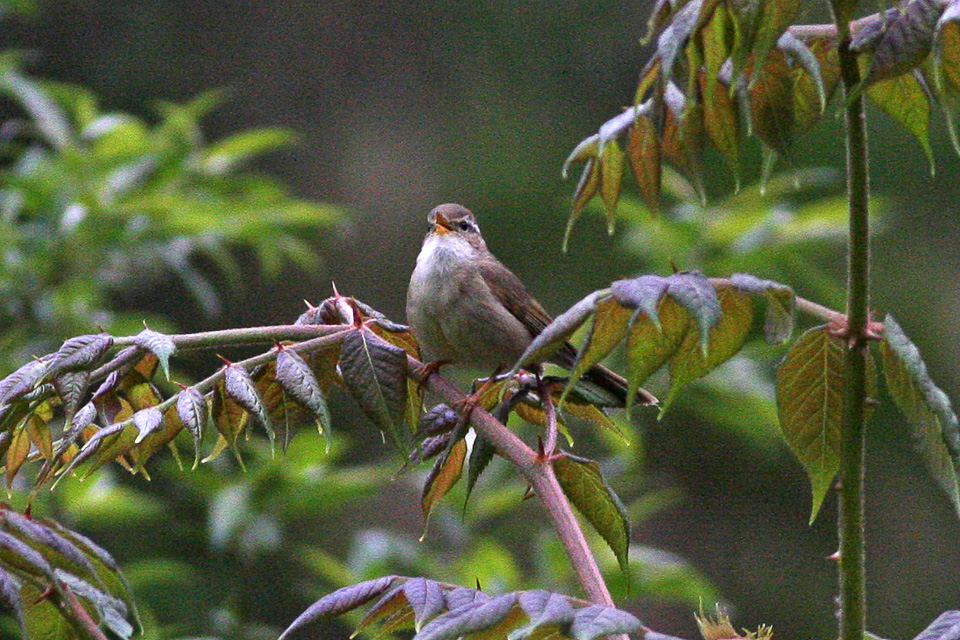
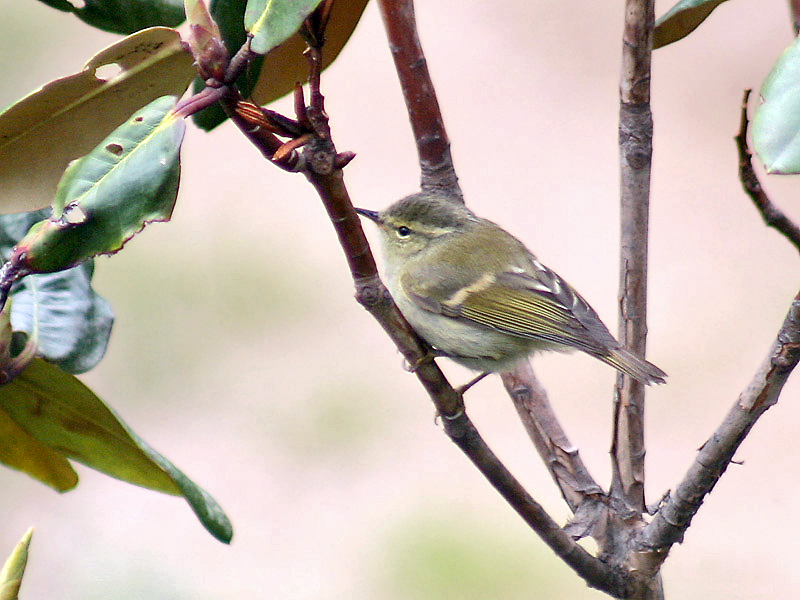
Hume's Warbler measures approximately 9-10 centimeters in length, making it a small warbler with a relatively short tail. Its plumage is predominantly greenish-gray, with subtle shades of olive on the upperparts and paler underparts. One of the key identification features is the presence of two pale wing bars, which are more prominent on the greater coverts. The bird's supercilium, or eyebrow stripe, is pale and distinct, contrasting with its dark eye stripe. Juvenile Hume's Warblers resemble adults but tend to have slightly duller plumage. Sexes appear similar, although males may exhibit marginally brighter colors during the breeding season. In flight, the warbler's small size and rapid, fluttering wingbeats are characteristic. Perched, it often adopts an upright posture, flicking its wings and tail as it scans for prey. Hume's Warbler can be confused with similar species such as the Yellow-browed Warbler (Phylloscopus inornatus), but the latter typically shows a more pronounced yellow tinge to the supercilium and lacks the distinctly two-note call of Hume's Warbler.
Having trouble telling birds apart? Upload a photo to our bird identification tool for an instant species match.
Hume's Warbler Habitat and Range
Preferred Habitat
Hume's Warbler exhibits a preference for a range of forested habitats, including coniferous and mixed forests during the breeding season. These forests are often situated at elevations between 2,500 and 4,000 meters, where the bird can take advantage of the cooler, insect-rich environment. In winter, the warbler descends to lower altitudes across the Indian subcontinent, occupying deciduous forests, scrublands, and urban parks. This seasonal shift allows the warbler to exploit different ecological niches and maintain a stable food supply. While primarily a forest-dwelling species, Hume's Warbler demonstrates remarkable adaptability by thriving in both rural and urban settings during the non-breeding season.
Geographic Range
Hume's Warbler breeds across a wide range that includes the eastern Himalayas, Tibet, and parts of western China. During the breeding season, it inhabits high-altitude forests, taking advantage of the abundant insect life. As winter approaches, the warbler migrates southwards to the Indian subcontinent, where it can be found in countries like India, Nepal, and Bangladesh. The bird's migratory path often follows mountain corridors, allowing it to navigate efficiently between breeding and wintering grounds. In its winter range, Hume's Warbler is relatively widespread, with population density hotspots occurring in regions that offer suitable habitat and food resources.
Want to know which birds visit your area? Browse our backyard birds by location guides for region-specific species lists.
What Does the Hume's Warbler Eat?
Hume's Warbler feeds primarily on insects and other small invertebrates. Its diet includes caterpillars, aphids, and spiders, which it gleans from leaves and branches with quick, nimble movements. During the breeding season, the warbler's diet is heavily reliant on the abundance of insects available in forested habitats. As the seasons change and it migrates to lower altitudes, the warbler adapts its foraging behavior to exploit available resources, occasionally consuming berries and seeds during times of food scarcity. The bird's foraging activity is most intense during the early morning and late afternoon, aligning with peak insect activity.
Hume's Warbler Behavior and Social Structure
Hume's Warbler is a solitary bird during the breeding season, maintaining territories to ensure sufficient resources for raising its young. Males engage in courtship displays that include vigorous singing and wing-fluttering to attract mates. Outside of the breeding season, the warbler exhibits more social behavior, occasionally joining mixed-species flocks to enhance foraging success. When faced with predators, Hume's Warbler can be quite elusive, using its agility to navigate through dense foliage and avoid capture. The bird's daily activity pattern involves active foraging interspersed with periods of rest, often in sheltered spots where it can remain hidden from potential threats.
Hume's Warbler Nesting and Reproduction
Hume's Warbler constructs its nest in the form of a compact cup, typically located on the ground or in low vegetation. The nest is made from grass, moss, and other plant materials, lined with feathers for insulation. Clutch size ranges from 4 to 6 eggs, with both parents participating in incubation, which lasts approximately 12 to 14 days. After hatching, the chicks remain in the nest for another 12 to 14 days, during which both parents share feeding duties. Hume's Warbler typically raises one brood per year, although in favorable conditions, a second brood may occur.
Hume's Warbler Sounds and Vocalizations
The primary song of Hume's Warbler is a distinctive two-note call, often rendered as a high-pitched 'tsee-tsee'. This simple, repetitive sound is a key identifying feature, making it easier to detect the bird in dense foliage. In addition to its primary song, the warbler emits a variety of call notes that include soft 'chip' sounds used for communication within pairs or flocks. During the dawn chorus, Hume's Warbler's calls stand out due to their clarity and persistence, contributing to the acoustic tapestry of its habitat.
Interesting Facts About the Hume's Warbler
- 1Hume's Warbler was first described scientifically in 1870 by Allan Octavian Hume, who is also considered a founder of the Indian National Congress.
- 2Despite being small, Hume's Warbler undertakes long migrations between its breeding grounds in the Himalayas and wintering areas in the Indian subcontinent.
- 3The warbler's two-note call is so distinctive that it can often be identified by sound alone, even in dense forests.
- 4Hume's Warbler is part of a complex of similar species, making it a challenge for birders to distinguish without careful observation.
- 5Breeding at high altitudes, Hume's Warbler is adapted to cold temperatures and thin air, making it a resilient mountain bird.
- 6The bird's Latin name, Phylloscopus humei, reflects its leaf-watching behavior, as it is often seen fluttering among the foliage in search of insects.
- 7During winter, Hume's Warbler can be found in urban parks, adapting well to human-altered landscapes.
Hume's Warbler Conservation Status
Hume's Warbler is currently listed as Least Concern by the IUCN, with populations considered stable across its range. While no significant threats are currently impacting its population, habitat loss due to deforestation poses a potential risk. Conservation efforts focus on preserving forested habitats and ensuring migratory corridors remain intact. Historical records indicate that the warbler's population has remained relatively stable, aided by its adaptability to different habitats and its broad geographic range.