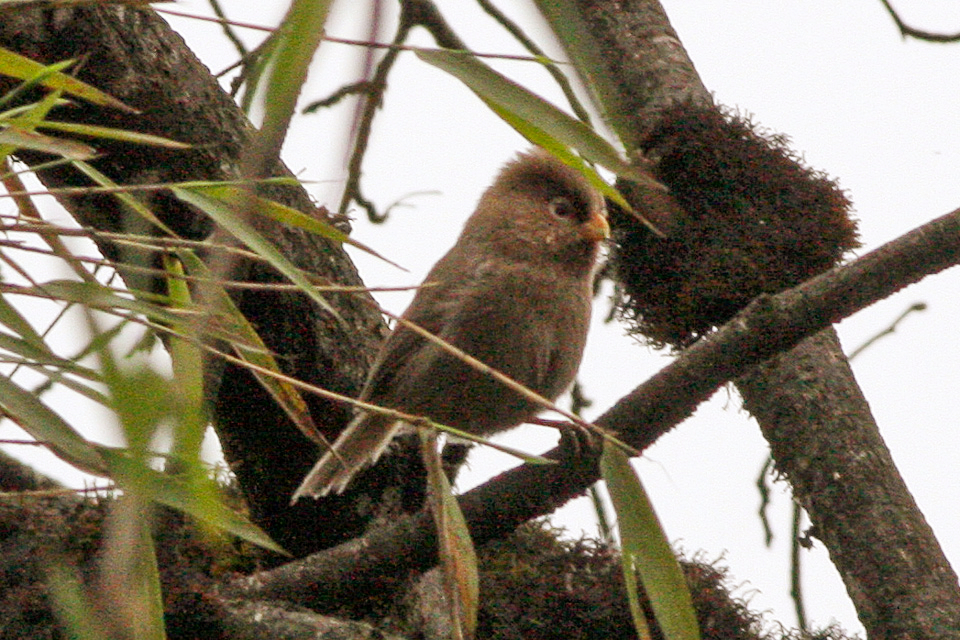
Indochinese Fulvetta
Fulvetta danisi
Order: Passeriformes / Family: Sylviidae

Wikimedia Commons
About the Indochinese Fulvetta
The Indochinese Fulvetta (Fulvetta danisi) is a small, social songbird found primarily in the subtropical and tropical moist lowland forests of Southeast Asia. This species plays a vital ecological role as both a consumer of insects and a disperser of seeds, contributing to the health and regeneration of its forest habitats. It is most commonly observed in Vietnam and Laos, with lesser populations extending into parts of southern China. The bird's social nature facilitates its role in these ecosystems, as flocks can efficiently manage insect populations while also spreading seeds across large areas.
Indochinese Fulvettas thrive in the dense undergrowth of forests, showing a particular affinity for bamboo thickets and secondary growth areas where they find ample food and shelter. Their presence is an indicator of a healthy, biodiverse forest. They demonstrate seasonal behaviors that include slight altitudinal movements in response to food availability, often descending to lower elevations during the dry season when resources become scarce in higher regions. This adaptability underscores their ecological significance, as they help maintain the balance of their environment year-round.
The bird's rapid and often playful movements, combined with its vocalizations, make it an integral part of the forest soundscape. Their calls and songs, while not particularly melodic, serve as communication tools within flocks, enabling coordination during foraging and alerting to potential dangers. This constant communication strengthens social bonds within groups and allows for efficient resource utilization. As a species, the Indochinese Fulvetta highlights the intricate connections within forest ecosystems, illustrating the complex interplay between flora and fauna in these biodiverse regions.
The Indochinese Fulvetta belongs to the family Sylviidae, within the order Passeriformes. These birds typically live average 5-6 years with a max recorded of 8 years.
How to Identify a Indochinese Fulvetta
The Indochinese Fulvetta is a small bird, measuring about 12-13 cm in length. Its most striking feature is the chestnut-colored crown, which stands out against the grayish-brown body. The bird's underparts are a lighter gray, creating a subtle contrast that aids in its identification. The wings and tail feathers are darker, often appearing almost black in certain lighting conditions, which further highlights the chestnut crown.
Juvenile Indochinese Fulvettas resemble adults but have slightly duller plumage, lacking the full intensity of the chestnut crown. There is little sexual dimorphism in this species, with males and females appearing similar in plumage and size, making it challenging to differentiate between them in the field. Observing behavior, such as courtship displays, may be necessary to distinguish between sexes.
In flight, the bird presents a rounded silhouette with a slightly fan-shaped tail. Its perching posture is upright, often seen clinging to vertical stems of bamboo or other slender branches. Confusion with similar species, like other fulvettas or small babblers, can occur, but the distinctive crown and social behavior typical of the Indochinese Fulvetta are reliable identifying features.
Having trouble telling birds apart? Upload a photo to our bird identification tool for an instant species match.
Indochinese Fulvetta Habitat and Range
Preferred Habitat
Indochinese Fulvettas primarily inhabit subtropical and tropical moist lowland forests. They are particularly fond of areas with dense undergrowth, including bamboo thickets and secondary growth forests. These environments provide ample food and protection from predators. The bird is typically found at elevations ranging from 300 to 1,500 meters, although it may venture higher or lower depending on seasonal food availability.
During the wet season, these fulvettas are more commonly found at higher elevations where they take advantage of abundant insect life. In contrast, the dry season sees a downward shift to lower elevations, where resources remain more consistent. While primarily a forest dweller, the Indochinese Fulvetta can occasionally be found along forest edges, adapting to changes in habitat brought about by human activity. However, it is not typically observed in urban environments, as it prefers the seclusion and complexity of forested areas.
Geographic Range
The breeding range of the Indochinese Fulvetta spans the forested regions of Vietnam and Laos, extending into southern China. These countries provide the dense forest habitats that are essential for their survival. The bird is non-migratory, maintaining residence year-round within its established range, although it does exhibit local movements in response to seasonal food availability.
Within its range, population density tends to be higher in areas with extensive bamboo growth and secondary forests, where food sources are plentiful. In Vietnam, hotspots include the northern regions such as Tam Dao National Park, while in Laos, areas like Nam Et-Phou Louey National Protected Area offer similar habitat richness. Despite its preference for dense forests, the bird's adaptable nature allows it to adjust its range within these countries, depending on environmental conditions and habitat changes.
Want to know which birds visit your area? Browse our backyard birds by location guides for region-specific species lists.
What Does the Indochinese Fulvetta Eat?
The diet of the Indochinese Fulvetta primarily consists of insects and other small invertebrates, which it gleans from foliage and the forest floor. It has been observed consuming caterpillars, ants, and beetles, playing a crucial role in controlling insect populations within its habitat. During the dry season, when insect availability might decrease, these birds supplement their diet with seeds and small berries, taking advantage of the forest's plant diversity.
Foraging usually occurs in small flocks, which allows the birds to cover large areas efficiently. They use a combination of gleaning and short, hopping flights between branches to search for food. This technique not only maximizes their foraging success but also minimizes the energy expended in their search for sustenance. The small size of their prey, often no longer than 1 cm, suits their petite bill and agile movements. Feeding occurs throughout the day, with peak activity during the cooler morning and late afternoon hours.
Indochinese Fulvetta Behavior and Social Structure
Indochinese Fulvettas are highly social birds, often found in flocks ranging from a few individuals to over a dozen. This gregarious nature facilitates efficient foraging and provides safety in numbers against predators. Their social structure includes a loose hierarchy, with more dominant individuals occasionally asserting control over prime foraging spots or shelter.
Territorial behavior is minimal, as these birds prioritize the benefits of flocking over individual territory defense. During the breeding season, however, pairs may temporarily separate from flocks to establish nesting sites. Courtship displays are subtle, involving mutual preening and soft calls exchanged between pairs.
In response to predators, such as snakes or birds of prey, the fulvettas exhibit alarm calls that alert the entire flock. These calls result in a coordinated retreat to denser cover, demonstrating their strong social cohesion. Daily activity patterns show peaks during morning and late afternoon, with midday periods spent resting in the shade of the undergrowth.
Indochinese Fulvetta Nesting and Reproduction
The Indochinese Fulvetta constructs cup-shaped nests using materials like grass, leaves, and bamboo fibers, often lined with softer materials such as feathers or animal hair. Nests are typically located in dense undergrowth or low-lying branches, providing concealment from predators.
Clutch size generally ranges from two to four eggs, which are incubated by both parents over a period of approximately 14 to 16 days. Once hatched, both male and female participate in feeding the chicks, which fledge about 12 to 14 days after hatching. The nesting period is characterized by high parental investment, with regular feeding and protection from environmental threats.
Indochinese Fulvettas may raise two broods per year, depending on food availability and environmental conditions. This reproductive strategy allows them to maintain stable population numbers despite potential threats from habitat loss.
Indochinese Fulvetta Sounds and Vocalizations
The primary song of the Indochinese Fulvetta features a series of high-pitched, rapid notes that can be described as a 'tsee-tsee-tsee' pattern. This song serves as a communication tool within flocks, helping maintain cohesion and coordinate movements during foraging.
Call notes are short and sharp, often used to alert others of potential dangers or to signal the presence of food. Alarm calls are more urgent, with a faster and more repetitive rhythm that prompts immediate attention from the flock.
During the dawn chorus, the fulvettas contribute a lively backdrop to the forest soundscape, their calls mingling with those of other resident species. While not as melodious as some songbirds, their vocalizations remain an essential component of their social interactions and environmental awareness.
Interesting Facts About the Indochinese Fulvetta
- 1Indochinese Fulvettas can form flocks of up to 20 individuals, showcasing their highly social nature and cooperative foraging behavior.
- 2Despite their small size, these birds play a crucial role in seed dispersal, aiding forest regeneration by spreading plant seeds as they forage.
- 3The species' preference for bamboo thickets highlights the ecological importance of these habitats, which support a wide range of flora and fauna.
- 4Indochinese Fulvettas have been observed using their sharp calls to communicate with mixed-species flocks, enhancing survival through shared vigilance.
- 5The bird's adaptability to secondary growth forests underscores the importance of habitat restoration efforts in maintaining biodiversity.
- 6While not migratory, Indochinese Fulvettas exhibit localized movements that reflect seasonal changes in their environment, demonstrating their ecological flexibility.
- 7The species' name honors the region's biodiversity, emphasizing the unique avian life found in the Indochinese Peninsula.
Indochinese Fulvetta Conservation Status
Currently, the Indochinese Fulvetta is listed as Least Concern on the IUCN Red List, with population trends considered stable. However, ongoing deforestation and habitat degradation in Southeast Asia pose significant threats to its habitat. Conservation efforts focus on habitat preservation, ensuring that protected areas like national parks maintain the necessary conditions for their survival. Programs aimed at sustainable forest management and the restoration of degraded areas are crucial for the long-term viability of their populations. Historical population changes have been minimal, thanks to the bird's adaptability and presence in protected regions. However, continued vigilance is necessary to safeguard against future threats posed by expanding agricultural activities and infrastructure development.