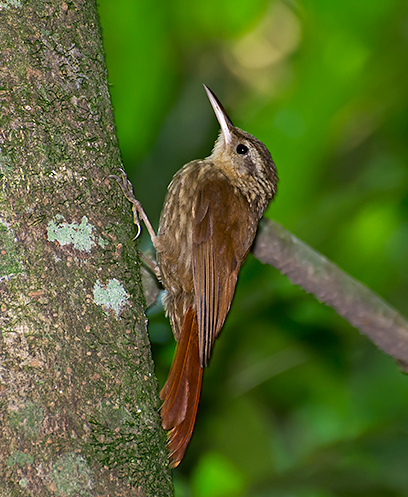
Ivory-billed Woodcreeper
Xiphorhynchus flavigaster
Order: Passeriformes / Family: Furnariidae

Wikimedia Commons
About the Ivory-billed Woodcreeper
The Ivory-billed Woodcreeper (Xiphorhynchus flavigaster) is a striking member of the family Furnariidae, commonly found in the tropical and subtropical forests of Central America. This bird is particularly noted for its slender, slightly curved bill which is pale ivory-an identifiable feature that contrasts with its rich brown plumage. Occupying a niche as an accomplished insectivore, the Ivory-billed Woodcreeper plays a significant role in controlling insect populations within its native habitats. This species inhabits lowland and montane forests, often preferring areas with dense canopy cover. It can be found from southern Mexico through Belize, Guatemala, and as far south as Honduras and Nicaragua. During the breeding season, the Ivory-billed Woodcreeper becomes more conspicuous as males engage in vocal displays to establish territories and attract mates. Outside of the breeding season, these birds maintain a lower profile, foraging discreetly among the trees. Their ecological role extends beyond insect control; they are also important for seed dispersal, contributing to forest regeneration. Despite their elusive nature, the Ivory-billed Woodcreeper’s presence is an indicator of a healthy forest ecosystem. In areas such as the Yucatán Peninsula, these birds are relatively stable, though habitat loss poses a threat to their populations. Conservation efforts focus on preserving the mature forests that are crucial for their survival.
The Ivory-billed Woodcreeper belongs to the family Furnariidae, within the order Passeriformes. These birds typically live typically around 5-8 years, with a maximum recorded of 12 years..
How to Identify a Ivory-billed Woodcreeper
The Ivory-billed Woodcreeper is medium-sized, measuring approximately 23 to 27 cm in length. Its plumage is predominantly a warm brown, with subtle streaks of lighter brown and buff on the underparts. The defining characteristic of this bird is its long, slender, and slightly down-curved bill, which is a striking ivory color, setting it apart from other woodcreepers in its range. Males and females are similar in appearance, making gender differentiation in the field challenging. Juvenile birds exhibit duller plumage with more pronounced streaking on the chest and belly, but they quickly acquire adult-like coloration as they mature. In flight, the Ivory-billed Woodcreeper displays a distinctive silhouette, with a long tail and wings that are broad at the base but taper towards the tips. When perched, it often clings vertically to tree trunks, using its stiff tail as a prop, in a manner typical of many woodcreepers. Potential confusion may arise with species such as the Strong-billed Woodcreeper, but the latter lacks the striking pale bill.
Having trouble telling birds apart? Upload a photo to our bird identification tool for an instant species match.
Ivory-billed Woodcreeper Habitat and Range
Preferred Habitat
The Ivory-billed Woodcreeper thrives in a variety of forested environments, most commonly in lowland tropical forests and montane forests up to 1500 meters in elevation. It shows a preference for primary forests with dense canopy cover, although it can also be found in secondary growth and forest edges. This bird is less commonly observed in urban areas, avoiding heavily disturbed landscapes. During the dry season, the Ivory-billed Woodcreeper may shift to areas with higher moisture availability, such as riparian zones or cloud forests. Despite these shifts, its primary habitat remains the lush, humid forests where it can find ample food and suitable nesting sites.
Geographic Range
The Ivory-billed Woodcreeper's range extends across several Central American countries. It breeds primarily in southern Mexico, including the states of Veracruz and Oaxaca, and extends through Belize, Guatemala, and into northern Honduras and Nicaragua. The species does not engage in long-distance migration but may exhibit local movements in response to food availability and climatic conditions. Population density is highest in regions such as the Yucatán Peninsula, where suitable forest habitats remain relatively intact. Despite its limited range, the Ivory-billed Woodcreeper is considered widespread within its preferred habitats, maintaining stable populations where sufficient habitat exists.
Want to know which birds visit your area? Browse our backyard birds by location guides for region-specific species lists.
What Does the Ivory-billed Woodcreeper Eat?
The diet of the Ivory-billed Woodcreeper consists primarily of insects and other arthropods. It forages by climbing tree trunks and branches, using its bill to probe into crevices in the bark where insects are hidden. This bird is adept at extracting beetles, ants, and caterpillars, which form the bulk of its diet. During the rainy season, when insect populations are abundant, the Ivory-billed Woodcreeper may consume a greater diversity of prey, including spiders and small vertebrates. It typically forages alone or in pairs, but may occasionally join mixed-species feeding flocks. Its feeding schedule is largely diurnal, with peak activity occurring during the cooler morning and late afternoon hours.
Ivory-billed Woodcreeper Behavior and Social Structure
The Ivory-billed Woodcreeper is generally solitary or found in pairs, but it may join mixed-species flocks especially outside the breeding season. It exhibits territorial behavior, with males and females actively defending their chosen parts of the forest. During the breeding season, males perform vocal displays, using a series of sharp, whistling notes to establish territory boundaries and attract mates. Courtship involves mutual preening and synchronized movements along tree trunks. In response to predators, the Ivory-billed Woodcreeper employs cryptic behavior, relying on its camouflaged plumage to blend into the bark of trees. Activity patterns are largely diurnal, with peak movements observed at dawn and dusk. This species shows a remarkable ability to navigate complex forest environments, using its strong legs and tail to maintain balance while foraging.
Ivory-billed Woodcreeper Nesting and Reproduction
Ivory-billed Woodcreepers nest in tree cavities, often selecting natural holes or abandoned nests of other species. They line the cavity with bark strips, leaves, and other plant material to create a suitable environment for their eggs. The typical clutch consists of two to three eggs. The incubation period lasts approximately 18 to 20 days, with both parents sharing incubation duties. Upon hatching, the chicks remain in the nest for about 23 to 25 days before fledging. Both parents participate in feeding the young, delivering food directly to the nest. While the Ivory-billed Woodcreeper typically raises one brood per year, favorable conditions may occasionally lead to a second brood.
Ivory-billed Woodcreeper Sounds and Vocalizations
The primary song of the Ivory-billed Woodcreeper is a series of sharp, whistling notes that ascend in pitch and intensity. These notes are typically repeated in quick succession, forming a characteristic pattern that serves to establish territory and attract mates. In addition to its song, the bird produces a variety of call notes, including a sharp 'chip' or 'chuck', used as contact calls between mates or to signal alarm. During the dawn chorus, the Ivory-billed Woodcreeper's song can be heard echoing through the forest, often accompanied by the calls of other woodcreepers. Its vocalizations are distinct from those of similar species, allowing experienced birders to identify it by sound alone.
Interesting Facts About the Ivory-billed Woodcreeper
- 1The Ivory-billed Woodcreeper can climb tree trunks almost vertically, using its stiff tail feathers for support.
- 2Despite its name, the Ivory-billed Woodcreeper's bill is not actually made of ivory but is a pale color reminiscent of it.
- 3These birds are known to follow army ant swarms, capturing insects that flee the ants.
- 4The Ivory-billed Woodcreeper's song is often mistaken for that of a nearby species, the Ruddy Woodcreeper.
- 5This species is part of a large family of birds known as the Furnariidae, which includes over 300 species.
- 6Studies show that the Ivory-billed Woodcreeper plays a significant role in maintaining insect population balance in its ecosystem.
- 7The Ivory-billed Woodcreeper's ability to adapt to secondary forests has helped it remain widespread despite habitat loss.
Ivory-billed Woodcreeper Conservation Status
According to the IUCN Red List, the Ivory-billed Woodcreeper is currently listed as Least Concern. While its population is considered stable in many areas, habitat loss due to deforestation poses a significant threat to its long-term survival. Conservation efforts focus on protecting mature forests and promoting sustainable land-use practices. Historical population declines have been noted in areas where logging and agricultural expansion have led to habitat fragmentation. Continued monitoring and habitat restoration are crucial to ensuring the persistence of this species. Local conservation programs in Central America aim to raise awareness and involve communities in protecting forested habitats.
Other Furnariidae Species


Birds Similar to the Ivory-billed Woodcreeper
These species are often confused with the Ivory-billed Woodcreeper due to similar appearance or overlapping range.