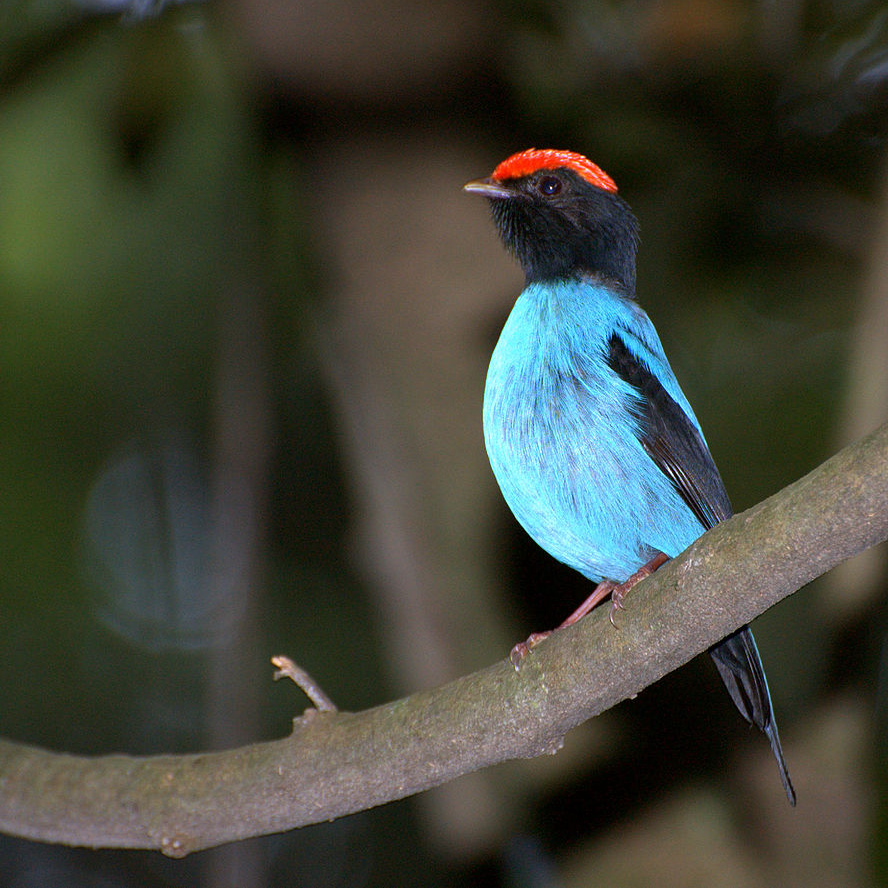
Jet Manakin
Xenopipo unicolor
Order: Passeriformes / Family: Pipridae

Wikimedia Commons
About the Jet Manakin
The Jet Manakin (Xenopipo unicolor) resides primarily in the dense tropical forests of South America, particularly in regions like the Amazon Basin. It holds a significant ecological role as a seed disperser and insect population regulator. This small, unobtrusive bird exhibits a preference for lowland rainforest environments, where it forages actively in the understory. The Jet Manakin’s presence in these ecosystems contributes to the health and diversity of its habitat, as it aids in the propagation of various plant species through its fruit consumption. In the wet season, this bird's activity increases, aligning with the abundance of food resources.
The significance of the Jet Manakin extends to its role as an indicator species for forest health. Its presence often signifies a well-preserved habitat, as it requires a certain level of ecological integrity to thrive. The bird’s preference for continuous forest cover highlights the importance of conserving large tracts of rainforest. This species, like many of its family members in the Pipridae, is an understated yet essential component of its ecosystem, contributing to both the biological diversity and structural complexity of its environment.
Ecologically, the Jet Manakin is part of a broader network of frugivorous and insectivorous birds that maintain the balance within tropical forests. Its seasonal behaviors include heightened vocal activity and increased territorial displays during the breeding season. These behaviors not only facilitate breeding success but also ensure the maintenance of territories that provide necessary resources throughout the year. As deforestation pressures mount, the ecological role of this bird becomes increasingly critical, underscoring the need for effective conservation measures.
The Jet Manakin belongs to the family Pipridae, within the order Passeriformes. These birds typically live average lifespan is around 5-7 years, with some reaching up to 9 years..
How to Identify a Jet Manakin
The Jet Manakin is best identified by its uniformly dark plumage, which appears almost black in the right light, giving it a sleek appearance that is unmatched by many of its kin. Adult males and females are similar in plumage, though males are slightly more iridescent. Juveniles tend to have a duller appearance with more brownish tones, which gradually darken as they mature.
A key field mark for identifying the Jet Manakin is its compact size, typically around 11 cm in length, with a relatively short tail and rounded wings. This bird also sports a proportionally large head, which gives it a distinct silhouette when perched among the dense foliage. Its beady dark eyes and short, stout bill are additional identifying features that assist in differentiating it from similar species.
In flight, the Jet Manakin exhibits a rapid and direct flight pattern, which is typical for the Pipridae family. This bird can easily be confused with other manakins, such as the Blue-backed Manakin, but its uniformly dark coloration and lack of vibrant markings make it distinguishable. Additionally, its perching posture, often on horizontal branches within the understory, is characteristic and aids in its identification.
Having trouble telling birds apart? Upload a photo to our bird identification tool for an instant species match.
Jet Manakin Habitat and Range
Preferred Habitat
The preferred habitat of the Jet Manakin is the lowland tropical rainforest, where it thrives in the understory and mid-story layers. This bird favors areas with dense vegetation, which provide ample cover and foraging opportunities. It is commonly found in the Amazon Basin, which includes parts of Brazil, Peru, and Colombia.
The Jet Manakin's elevation range is typically from sea level up to 1,500 meters, although it most frequently occupies areas below 1,000 meters. It shows little seasonal habitat shift, remaining largely within its forested environment throughout the year. Unlike some other manakins, the Jet Manakin is not often found in urban areas, as it prefers the natural complexity and cover of dense forests.
While it is primarily a resident of pristine forest habitats, the Jet Manakin can occasionally be found in secondary growth areas, provided the vegetation is sufficiently dense. However, such occurrences are rare, as this bird generally avoids open or fragmented habitats that do not provide adequate shelter or food resources.
Geographic Range
The Jet Manakin’s range is confined to the northern part of South America, with significant populations residing in the Amazon Basin. This includes the vast rainforest regions of Brazil, Peru, Colombia, and parts of Venezuela. The bird is a non-migratory resident, maintaining a year-round presence within these territories.
While its range is extensive within the Amazon Basin, the Jet Manakin's population density is highest in regions where forest cover remains largely intact. The dense canopies and rich biodiversity of these areas provide the optimal environment for foraging and breeding.
The bird does not exhibit extensive seasonal movements, instead opting to remain within established territories. This sedentary nature underscores the importance of intact rainforest ecosystems for its survival. Its presence is less common in the fragmented forests on the edges of its range, where habitat loss has impacted its distribution.
Want to know which birds visit your area? Browse our backyard birds by location guides for region-specific species lists.
What Does the Jet Manakin Eat?
The Jet Manakin primarily feeds on a diet of small fruits and insects, with its food preferences varying seasonally. During the wet season, when fruit is abundant, it predominantly consumes berries and small drupes. These fruits are typically less than 1 cm in diameter, allowing the bird to swallow them whole.
In the dry season, the Jet Manakin's diet shifts towards a greater reliance on insects, including beetles, ants, and small caterpillars. It employs a foraging technique known as 'gleaning,' where it picks insects from leaves and branches.
The bird's feeding schedule is largely diurnal, with peak activity occurring in the early morning and late afternoon. This pattern aligns with the availability of its primary food resources and the activity levels of its prey. The Jet Manakin’s role in seed dispersal is crucial, as it aids in the propagation of the plants on which it feeds.
Jet Manakin Behavior and Social Structure
Jet Manakins are typically solitary, with pronounced territorial behavior, especially during the breeding season. Males defend small territories where they perform elaborate courtship displays to attract females. These displays often involve rapid wing flicks and short flights to showcase their plumage.
Outside the breeding season, the Jet Manakin is less territorial and may be seen foraging in loose associations with other frugivorous birds. Despite its generally solitary nature, it exhibits a tolerance for other species, provided food resources are plentiful.
In response to predators, the Jet Manakin is adept at using its environment for cover. It often remains still within dense foliage when threatened, making use of its dark plumage as camouflage. Daily activity patterns center around foraging periods in the early morning and twilight hours, with rest periods during the hottest part of the day.
Jet Manakin Nesting and Reproduction
The Jet Manakin constructs an open cup-shaped nest, typically located in the fork of a small tree or shrub within the understory of dense forests. The nest is crafted from fine plant fibers, leaves, and occasionally spider silk, which provide both strength and camouflage.
Females lay a clutch of two eggs, with an incubation period lasting approximately 18 to 21 days. During this time, the female assumes the primary role of incubating the eggs, while the male may assist by providing food.
After hatching, the fledglings remain in the nest for about 15 to 18 days, during which both parents contribute to feeding and protecting the young. The Jet Manakin typically raises one brood per year, but in areas with abundant resources, a second brood is possible.
Jet Manakin Sounds and Vocalizations
The Jet Manakin's primary song consists of a series of soft, melodious whistles, often described as having a flute-like quality. The rhythm is slow and deliberate, with each note clearly enunciated.
Call notes include sharp clicks and short twitters, which serve as contact calls among individuals. Alarm calls are more abrupt and higher-pitched, designed to alert nearby birds to potential danger.
During the dawn chorus, the Jet Manakin's song contributes to the rich tapestry of sounds that define the forest at daybreak, though it is less dominant compared to other, more vocal species.
Interesting Facts About the Jet Manakin
- 1The Jet Manakin can consume more than half its body weight in fruit daily during peak foraging periods.
- 2Despite its small size, the Jet Manakin plays a crucial role in seed dispersal, aiding in forest regeneration.
- 3This bird's courtship display includes a unique wing-flicking maneuver that is both visual and auditory.
- 4The Jet Manakin is often one of the first bird species to disappear when forest fragmentation occurs.
- 5Its ability to remain motionless for extended periods helps it evade predators in dense foliage.
Jet Manakin Conservation Status
The Jet Manakin currently holds a status of Least Concern on the IUCN Red List. However, its population trend is decreasing due to ongoing habitat loss from deforestation. Primary threats include logging, agricultural expansion, and infrastructure development. Conservation efforts focus on preserving large tracts of rainforest and implementing sustainable land-use practices. Historically, the Jet Manakin has maintained stable populations in well-preserved areas, but fragmentation poses a growing threat. Continued conservation initiatives are crucial to safeguard its future.