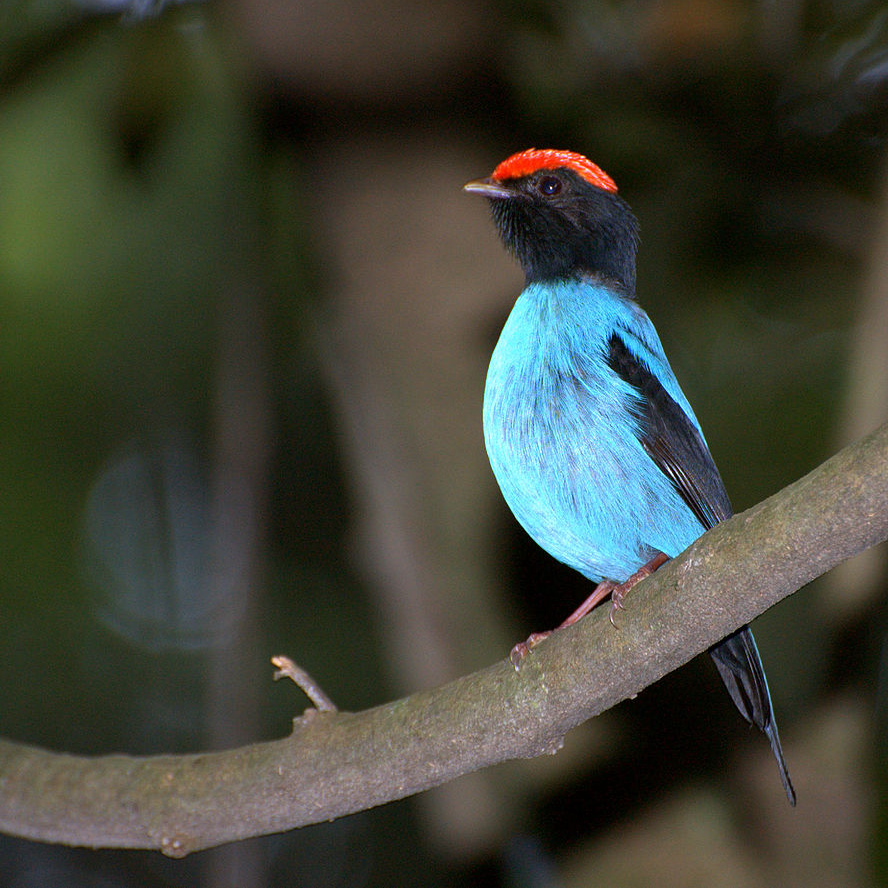
Long-tailed Manakin
Chiroxiphia linearis
Order: Passeriformes / Family: Pipridae

Wikimedia Commons
About the Long-tailed Manakin
The Long-tailed Manakin (Chiroxiphia linearis) stands as one of the most visually distinct members of the Pipridae family, thanks to its vibrant coloration and elaborate mating rituals. These small passerines, native to the tropical forests of Central America, particularly in countries like Mexico, Costa Rica, and Panama, are a sight to behold. Their striking plumage features bold contrasts of deep blues and fiery reds, making them easily recognizable among the dense forest canopy. The ecological role of the Long-tailed Manakin is significant within its habitat. As frugivores, they contribute to seed dispersal, which is vital for maintaining the health and regeneration of tropical forests. This role supports a wide array of plant species, fostering biodiversity within these ecosystems. During the breeding season, which typically spans from March to June, their courtship displays become a central focus. These displays are not only a marvel of nature but also crucial for the continuation of the species, ensuring that only the most fit individuals reproduce. Outside of the breeding season, the Long-tailed Manakin continues to play an integral role in its ecosystem, maintaining its territory and participating in mutualistic relationships with other species. Its presence indicates a healthy forest environment, making it a valuable indicator species for conservationists. The bird's ecological significance, coupled with its captivating behaviors, makes the Long-tailed Manakin a key species for understanding the dynamics of tropical forest ecosystems.
The Long-tailed Manakin belongs to the family Pipridae, within the order Passeriformes. These birds typically live average 8 years with a maximum recorded of 12 years..
How to Identify a Long-tailed Manakin
Identifying the Long-tailed Manakin involves looking for a striking combination of colors and physical characteristics. Adult males exhibit a bright blue body, contrasted with a vivid red crown and an elongated black tail, which is where the bird gets its name. The tail feathers can measure up to twice the length of the body, providing a distinctive silhouette. Females, on the other hand, have a more subdued olive-green plumage, lacking the vibrant blue and red seen in males, and their tails are significantly shorter. Juveniles resemble females but can be differentiated by their gradual acquisition of the male's signature colors as they mature. When in flight, the Long-tailed Manakin displays a unique profile, with its long tail streamers trailing behind. Perched, it often sits upright, showcasing its vibrant blue against the green forest backdrop. Confusion with other manakin species can occur, but the combination of blue and red in males is a reliable differentiator. Observers should also note the bird's behavior, as its unique courtship displays are a giveaway.
Having trouble telling birds apart? Upload a photo to our bird identification tool for an instant species match.
Long-tailed Manakin Habitat and Range
Preferred Habitat
The Long-tailed Manakin inhabits the lowland and foothill forests of Central America. It thrives in areas with dense understory vegetation, which provides both food and protection. These birds prefer elevations up to 1500 meters, often favoring secondary growth forests and forest edges where sunlight penetrates, promoting fruit-bearing plants. Seasonal shifts in habitat are minimal, as they are non-migratory and remain within their established territories year-round. While they primarily reside in rural forested areas, their presence is less common in urban settings. The preservation of their natural habitats is crucial for their survival, as deforestation poses a significant threat.
Geographic Range
The Long-tailed Manakin's range stretches from southern Mexico through Central America, covering countries such as Guatemala, Belize, Honduras, Nicaragua, Costa Rica, and Panama. These birds are year-round residents of these regions, with no significant migratory movements. Their population density tends to be higher in areas with abundant fruiting plants and suitable nesting sites. In Mexico, they are primarily found in the states of Chiapas and Oaxaca. The species' range highlights the importance of maintaining forested areas in Central America to support their populations. Conservation efforts in these regions are crucial in ensuring the continued presence of the Long-tailed Manakin.
Want to know which birds visit your area? Browse our backyard birds by location guides for region-specific species lists.
What Does the Long-tailed Manakin Eat?
The diet of the Long-tailed Manakin primarily consists of a variety of fruits, supplemented occasionally by small insects. Their frugivorous nature means they play a crucial role in seed dispersal, aiding in the propagation of numerous plant species. They display a preference for fruits from trees and shrubs found within their forest habitats, such as figs and berries. During the breeding season, their fruit consumption increases as they require additional energy. Foraging typically occurs in the early morning and late afternoon when these birds are most active. They employ a gleaning technique, picking fruits directly from branches while hovering momentarily.
Long-tailed Manakin Behavior and Social Structure
The Long-tailed Manakin exhibits fascinating social and behavioral patterns, particularly during the breeding season. Males engage in complex courtship displays, performed in leks, where several males display in unison to attract females. These displays involve coordinated dances, jumps, and vocalizations, often lasting several minutes. Outside of breeding, they maintain small territories, where they forage and rest. Socially, they are relatively solitary, but may form loose associations with other manakins during feeding. Their response to predators includes a swift retreat into dense foliage, using their agility to evade capture. Daily activity peaks during cooler parts of the day, aligning with feeding schedules.
Long-tailed Manakin Nesting and Reproduction
Long-tailed Manakins build open cup nests, typically situated in the fork of a tree branch, well concealed by foliage. The nests are constructed from fine plant fibers, leaves, and sometimes cobwebs, providing a secure environment for the eggs. The typical clutch consists of two eggs, which are pale with brown speckles. Incubation lasts approximately 18 to 21 days, primarily by the female, as the male does not participate in nesting duties. After hatching, the chicks fledge about 20 days later. Long-tailed Manakins usually produce one brood per year, although conditions may allow for a second.
Long-tailed Manakin Sounds and Vocalizations
The primary song of the Long-tailed Manakin is a series of melodious whistles, characterized by a rhythmic, descending pitch with a flute-like quality. Males use this song prominently during courtship displays. Call notes are sharp and quick, used for communication between individuals. Alarm calls are more abrupt and harsher, serving as warnings to potential threats. During the dawn chorus, males often sing in synchrony, creating a captivating soundscape. The vocalizations are unique enough to serve as an auditory cue for identification, even when the bird itself is hidden from view.
Interesting Facts About the Long-tailed Manakin
- 1Long-tailed Manakins perform one of the most elaborate courtship dances in the bird world, involving coordinated movements by multiple males.
- 2The male's tail feathers can extend up to twice the length of its body, making it a standout feature among manakins.
- 3Long-tailed Manakins are key seed dispersers, helping to maintain diversity in the forests they inhabit.
- 4Despite their flamboyant courtship displays, only the dominant male in a lek typically mates with visiting females.
- 5The lekking system of Long-tailed Manakins involves cooperative dancing, a rare behavior among birds.
- 6The species is a year-round resident of its range, exhibiting no migratory behavior unlike many other passerines.
- 7Young males can take up to four years to acquire full adult plumage, a relatively long maturation period for small birds.
Long-tailed Manakin Conservation Status
The Long-tailed Manakin currently holds a status of Least Concern on the IUCN Red List, with a stable population trend. However, habitat loss due to deforestation and agricultural expansion poses significant threats. Conservation efforts focus on habitat preservation and reforestation projects within its range. Historical populations have remained relatively stable, but continued habitat degradation could alter this trend. Efforts by local governments and international organizations aim to protect critical habitats and raise awareness about the ecological importance of this species.