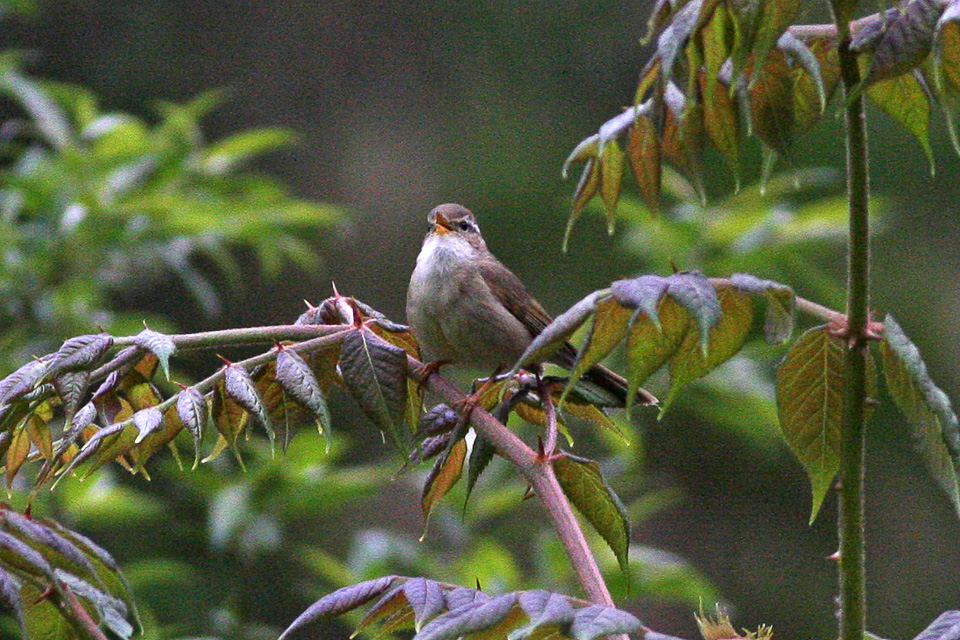
Mountain Leaf Warbler
Phylloscopus trivirgatus
Order: Passeriformes / Family: Phylloscopidae

Wikimedia Commons
About the Mountain Leaf Warbler
The Mountain Leaf Warbler (Phylloscopus trivirgatus) is a small passerine bird found predominantly in Southeast Asia's high-altitude regions. This vibrant warbler is a member of the family Phylloscopidae and is highly adapted to life in mountainous forests. It plays a significant role in the ecosystems it inhabits, acting as both a predator of insects and a prey species for larger birds. The Mountain Leaf Warbler's presence is an indicator of healthy forest ecosystems, as it requires undisturbed habitats for nesting and foraging. This species is typically found in montane forests ranging from the lower hill forests to the tree line, often above 1000 meters. It thrives in the lush canopies of these forests, where the vegetation is dense and insect life abundant. The bird's role in controlling insect populations helps maintain the ecological balance, preventing infestations that could otherwise damage the forest flora. Throughout the year, the Mountain Leaf Warbler exhibits various behaviors aligned with seasonal changes. During the breeding season, it becomes more territorial, with males singing frequently to establish and defend their territories. In contrast, during the non-breeding season, these warblers may join mixed-species foraging flocks, moving through the forest in search of food. Their adaptability to high-altitude environments and their requirement for specific habitat conditions make them an essential component of mountain ecosystems, particularly in regions such as Sumatra, Java, and the Philippines.
The Mountain Leaf Warbler belongs to the family Phylloscopidae, within the order Passeriformes. These birds typically live typically 5-7 years, with a maximum recorded of 9 years..
How to Identify a Mountain Leaf Warbler
The Mountain Leaf Warbler is easily identified by its bright yellow-green plumage, which provides excellent camouflage among the leaves of its forest habitat. Adult birds have a distinct dark eye stripe that contrasts with their lighter supercilium, which is yellowish in color. Juveniles tend to have duller plumage, lacking the vivid green of adults, and may have more buff-colored underparts. Males and females are similar in appearance, though males might exhibit slightly brighter plumage during the breeding season. In flight, the Mountain Leaf Warbler appears agile and quick, with rounded wings and a slightly notched tail. Its perching posture is typically upright, with the bird often seen flitting between branches as it searches for insects. When comparing similar species, such as other Phylloscopus warblers, the Mountain Leaf Warbler's yellow-green color and distinctive facial markings aid in its identification. Despite being similar in size to other warblers, its coloration and habitat preference often prevent confusion.
Having trouble telling birds apart? Upload a photo to our bird identification tool for an instant species match.
Mountain Leaf Warbler Habitat and Range
Preferred Habitat
The Mountain Leaf Warbler inhabits montane forests, thriving in areas with dense understory and abundant insect life. It is most at home in altitudes ranging from 1000 to 3000 meters. These warblers favor evergreen forests and are particularly common in regions like the mountainous areas of Sumatra, Java, and the Philippines. In some regions, they may descend to lower elevations during the non-breeding season, though they seldom appear in urban or heavily disturbed areas. Their preference for undisturbed, high-altitude forests makes them less common in populated areas, where habitat degradation limits their presence.
Geographic Range
The Mountain Leaf Warbler primarily resides in Southeast Asia, with its range extending across the mountain regions of Sumatra, Java, Borneo, and the Philippines. This bird is a year-round resident in these areas, showing limited migratory behavior due to its specialized habitat requirements. In Sumatra and Java, the warbler is most frequently observed in high-altitude forests, where population densities are highest. Its presence is indicative of the health of these montane ecosystems. Though their range is relatively confined, within it, the Mountain Leaf Warbler is widespread, taking advantage of suitable habitats across its distribution.
Want to know which birds visit your area? Browse our backyard birds by location guides for region-specific species lists.
What Does the Mountain Leaf Warbler Eat?
The Mountain Leaf Warbler's diet consists mainly of insects and other small invertebrates. It actively forages among the leaves and branches, using its sharp eyesight to detect prey. The bird employs a variety of foraging techniques, including gleaning insects from leaf surfaces and hawking flying insects mid-air. During the breeding season, its insect consumption increases to meet the higher energy demands of raising young. In the non-breeding season, it may also consume small quantities of fruit or seeds, though insects remain its primary food source. This diet is crucial for its survival in high-altitude forests, where food availability fluctuates with seasons.
Mountain Leaf Warbler Behavior and Social Structure
Mountain Leaf Warblers are generally solitary or found in pairs, especially during the breeding season when they become highly territorial. Males sing frequently, using their song to establish territory and attract mates. The species is known for its agility, moving quickly and efficiently through dense foliage as it searches for food. During the non-breeding season, Mountain Leaf Warblers may join mixed-species foraging flocks, which can help in locating food and offer some protection against predators. Their daily activity peaks during the early morning and late afternoon, coinciding with periods of increased insect activity. The warblers exhibit a strong response to predators, often using alarm calls and seeking dense cover.
Mountain Leaf Warbler Nesting and Reproduction
The Mountain Leaf Warbler builds a cup-shaped nest, usually placed in a concealed location within dense foliage or among the roots of a tree. The nest is constructed from moss, leaves, and other plant materials, lined with softer substances like feathers or hair. Clutch size typically ranges from 2 to 4 eggs, with both parents sharing incubation duties. The incubation period lasts about 12 to 14 days, after which the chicks hatch and are cared for by both parents. Fledging occurs approximately 10 to 12 days after hatching. The Mountain Leaf Warbler may raise one or two broods per year, depending on environmental conditions.
Mountain Leaf Warbler Sounds and Vocalizations
The Mountain Leaf Warbler's song is a series of high-pitched, rapid notes that can be described as a trill or a warble. This song serves to establish territory and attract a mate. Call notes are more subdued, often used in communication between pairs or as a warning signal. Alarm calls are sharp and distinctive, alerting other birds to the presence of predators. During the dawn chorus, the Mountain Leaf Warbler's song can be heard clearly, cutting through the ambient sounds of the forest. Its vocalizations are an integral part of its territorial and social behaviors.
Interesting Facts About the Mountain Leaf Warbler
- 1The Mountain Leaf Warbler can be found at elevations as high as 3000 meters, demonstrating remarkable adaptation to alpine environments.
- 2This species is part of the rapidly diversifying Phylloscopus genus, which includes over 70 species worldwide.
- 3Despite its small size, the Mountain Leaf Warbler's song can carry over long distances, aiding in territorial defense.
- 4Mountain Leaf Warblers exhibit a unique behavior known as 'hover-gleaning,' where they hover briefly to pick insects off leaves.
- 5Studies have shown that Mountain Leaf Warblers can significantly reduce caterpillar populations in their habitats.
- 6In their preferred habitat, Mountain Leaf Warblers often coexist with other insectivorous birds, sharing the rich insect bounty.
- 7The Mountain Leaf Warbler's bright plumage not only serves as camouflage but also plays a role in mate selection, with brighter individuals often being more successful.
Mountain Leaf Warbler Conservation Status
Currently, the Mountain Leaf Warbler is not considered endangered and is classified as Least Concern by the IUCN. However, its population is vulnerable to habitat destruction, particularly deforestation in its montane forest environment. Conservation efforts focus on protecting these critical habitats from logging and agricultural expansion. Historically, their populations have remained stable in protected areas, but ongoing habitat loss poses a significant threat to their future. Conservation measures include establishing protected areas and promoting sustainable land use practices in regions where the warbler is found.