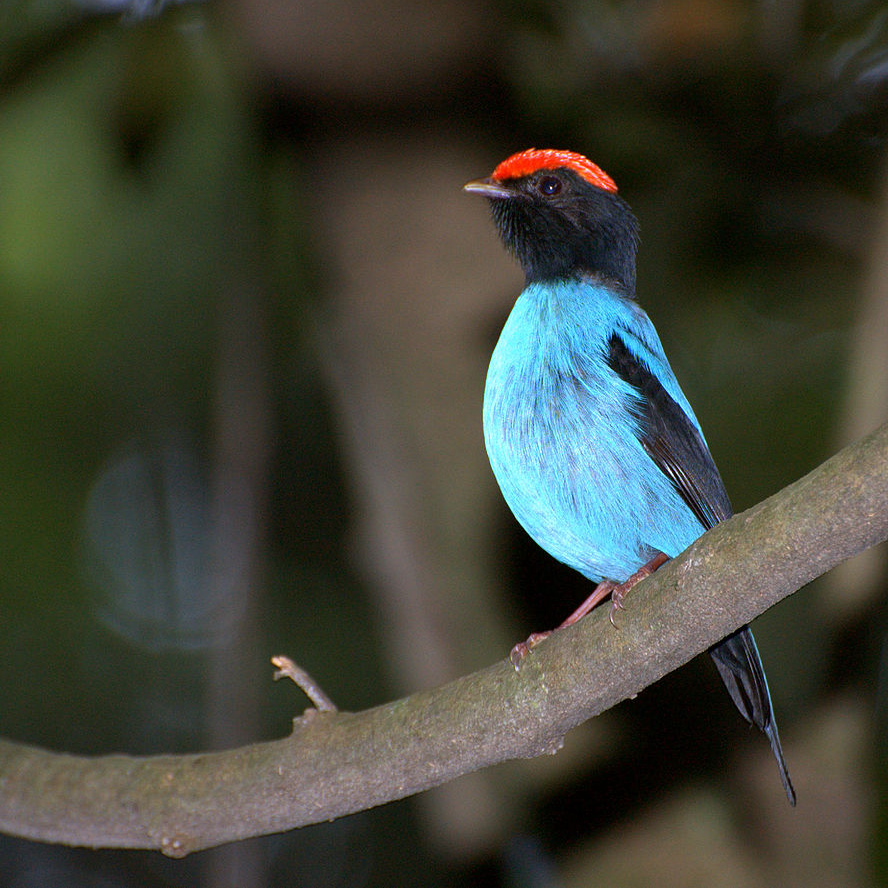
Opal-crowned Manakin
Lepidothrix iris
Order: Passeriformes / Family: Pipridae

Wikimedia Commons
About the Opal-crowned Manakin
The Opal-crowned Manakin (Lepidothrix iris) is a small yet striking member of the Pipridae family, residing primarily in the lush tropical forests of South America. Known for its iridescent crown that shimmers under the canopy light, this bird is a symbol of the vibrant biodiversity within these dense ecosystems. Found predominantly in the Amazon Basin, the Opal-crowned Manakin thrives in regions such as eastern Ecuador, northeastern Peru, and western Brazil. This bird plays a crucial role in the ecological framework by aiding in seed dispersal, thus promoting forest regeneration.
Its significance extends beyond ecology; the Opal-crowned Manakin draws the interest of birdwatchers and researchers alike. The bird's dazzling plumage and unique behaviors make it a focal point in studies of avian sexual selection and evolutionary biology. The bird's active courtship displays, characterized by rapid wing beats and acrobatic maneuvers, are a testament to its evolutionary adaptation to attract potential mates. While these displays occur year-round, they peak during the breeding season, which varies slightly across its range due to regional climatic influences.
Ecologically, the Opal-crowned Manakin contributes significantly to its habitat. As a frugivore, it primarily consumes a variety of forest fruits, inadvertently aiding in seed dispersal. This mutualistic relationship between the bird and its environment underscores the delicate balance within the forest ecosystem. The presence of the Opal-crowned Manakin often indicates a healthy forest, as it relies on abundant fruiting trees and a thriving understory. Seasonal behaviors include slight altitudinal migrations and shifts within the forest to follow fruiting cycles, ensuring a consistent food source.
The Opal-crowned Manakin belongs to the family Pipridae, within the order Passeriformes. These birds typically live average 5-7 years..
How to Identify a Opal-crowned Manakin
The Opal-crowned Manakin is unmistakable due to its striking plumage and distinctive features. Adult males display a brilliant opalescent crown that can shift in color depending on the angle of light, ranging from soft blues to vivid greens. The rest of the plumage is primarily a deep black, providing a stark contrast to the shimmering crown. Females and juveniles, however, differ significantly. They exhibit a more subdued olive-green plumage, which offers better camouflage in the dense foliage and lacks the iridescent crown. This sexual dimorphism plays a critical role during mating displays and in diminishing predation risk for females and young.
Observers may occasionally confuse the Opal-crowned Manakin with other manakin species like the Blue-crowned Manakin, which shares a similar habitat. However, the Blue-crowned Manakin lacks the opalescent quality that defines the Opal-crowned Manakin's crown. In flight, the bird presents a compact silhouette with rapid, fluttering wingbeats, typical of manakins. When perched, it often adopts a slightly upright posture, showcasing its crown to optimal effect during courtship displays and territorial interactions.
Having trouble telling birds apart? Upload a photo to our bird identification tool for an instant species match.
Opal-crowned Manakin Habitat and Range
Preferred Habitat
The Opal-crowned Manakin predominantly inhabits the primary and secondary lowland rainforests of the Amazon Basin. These forests offer a complex structure of dense canopy, understory, and plentiful fruiting trees, providing both food and shelter. The species is typically found at elevations ranging from sea level to about 1000 meters. Within these forests, the Opal-crowned Manakin shows a preference for areas with rich understory growth, which supports its frugivorous diet and offers protection from predators.
While it thrives in pristine habitats, the Opal-crowned Manakin can also adapt to disturbed areas, provided that certain ecological features remain intact. During certain seasons, slight habitat shifts occur as the birds follow the availability of fruit. Unlike some bird species, the Opal-crowned Manakin does not venture into urban areas, remaining closely tied to its tropical forest environment.
Geographic Range
The Opal-crowned Manakin's range is largely confined to the Amazon Basin, encompassing parts of eastern Ecuador, northeastern Peru, and the western section of Brazil. This region provides the tropical climate and rich biodiversity that the species requires. It does not exhibit long-distance migratory behavior, instead undertaking local movements in response to fruiting patterns.
Within its range, the bird is relatively widespread, although populations can be patchy depending on habitat quality and availability. The densest populations often occur in regions with minimal human disturbance and abundant fruit sources. While it does not migrate across continents, subtle altitudinal migrations within the forest occur as the bird tracks fruiting cycles. This behavior ensures that the Opal-crowned Manakin maintains access to its primary food sources throughout the year.
Want to know which birds visit your area? Browse our backyard birds by location guides for region-specific species lists.
What Does the Opal-crowned Manakin Eat?
Primarily frugivorous, the Opal-crowned Manakin's diet consists largely of small, soft fruits. It favors those from understory plants and small trees, such as berries from the Rubiaceae and Melastomataceae families. These fruits provide essential nutrients that sustain the bird's active lifestyle and vibrant plumage. During the dry season, when fruit availability decreases, it may supplement its diet with small insects, capturing them through quick aerial sallies.
The feeding schedule of the Opal-crowned Manakin is typically diurnal, with peaks in activity during the early morning and late afternoon. This timing allows the bird to avoid the midday heat and capitalize on the peak availability of ripe fruits. Foraging often occurs solitarily or in small groups, where they exhibit agile movements, hopping between branches to locate and consume their preferred food items.
Opal-crowned Manakin Behavior and Social Structure
The Opal-crowned Manakin exhibits intriguing social behaviors, particularly during the breeding season. Males are known for their elaborate courtship displays, which involve rapid wing beats and acrobatic flights designed to showcase their iridescent crowns to potential mates. These displays typically occur in specific lekking sites, where males congregate to perform competitive displays. While generally solitary outside of the breeding season, these birds may form small, loose flocks when foraging.
Territoriality is another key aspect of their behavior, especially for males during the breeding season. They actively defend their display area from rival males, using both vocalizations and physical displays to assert dominance. In response to predators, the Opal-crowned Manakin employs evasive flight tactics, utilizing its agility to escape from threats. Its daily activity pattern includes periods of heightened activity during the cooler parts of the day, with frequent rest during the midday heat.
Opal-crowned Manakin Nesting and Reproduction
The Opal-crowned Manakin constructs small, delicate cup nests using fine plant fibers, moss, and spider silk. These nests are typically situated in the fork of a tree branch, concealed within dense foliage to protect from predators. The female alone is responsible for nest building, incubation, and care of the young. Clutch size usually consists of two eggs, which she incubates for about 18-21 days.
Upon hatching, the young are altricial, requiring extensive care and feeding. The female provides all parental care, feeding the chicks a diet primarily composed of regurgitated fruit. Fledging occurs after approximately 18-20 days, but juveniles may remain near the nest site for some time, relying on the female for food and protection. Typically, the Opal-crowned Manakin raises one to two broods per year, depending on environmental conditions and food availability.
Opal-crowned Manakin Sounds and Vocalizations
The vocalizations of the Opal-crowned Manakin are varied and serve multiple functions within their social structure. The primary song is a series of high-pitched, mechanical-sounding notes delivered in rapid succession, often compared to the sound of a 'ticking clock.' These songs are used primarily by males during courtship displays and territorial defense.
Call notes include sharp, single tones used to maintain contact with other individuals, especially during foraging. Alarm calls, distinct in their abrupt change in rhythm and pitch, serve to alert nearby individuals to potential dangers. The dawn chorus of the Opal-crowned Manakin is typically subdued compared to more vocal species, reflecting its preference for quieter, dense forest habitats.
Interesting Facts About the Opal-crowned Manakin
- 1The Opal-crowned Manakin's iridescent crown can appear blue, green, or even violet, depending on the lighting.
- 2Male Opal-crowned Manakins perform complex 'dances' to attract females, showcasing evolutionary adaptations.
- 3Despite their small size, Opal-crowned Manakins play a vital role in seed dispersal within the Amazon Basin.
- 4The Opal-crowned Manakin's diet is primarily frugivorous, but it can include small insects during lean fruit seasons.
- 5These birds often form leks, where males gather to perform competitive courtship displays, a rare behavior among birds.
- 6Opal-crowned Manakins are non-migratory but show seasonal movements within their range to follow fruiting cycles.
- 7The bird's unique vocalizations, resembling mechanical sounds, are pivotal in territory establishment and mate attraction.
Opal-crowned Manakin Conservation Status
The Opal-crowned Manakin is currently classified as Least Concern by the IUCN, with stable population trends. However, ongoing deforestation in the Amazon Basin poses a significant threat to its habitat. Habitat loss from logging and agricultural expansion remains the primary concern for long-term survival. Conservation efforts focus on preserving large tracts of forest and promoting sustainable land-use practices. Historically, the population has fluctuated in response to habitat changes, emphasizing the importance of habitat conservation for this species.