
Orange-breasted Laughingthrush
Garrulax annamensis
Order: Passeriformes / Family: Leiothrichidae

Wikimedia Commons
About the Orange-breasted Laughingthrush
The Orange-breasted Laughingthrush, scientifically known as Garrulax annamensis, is a captivating species belonging to the family Leiothrichidae. This bird is primarily found in the dense forests of Vietnam, particularly in the Annamite Range, a biodiversity hotspot that offers the lush, subtropical environment they prefer. The Orange-breasted Laughingthrush is an essential component of its ecosystem, as it plays a role in seed dispersal and insect population control. Its striking plumage, characterized by a bright orange chest and a mix of brown, white, and gray feathers, makes it a favorite among birdwatchers and ornithologists alike.
This species is adapted to a life in the undergrowth of forests, where it forages for food and finds shelter from predators. The Orange-breasted Laughingthrush is a resident bird, meaning it does not migrate, and can be observed year-round in its natural habitat. Its preference for the dense understory of forests makes it somewhat elusive, as it often remains hidden among the leaves and branches. However, its distinct vocalizations, which are loud and melodious, often betray its presence to those who are listening.
Ecologically, the Orange-breasted Laughingthrush contributes to the health of its forest environment. By consuming insects and fruits, it helps maintain a balance in the ecosystem, supporting both plant and insect populations. During the breeding season, which typically occurs in the warmer months, this species becomes more vocal and territorial, defending its chosen nesting sites from intruders. As forests face increasing pressure from human activities such as logging and agriculture, the habitat of the Orange-breasted Laughingthrush is at risk, making conservation efforts crucial for its continued survival.
The Orange-breasted Laughingthrush belongs to the family Leiothrichidae, within the order Passeriformes. These birds typically live average 7 years, with a max recorded at 10 years..
How to Identify a Orange-breasted Laughingthrush
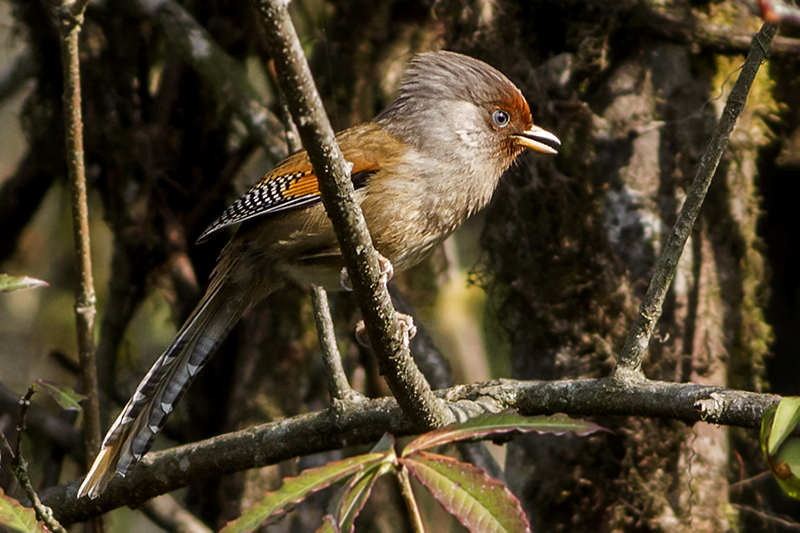
The Orange-breasted Laughingthrush is a medium-sized bird, measuring approximately 27 to 30 cm in length. Its most distinguishing feature is its vivid orange breast, which contrasts sharply with its otherwise more subdued plumage. The back and wings are predominantly brown, while the belly is white. The head is adorned with a slate-gray crown and nape, and a white throat that merges into the orange breast.
Both males and females exhibit similar coloring, with no significant differences in plumage. Juveniles, however, are slightly less vibrant, with paler orange on the breast and a more mottled appearance. In flight, the Orange-breasted Laughingthrush displays rounded wings and a long tail, which it uses to maneuver deftly through the forest understory.
Birdwatchers might confuse the Orange-breasted Laughingthrush with other laughingthrush species, but the specific combination of the orange breast and gray head serves as a reliable field mark. When perched, it maintains an upright posture, often flicking its tail, a behavior typical of many laughingthrushes.
Having trouble telling birds apart? Upload a photo to our bird identification tool for an instant species match.
Orange-breasted Laughingthrush Habitat and Range
Preferred Habitat
The Orange-breasted Laughingthrush is primarily associated with subtropical or tropical moist forests. It inhabits the dense underbrush of these forests, where it can easily find cover and forage for food. The Annamite Range in Vietnam, a region known for its rich biodiversity, is a key area where this species is found. Here, the elevation ranges from lowland forests to montane forests, and the Orange-breasted Laughingthrush shows a preference for altitudes between 800 and 1800 meters.
While it primarily resides in forested areas, the bird is occasionally observed in secondary forests and forest edges, indicating some adaptability to habitat changes. However, its presence in urban areas is rare due to its specific habitat needs. Seasonal shifts in habitat are minimal, as the species does not migrate, but it may move slightly within its range to take advantage of food availability and nesting sites.
Geographic Range
The Orange-breasted Laughingthrush is endemic to Vietnam, with its range largely confined to the central and southern regions, particularly within the Annamite Range. This area spans several provinces, including Quang Nam, Kon Tum, and Lam Dong, providing the forested environments essential for the species' survival.
As a resident bird, it does not undertake long-distance migrations, but rather remains within its established range throughout the year. The population density is higher in areas where the forest canopy and understory provide ample cover and food resources. Despite its limited geographic range, the bird's adaptability to different forest types helps sustain its population in the face of environmental changes.
Want to know which birds visit your area? Browse our backyard birds by location guides for region-specific species lists.
What Does the Orange-breasted Laughingthrush Eat?
The diet of the Orange-breasted Laughingthrush consists primarily of insects and fruit, which it forages from the forest floor and low vegetation. Insects such as beetles, caterpillars, and ants form a significant part of its diet, providing essential protein. The bird also consumes a variety of fruits and berries, which not only supplement its diet but also aid in seed dispersal within its habitat.
During the breeding season, the demand for protein increases, leading the Orange-breasted Laughingthrush to focus more on insect prey to support the growth of its young. Foraging typically occurs during the early morning and late afternoon when the forest is cooler and insect activity is higher. The bird employs a hopping motion to move through the understory, using its keen eyesight to spot prey and ripe fruit among the foliage.
Orange-breasted Laughingthrush Behavior and Social Structure
The Orange-breasted Laughingthrush is a social bird, often found in small groups or family units outside of the breeding season. It exhibits strong territorial behavior, particularly during the breeding season when pairs become more isolated to defend their nesting sites. Vocal communication plays a crucial role in maintaining social bonds and territorial boundaries, with its melodious calls distinguishing it among the forest inhabitants.
Courtship displays are subtle but include mutual preening and synchronized movements between pairs. This species is generally diurnal, active during daylight hours with peaks in activity during the morning and late afternoon. When predators are detected, the Orange-breasted Laughingthrush employs alarm calls to alert fellow group members, often retreating to denser cover for protection.
Orange-breasted Laughingthrush Nesting and Reproduction
The Orange-breasted Laughingthrush constructs cup-shaped nests using twigs, leaves, and grasses. These nests are typically placed in dense shrubs or low trees, concealed well within the forest understory. The breeding season aligns with the warmer months, providing optimal conditions for raising young.
A typical clutch consists of 2 to 4 eggs, which are incubated by both parents for approximately 14 to 16 days. Once hatched, the chicks remain in the nest for about 12 to 14 days, during which both parents actively participate in feeding and caring for the young. The species generally raises one brood per year, although in some favorable conditions, a second brood may occur.
Orange-breasted Laughingthrush Sounds and Vocalizations
The primary song of the Orange-breasted Laughingthrush is a series of melodious, flute-like notes that vary in pitch and rhythm, creating a harmonious and uplifting soundscape. These songs often serve to establish territory and strengthen pair bonds. In addition to its song, the bird produces a variety of call notes, including sharp whistles and chattering sounds, which facilitate communication within groups.
Alarm calls are harsher and more abrupt, designed to alert others to potential threats. During the dawn chorus, the Orange-breasted Laughingthrush is often one of the more prominent voices, adding to the vibrant symphony of forest sounds.
Interesting Facts About the Orange-breasted Laughingthrush
- 1The Orange-breasted Laughingthrush's song is so melodious that it was once a popular cage bird, although it is now protected by law.
- 2Despite its striking appearance, the bird's preference for dense underbrush makes it surprisingly elusive.
- 3The species plays a vital role in seed dispersal, contributing to forest regeneration.
- 4First described scientifically in the early 20th century, its unique vocalizations quickly intrigued ornithologists.
- 5Pairs of Orange-breasted Laughingthrushes often engage in duet singing, enhancing their bond.
- 6The bird's name reflects its laughing-like vocalizations, a common trait among laughingthrushes.
- 7Its habitat is part of the Indo-Burma biodiversity hotspot, home to many unique species.
Orange-breasted Laughingthrush Conservation Status
The IUCN currently lists the Orange-breasted Laughingthrush as Near Threatened, with its population trend showing signs of decline. Habitat loss due to deforestation and agricultural expansion poses the most significant threat to this species, as these activities reduce the available habitat necessary for its survival. Conservation efforts focus on protecting remaining forest areas and promoting sustainable land-use practices. Initiatives include establishing protected areas within the Annamite Range and raising awareness of the species' ecological importance. Historically, the population has fluctuated with changes in land use, underscoring the need for ongoing conservation measures.
Other Leiothrichidae Species


Birds Similar to the Orange-breasted Laughingthrush
These species are often confused with the Orange-breasted Laughingthrush due to similar appearance or overlapping range.

