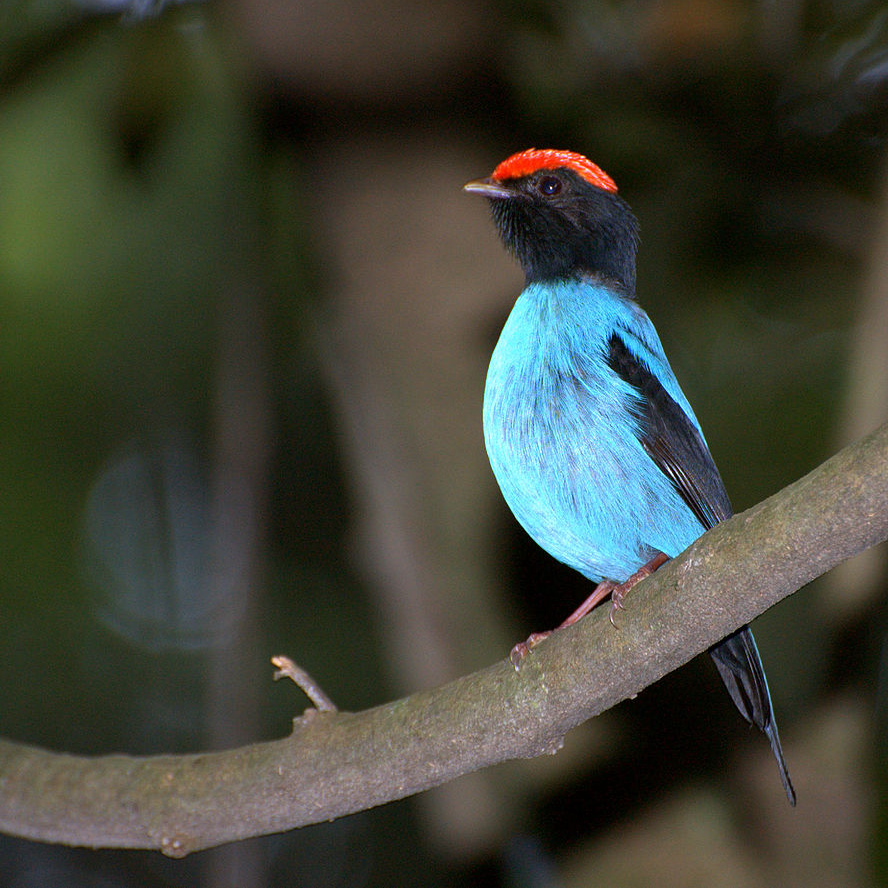
Orange-crowned Manakin
Heterocercus aurantiivertex
Order: Passeriformes / Family: Pipridae

Wikimedia Commons
About the Orange-crowned Manakin
The Orange-crowned Manakin (Heterocercus aurantiivertex) is a striking bird belonging to the family Pipridae. Endemic to the rainforests of northern South America, this species is particularly prevalent in the lowland tropical forests of Venezuela, Brazil, and Colombia. These birds thrive in humid, densely wooded areas where the canopy provides ample cover and food sources. The Orange-crowned Manakin plays a vital role in its ecosystem, contributing to seed dispersal and serving as prey for larger predators. Manakins, including the Orange-crowned, are known for their complex courtship displays which are significant for maintaining genetic diversity within their populations. During the breeding season, which typically coincides with the wet season, the males perform elaborate displays to attract females. These displays occur in leks, where multiple males gather to showcase their talents. The ecological role of the Orange-crowned Manakin extends beyond its breeding behaviors, as it participates in the control of insect populations within its habitat. As a frugivore-insectivore, it helps manage the balance of plant life and insect numbers. The Orange-crowned Manakin's presence in a given area is an indicator of forest health, as these birds require a diverse array of fruiting plants and a rich insect population. The bird's seasonal behaviors include a slight range expansion during the non-breeding season, often moving to adjacent forest areas that offer abundant resources. This seasonal movement ensures genetic flow between populations and aids in maintaining a stable population density across regions. The importance of preserving their habitat cannot be overstated, as deforestation and habitat fragmentation pose significant threats to their survival.
The Orange-crowned Manakin belongs to the family Pipridae, within the order Passeriformes. These birds typically live 4 years on average, with a maximum recorded of 7 years..
How to Identify a Orange-crowned Manakin
The Orange-crowned Manakin is a small bird, measuring about 10-11 cm in length. Adult males are easily identifiable by their vibrant orange crown, which sharply contrasts with their olive-green body. The wings and tail are slightly darker, providing a subtle contrast. Female Orange-crowned Manakins, in contrast, lack the bright crown, sporting a more uniform green plumage that offers better camouflage in the leafy canopy. Juveniles resemble females but with a somewhat duller hue. In flight, the manakin's silhouette is compact, with short, rounded wings and a slightly rounded tail. Perching posture is typically upright, often on thin branches where they can readily spot potential mates or predators. Differentiating the Orange-crowned Manakin from similar species, such as the Dwarf Tyrant-Manakin, requires attention to the crown color and overall size. While both species exhibit similar body shapes, the Dwarf Tyrant-Manakin lacks the distinct orange crown and is generally smaller. Observers noting the bright crown and listening for the unique vocalizations of the Orange-crowned Manakin can confidently identify this charming bird in its natural habitat.
Having trouble telling birds apart? Upload a photo to our bird identification tool for an instant species match.
Orange-crowned Manakin Habitat and Range
Preferred Habitat
The Orange-crowned Manakin inhabits the lowland tropical rainforests of South America, primarily in Venezuela, Brazil, and Colombia. These birds prefer dense, humid forests with a diverse canopy structure, allowing for ample foraging opportunities and protection from predators. They are typically found at elevations ranging from sea level to about 1000 meters. Within these forests, the manakins favor areas with a rich understory and abundant fruiting plants. Seasonal habitat shifts are minor, as these birds tend to remain in or near their breeding territories year-round, moving only as necessary to find food. While the Orange-crowned Manakin is predominantly found in forested environments, it occasionally ventures into adjacent secondary growth areas, especially when primary forests are scarce. Urban presence is limited, as these birds require the dense foliage of natural forest habitats to thrive.
Geographic Range
The Orange-crowned Manakin's range is confined to northern South America, with its primary distribution across the lowland forests of Venezuela, Brazil, and Colombia. Within these countries, the bird occupies continuous tracts of rainforest, avoiding heavily fragmented or disturbed areas. During the breeding season, which aligns with the local wet season, these birds concentrate in regions with high fruit availability and suitable lekking sites. The non-breeding range remains largely the same, though individuals may spread slightly into adjacent forested areas to exploit seasonal food resources. Migration in the traditional sense is not observed in this species, as it tends to remain in its home range throughout the year. Population density hotspots include the Amazon basin and the Orinoco River basin, where vast expanses of suitable habitat support stable populations. Despite the pressures of deforestation, these areas continue to provide refuge for the Orange-crowned Manakin due to ongoing conservation efforts.
Want to know which birds visit your area? Browse our backyard birds by location guides for region-specific species lists.
What Does the Orange-crowned Manakin Eat?
The diet of the Orange-crowned Manakin primarily consists of fruits and insects, classifying it as a frugivore-insectivore. During the wet season, when fruits are abundant, these birds focus on consuming a variety of berries and small fruits from native plant species. This diet provides essential sugars and nutrients necessary for maintaining energy levels, especially during the breeding season. Insects, particularly small arthropods such as beetles and ants, supplement their diet and are especially important when raising young. The manakins employ a technique known as 'hover-gleaning,' where they hover momentarily to pick insects off leaves and branches. Prey size is generally small, consistent with their compact size. Feeding occurs throughout the day, peaking during early morning and late afternoon when temperatures are cooler. Seasonal diet changes reflect the availability of resources, with a heavier reliance on insects during the dry season when fruit is less available.
Orange-crowned Manakin Behavior and Social Structure
The Orange-crowned Manakin exhibits fascinating social and territorial behaviors, particularly in regards to its breeding displays. Males are known for participating in leks, where they gather in specific locations to perform elaborate courtship displays. These displays involve a combination of vocalizations and acrobatic maneuvers designed to attract females. The lekking behavior is competitive, with males vying for the most advantageous positions and the attention of visiting females. Outside of the breeding season, the Orange-crowned Manakin is generally solitary, though it may occasionally form loose associations with mixed-species foraging flocks. Territorial behavior is pronounced during the breeding season, with males vigorously defending their display sites. In response to predators, the manakins rely on their agility and dense foliage cover to evade capture. Daily activity patterns show peaks in activity during the cooler parts of the day, with a marked decrease in vocal and visual activity at midday.
Orange-crowned Manakin Nesting and Reproduction
Orange-crowned Manakins construct their nests in the understories of dense forests, selecting locations that offer concealment from predators. The nest is a small cup made from fine plant fibers, leaves, and spider webs, strategically placed on a horizontal branch or in the fork of a tree. Clutch size typically consists of two eggs, which are creamy white with small brown spots. The female alone incubates the eggs over a period of approximately 16-18 days. After hatching, the young remain in the nest for about 14-16 days before fledging. Parental roles are distinctly divided, with the female taking on the responsibility of feeding and caring for the chicks. The number of broods per year is generally one, though in areas with abundant resources, a second brood may occur.
Orange-crowned Manakin Sounds and Vocalizations
The Orange-crowned Manakin's primary song is a series of sharp, high-pitched notes delivered in quick succession, often described as 'chip-chip-chip.' This song is prominently featured during lekking displays, serving as both a territorial declaration and a courtship call. In addition to the primary song, these manakins produce a variety of call notes, ranging from soft, contact calls used between individuals to more urgent alarm calls signaling the presence of predators. During the dawn chorus, the Orange-crowned Manakin's song can be heard interspersed with those of other forest birds, contributing to the vibrant soundscape of the rainforest. The quality of the song is crisp and clear, with a rhythm that is both repetitive and engaging.
Interesting Facts About the Orange-crowned Manakin
- 1The Orange-crowned Manakin's lekking displays can attract up to 20 males competing in a single area.
- 2Despite their small size, Orange-crowned Manakins have a diverse vocal repertoire with over a dozen distinct calls.
- 3The orange crown of male Orange-crowned Manakins is a key factor in mate selection, influencing female choice.
- 4Studies have shown that manakins are important seed dispersers, aiding in forest regeneration.
- 5The Orange-crowned Manakin was first described scientifically in the mid-19th century, highlighting its longstanding intrigue for ornithologists.
- 6These manakins are known to participate in mixed-species foraging flocks, increasing their foraging success.
- 7Orange-crowned Manakins are part of a family renowned for their colorful plumage and intricate courtship behaviors.
Orange-crowned Manakin Conservation Status
The Orange-crowned Manakin is currently listed as Least Concern by the IUCN, with a stable population trend. However, habitat destruction due to deforestation poses a significant threat to its long-term survival. Conservation efforts focus on preserving large tracts of intact rainforest and promoting sustainable land-use practices. Historical population changes are not well-documented, but it is understood that habitat fragmentation has led to localized declines in some areas. Initiatives to protect critical habitats and establish ecological corridors are crucial for maintaining genetic diversity and population stability. Continued monitoring and research are needed to better understand the population dynamics and inform conservation strategies.