
Paradise-crow
Lycocorax pyrrhopterus
Order: Passeriformes / Family: Paradisaeidae
Wikimedia Commons
About the Paradise-crow
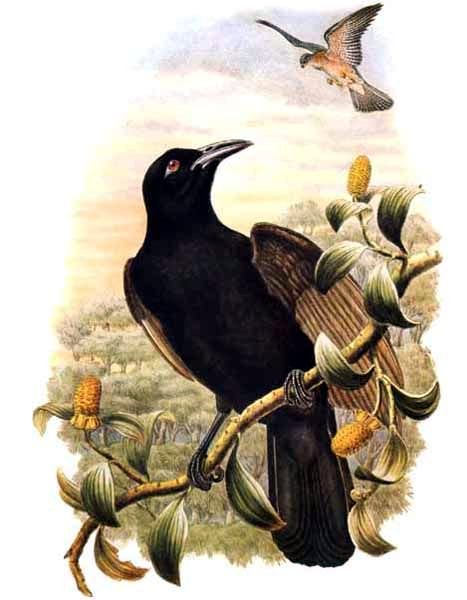
The Paradise-crow, scientifically known as Lycocorax pyrrhopterus, is a striking member of the bird-of-paradise family, Paradisaeidae. Found exclusively in the lowland and hill forests of the Maluku Islands in Indonesia, this bird plays a vital role in its ecosystem. The Paradise-crow exhibits an all-black plumage with a slight greenish sheen, setting it apart from other birds in its range. Its robust body and strong bill suggest its adaptability to a varied diet and its ability to thrive in dense forest habitats. The significance of the Paradise-crow extends beyond its ecological role. As a member of the Paradisaeidae family, it represents a fascinating evolutionary path where sexual selection has led to the stunning developments of plumage and display behaviors in related species. Although the Paradise-crow lacks the elaborate feathers of some of its relatives, its vocalizations provide an auditory spectacle that is equally mesmerizing. Ecologically, the Paradise-crow contributes to seed dispersal through its fruit-eating habits, fostering forest regeneration. Its preference for undisturbed forest areas makes it a useful indicator of habitat health. The bird is most active during the early morning and late afternoon, periods during which its calls resonate through the forest. Seasonal behaviors of the Paradise-crow include minor altitudinal movements, likely in response to fruit availability, but it remains largely resident throughout the year. Its presence in the Maluku Islands highlights the region's unique biodiversity and the importance of conservation efforts in these tropical habitats.
The Paradise-crow belongs to the family Paradisaeidae, within the order Passeriformes. These birds typically live estimated at 8-12 years, with some individuals living up to 15 years..
How to Identify a Paradise-crow
The Paradise-crow presents a distinct profile with its all-black plumage and medium size, reaching about 42 cm in length. The adult plumage is a glossy black, with a subtle greenish sheen that becomes apparent in certain lighting conditions. Juveniles are similar in appearance but may exhibit a slightly browner tint. Unlike many of its Paradisaeidae relatives, male and female Paradise-crows are similar in appearance, with no significant sexual dimorphism in plumage. This makes field identification based primarily on vocalizations and behavior rather than visual differences. The strong, slightly curved bill is a key feature, adapted for their diet of fruits and insects. In flight, the Paradise-crow's silhouette is robust, with broad wings and a medium-length tail. It perches with a confident, upright posture, often in the mid to upper canopy, which can make it somewhat challenging to spot amidst dense foliage. While its black plumage might suggest confusion with other black birds, its habitat, behavior, and vocalizations are distinctive. The Paradise-crow's calls, a series of haunting, melodic whistles, can also help distinguish it from other species.
Having trouble telling birds apart? Upload a photo to our bird identification tool for an instant species match.
Paradise-crow Habitat and Range
Preferred Habitat
The Paradise-crow inhabits the lush lowland and hill forests of Indonesia's Maluku Islands, specifically on Halmahera, Morotai, and Bacan. These forests provide the dense canopy cover and abundant fruit supply essential for its survival. The bird favors primary forests but can also be found in selectively logged areas, demonstrating some adaptability. It typically resides at elevations ranging from sea level to about 1200 meters. There are no significant seasonal habitat shifts observed in the Paradise-crow, as it remains a resident species throughout the year. However, its dependency on forested environments means it is rarely found in urban settings or heavily disturbed areas. The continuity of forest habitat is crucial for its foraging and nesting activities, emphasizing the importance of habitat conservation for its continued survival.
Geographic Range
The Paradise-crow is endemic to the Maluku Islands of Indonesia, with its range limited to Halmahera, Morotai, and Bacan. It does not migrate and is considered a resident species throughout its range. As a non-migratory bird, it does not participate in long-distance seasonal movements, unlike many other bird species. Population density tends to be higher in undisturbed forests, where food resources are abundant and competition remains relatively low. The islands' isolation and unique habitat conditions have confined the Paradise-crow to this specific region, making it an important species for local biodiversity studies. Conservation efforts are crucial to maintaining its habitat, given its limited range and the potential threats from habitat destruction.
Want to know which birds visit your area? Browse our backyard birds by location guides for region-specific species lists.
What Does the Paradise-crow Eat?
The Paradise-crow primarily feeds on fruits, making it an essential seed disperser in its ecosystem. Figs and other forest fruits constitute the bulk of its diet, with insects and small invertebrates serving as secondary food sources. Foraging occurs mainly in the morning and late afternoon, aligning with peak fruit availability and insect activity. The bird employs a methodical approach to foraging, often seen hopping along branches and using its strong bill to pluck fruits. During certain seasons, when fruit supply diminishes, the Paradise-crow may increase its intake of protein-rich insects and other small prey. Its feeding schedule and habits underscore its adaptability and the importance of preserving its natural habitat, which provides both the fruits and insects critical to its diet.
Paradise-crow Behavior and Social Structure
The Paradise-crow exhibits fascinating social and territorial behaviors. Typically found in pairs or small family groups, it maintains a defined territory within its forest home. Courtship displays are subtle compared to other birds-of-paradise, relying more on vocal prowess than visual displays. The male often engages in duet singing with the female, a behavior that strengthens pair bonds and establishes territorial claims. Vigilance against predators is high, with the Paradise-crow employing a range of alarm calls to alert others to potential threats. Flight is strong and direct, though the bird often prefers to move through the canopy by hopping from branch to branch. Daily activity patterns involve periods of foraging interspersed with rest and vocalizing sessions, especially in the cooler parts of the day. Despite its relatively cryptic appearance, the Paradise-crow's vocalizations and social interactions make it an engaging species to observe.
Paradise-crow Nesting and Reproduction
The Paradise-crow builds its nest high in the forest canopy, utilizing twigs, leaves, and other natural materials to construct a sturdy platform. Nesting sites are chosen with care, often in well-hidden locations to minimize predation risk. Clutch size typically consists of one to two eggs, with an incubation period lasting around two weeks. Both parents participate in feeding and caring for the young, although the female often takes on a more prominent role during incubation. The fledging timeline is approximately three to four weeks after hatching, with juvenile birds staying close to the nest site for several weeks thereafter. Generally, the Paradise-crow produces one brood per year, though this can vary depending on environmental conditions and food availability. The collaborative nesting effort underscores the species' strong pair bonds and parental investment.
Paradise-crow Sounds and Vocalizations
The primary song of the Paradise-crow is a haunting series of whistles and melodious notes, often described as ethereal. These vocalizations, characterized by their rhythmic and clear quality, serve both as territorial markers and courtship signals. Alongside its song, the Paradise-crow produces a range of call notes, including sharp chattering sounds used to communicate with its mate or warn of danger. Alarm calls are distinct, with a harsher tone that alerts other birds to the presence of predators. The dawn chorus, often featuring the Paradise-crow's calls, is a notable auditory experience in its native forests. Compared to other more visually spectacular birds-of-paradise, the Paradise-crow's vocalizations are a key identifier and a highlight for birdwatchers.
Interesting Facts About the Paradise-crow
- 1The Paradise-crow's haunting calls can carry over long distances, a feature that helps maintain communication in dense forests.
- 2Unlike many birds-of-paradise, the Paradise-crow exhibits little in the way of ornamental plumage, relying instead on vocal displays.
- 3The species is endemic to the Maluku Islands, highlighting the region's rich biodiversity and its isolation's role in evolution.
- 4Paradise-crows play a crucial role in forest ecology as seed dispersers, aiding in the regeneration of their native habitats.
- 5Despite its name, the Paradise-crow is not a member of the crow family, Corvidae, but shares some behavioral similarities.
- 6The strong bill of the Paradise-crow is well-suited for breaking tough fruit skins, a testament to its dietary specialization.
- 7The Paradise-crow is a rare example of a bird-of-paradise where males and females share similar plumage, reducing sexual dimorphism.
Paradise-crow Conservation Status
The Paradise-crow is currently listed as Least Concern by the IUCN, with its population considered stable. However, habitat loss due to logging and agricultural expansion poses ongoing threats to its habitat. Conservation efforts focus on protecting the remaining forest areas within its range and promoting sustainable land use practices. Historically, the Paradise-crow's population has remained relatively stable, benefiting from the remoteness of its island habitats, which have provided a natural buffer against widespread human encroachment. Continued monitoring and conservation initiatives are essential to ensure the long-term survival of this unique species.


