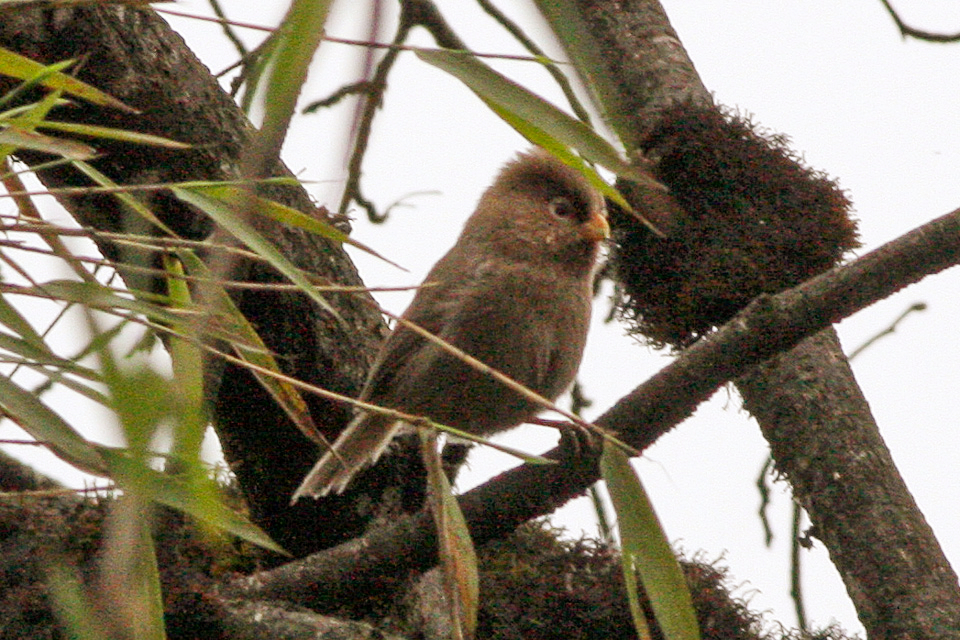
Paradoxornis polivanovi
Paradoxornis polivanovi
Order: Passeriformes / Family: Sylviidae

Wikimedia Commons
About the Paradoxornis polivanovi
The Paradoxornis polivanovi, commonly known as the Vinous-throated Parrotbill, inhabits the dense undergrowth of temperate forests across parts of East Asia. This species holds ecological significance as both a seed disperser and insect predator within its native habitats. Often found in countries such as China, Korea, and Japan, the Vinous-throated Parrotbill thrives in environments that offer thick vegetation and ample food sources.
The bird's role in the ecosystem is multifaceted. As a seed disperser, it contributes to forest regeneration by consuming and excreting seeds from various plant species. Its diet, predominantly composed of insects, helps control pest populations, maintaining a balanced ecosystem. The Paradoxornis polivanovi is particularly active during the breeding season, which typically spans from late spring to early summer. During this period, its presence becomes more noticeable as it forages more actively and engages in courtship behaviors.
The bird is known for its adaptability to different habitats, including urban parks, where it can find suitable nesting sites and food. This adaptability makes the Vinous-throated Parrotbill a resilient species, capable of surviving in fragmented landscapes. Despite urban encroachment, it continues to maintain stable population numbers in many regions. The Paradoxornis polivanovi exhibits a variety of behaviors that are particularly fascinating to ornithologists. For example, its ability to form mixed-species foraging flocks indicates a high level of social interaction, enhancing foraging efficiency and predator avoidance.
The Paradoxornis polivanovi belongs to the family Sylviidae, within the order Passeriformes. These birds typically live estimated 5-6 years, though data is limited..
How to Identify a Paradoxornis polivanovi
The Vinous-throated Parrotbill, or Paradoxornis polivanovi, is a medium-sized songbird with distinctive physical traits. Adults display a striking plumage characterized by a vinous or reddish-brown throat, contrasted by a paler brown body. The long, graduated tail is a key identifying feature, often held upright while perched.
Juveniles resemble adults but can be distinguished by their duller coloration, lacking the vivid contrast seen in mature birds. Males and females appear similar, making gender differentiation challenging without close observation. However, males may exhibit slightly more vibrant plumage during the breeding season.
This species can be confused with similar parrotbills but is set apart by its unique throat coloration and tail length. In flight, the Paradoxornis polivanovi presents a compact silhouette, with rapid wingbeats and a slightly undulating pattern. When perched, it often adopts an upright posture, making it recognizable to seasoned birders.
Having trouble telling birds apart? Upload a photo to our bird identification tool for an instant species match.
Paradoxornis polivanovi Habitat and Range
Preferred Habitat
Paradoxornis polivanovi thrives in dense thickets and bamboo groves, preferring habitats with abundant underbrush and cover. Typically found at elevations ranging from lowland areas up to 2,000 meters, this species adapts well to various forest types, including deciduous and mixed broadleaf forests.
During the breeding season, the bird tends to favor more secluded and dense habitats, ensuring safety for its nest. Outside the breeding season, it can be seen in more open areas, including urban parks and gardens, where suitable vegetation is present. The Vinous-throated Parrotbill demonstrates a certain level of habitat plasticity, allowing it to inhabit both rural and urban settings effectively.
Geographic Range
The Vinous-throated Parrotbill's range extends across several East Asian countries, including China, Korea, and Japan. In China, it is prevalent in provinces such as Sichuan and Yunnan. The bird's breeding range encompasses areas with temperate climates, where dense vegetation and abundant food sources are available.
Wintering populations may shift slightly southward, although many individuals remain resident in their breeding territories. Migration corridors are not well-defined, as the species is largely non-migratory. Population density tends to be highest in regions with extensive bamboo forests, where optimal conditions promote thriving communities.
Want to know which birds visit your area? Browse our backyard birds by location guides for region-specific species lists.
What Does the Paradoxornis polivanovi Eat?
The diet of Paradoxornis polivanovi consists primarily of insects and seeds. During the spring and summer months, insects such as caterpillars and beetles become the mainstay of its diet, providing essential protein for breeding and chick rearing.
In autumn and winter, the bird shifts its focus to seeds and small fruits, which are more readily available. Foraging usually occurs in the lower to mid-canopy levels, where the bird utilizes its nimble nature to navigate dense foliage. The Vinous-throated Parrotbill often employs a gleaning technique, picking insects and seeds from leaves and branches with precision.
Paradoxornis polivanovi Behavior and Social Structure
Paradoxornis polivanovi exhibits a highly social structure, often forming loose flocks with conspecifics and other parrotbill species. These mixed-species flocks enhance foraging efficiency and provide increased vigilance against predators.
Territorial behavior becomes prominent during the breeding season, with pairs defending their nesting areas aggressively. Courtship displays involve vocalizations and physical gestures, such as bowing and tail fanning, to attract mates.
Outside the breeding season, the Vinous-throated Parrotbill engages in more communal activities, joining larger flocks that traverse the forest in search of food. Daily activity is mostly diurnal, with peaks in foraging occurring in the early morning and late afternoon.
Paradoxornis polivanovi Nesting and Reproduction
The nesting behavior of Paradoxornis polivanovi involves constructing cup-shaped nests using grasses, leaves, and bamboo strips. Nests are typically located in dense shrubs or low trees, providing cover from predators and harsh weather.
Clutch size generally ranges from three to five eggs, with both parents sharing incubation duties over approximately 12-14 days. After hatching, both male and female play active roles in feeding and caring for the young.
Fledging occurs about two weeks post-hatching, with juveniles remaining dependent on their parents for a short period thereafter. The species often produces two broods per year, ensuring reproductive success across diverse conditions.
Paradoxornis polivanovi Sounds and Vocalizations
The Vinous-throated Parrotbill's primary song consists of a series of melodious, flute-like notes, which vary in pitch and rhythm. These songs serve multiple purposes, including territory defense and mate attraction.
Call notes include sharp, metallic 'tink' sounds that are easily recognizable. Alarm calls, typically harsher in tone, alert conspecifics to potential threats. The dawn chorus features prominently in this species' daily routine, with males often leading the calls at first light.
Interesting Facts About the Paradoxornis polivanovi
- 1The Vinous-throated Parrotbill can form flocks of up to 40 individuals, enhancing their foraging success.
- 2Despite its wide range, the Paradoxornis polivanovi remains largely non-migratory, staying in its home range year-round.
- 3This species is known for its adaptability, often thriving in urban environments where other birds struggle.
- 4The species is named for its distinctive vinous throat, a feature not commonly seen in related parrotbills.
- 5Vinous-throated Parrotbills are adept at using their feet and beaks in tandem to manipulate food items and nest materials.
Paradoxornis polivanovi Conservation Status
Currently, the Paradoxornis polivanovi holds a status of Least Concern on the IUCN Red List, with population trends appearing stable. Primary threats include habitat loss due to deforestation and urban expansion. Conservation efforts focus on habitat preservation and restoration, particularly in areas with significant human encroachment. Historical population data suggests resilience in the face of moderate environmental changes, but ongoing monitoring remains crucial.